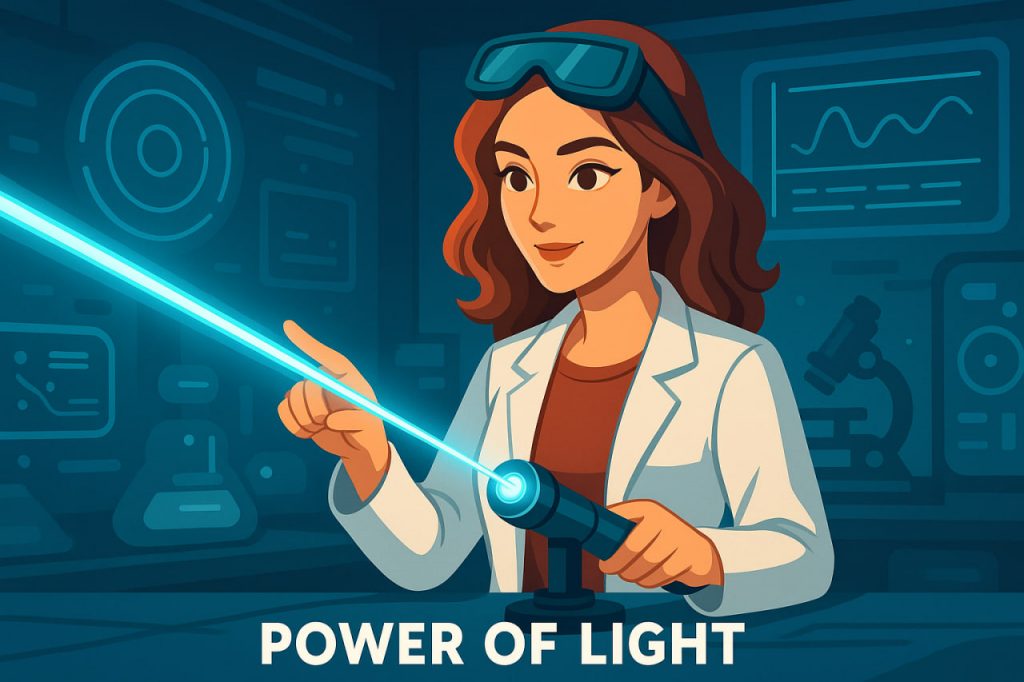
The laser, an invention that revolutionized modern technology, is one of the most remarkable tools ever created by humankind. The term “laser” stands for Light Amplification by Stimulated Emission of Radiation, and it refers to a process that produces a concentrated beam of light with extraordinary precision. Since its invention in 1960 by physicist Theodore Maiman, the laser has become indispensable across fields ranging from medicine and communication to manufacturing and entertainment. Its unique ability to focus light into a single wavelength allows it to cut, heal, measure, and even transmit data at incredible speeds. Understanding how lasers work reveals not only the beauty of physics but also the endless possibilities of controlled light.
How Lasers Work
A laser operates by stimulating atoms or molecules within a medium—such as a gas, crystal, or semiconductor—to emit photons, or particles of light. These photons are amplified between two mirrors, one of which is partially transparent, allowing a focused beam of light to escape. Unlike ordinary light, which spreads in all directions, laser light is coherent, meaning all its waves move in unison. This coherence gives lasers their characteristic intensity and precision. According to optical physicist Dr. Elaine Foster, “The brilliance of the laser lies in its simplicity—it takes what nature already provides, light, and channels it into pure order.” This process makes lasers incredibly versatile for applications that demand accuracy and control.
Applications of Laser Technology
Lasers are used in almost every industry imaginable. In medicine, surgeons use them for delicate procedures such as eye surgery (LASIK) and tissue repair, minimizing pain and recovery time. In manufacturing, lasers cut through metal, glass, and even diamonds with millimeter-level accuracy. Communication systems rely on fiber-optic lasers to transmit vast amounts of data at the speed of light, forming the backbone of the internet. Scientists employ lasers in spectroscopy to analyze chemical compositions, while artists use them for stunning visual effects in concerts and architecture. The same principle that guides a laser pointer in a classroom can guide spacecraft millions of kilometers away in deep-space communication.
The Role of Lasers in Science and Research
Lasers have also become essential tools in scientific discovery. They enable high-precision measurements, such as determining atomic distances and studying quantum behavior. The 2018 Nobel Prize in Physics was awarded to researchers who developed optical tweezers—laser-based tools capable of manipulating individual atoms and molecules. These advancements have opened new frontiers in biology, nanotechnology, and fundamental physics. Dr. Hiroshi Tanaka, a quantum optics researcher, explains, “Without lasers, our ability to study matter at its smallest scales would be severely limited. They are the microscopes of modern physics.” From measuring gravitational waves to cooling atoms to near absolute zero, lasers continue to expand our understanding of the universe.
Safety and Ethical Considerations
Despite their usefulness, lasers must be used responsibly. High-powered lasers can cause eye injuries, burns, and even fires if handled incorrectly. Many countries enforce strict regulations on industrial and medical laser use to prevent accidents. In consumer devices, such as barcode scanners and laser pointers, power levels are limited to ensure safety. Ethical debates have also arisen regarding the development of laser-based weapons and surveillance systems. While innovation continues, researchers stress the importance of balancing technological progress with safety and moral responsibility. As with all powerful tools, the benefits of lasers depend on how wisely they are used.
The Future of Laser Technology
The future of laser technology looks brighter than ever. Researchers are developing quantum lasers, ultrafast lasers, and laser propulsion systems for spacecraft. In renewable energy, lasers may soon be used to ignite controlled nuclear fusion, providing a nearly limitless source of clean power. In medicine, next-generation lasers promise even more precise surgeries with faster healing times. Moreover, the combination of artificial intelligence and laser diagnostics could revolutionize how diseases are detected and treated. As Dr. Sarah Morgan, a photonics engineer, notes, “We are only beginning to understand the potential of laser light—it could very well define the next century of innovation.”
Interesting Facts
- The first laser ever built used a ruby crystal as its medium.
- Lasers can travel at the speed of light—about 299,792 kilometers per second.
- The word “laser” was once written in all caps but later became a common noun like “radar.”
- NASA uses laser beams to measure the distance between the Earth and the Moon with centimeter precision.
- Some lasers are so powerful they can cut through steel or even create plasma from air.
Glossary
- Photon — A particle of light that carries energy.
- Coherent light — Light waves that move in perfect synchronization.
- Optical tweezers — Laser-based tools used to manipulate microscopic particles.
- Quantum laser — A laser that operates based on the principles of quantum mechanics.
- Photonics — The science of generating, controlling, and detecting light particles.