Skip to content

Science Observer

Useful articles about our universe and science

  • Home
  • Calculators
    • Ohm’s Law Calculator!
    • Resistors in Series / Parallel Calculator
    • Science
      • Capacitor Calculator (C, Q, V, Energy, RC)
      • Coulomb’s Law Calculator
      • Dilution Calculator (C₁V₁ = C₂V₂) !
      • Doppler Effect Calculator (Sound)
      • Free Fall Calculator!
      • Gravitational Force Calculator
      • Kinetic Energy Calculator
      • Momentum & Impulse Calculator!
      • Newton’s Second Law Calculator (F = m·a)
      • pH / pOH Converter
      • pH Calculator
      • Projectile Motion Calculator
      • Radioactive Half-Life Calculator
      • Science Unit Converter
      • Sound Distance Calculator (Thunder)
      • Sound Level (dB) Calculator
      • Time Dilation Calculator
      • VO₂max Estimate Calculator
      • Wave Calculator
    • Universe
      • Age on Other Planets Calculator
      • Asteroid Impact Energy Calculator
      • Black Hole Radius Calculator
      • Escape Velocity Calculator
      • Exoplanet Habitability Quick Score
      • Horizon Distance Calculator
      • How Many Stars Can You See?
      • Light Travel Time Calculator
      • Light Travel Time Calculator!
      • Orbit Speed & Period Calculator
      • Photon Calculator (Wavelength, Frequency, Energy)!
      • Satellite Signal Delay Calculator
      • Space Travel Time Calculator
      • Telescope Resolution Calculator
      • Weight on Other Planets Calculator
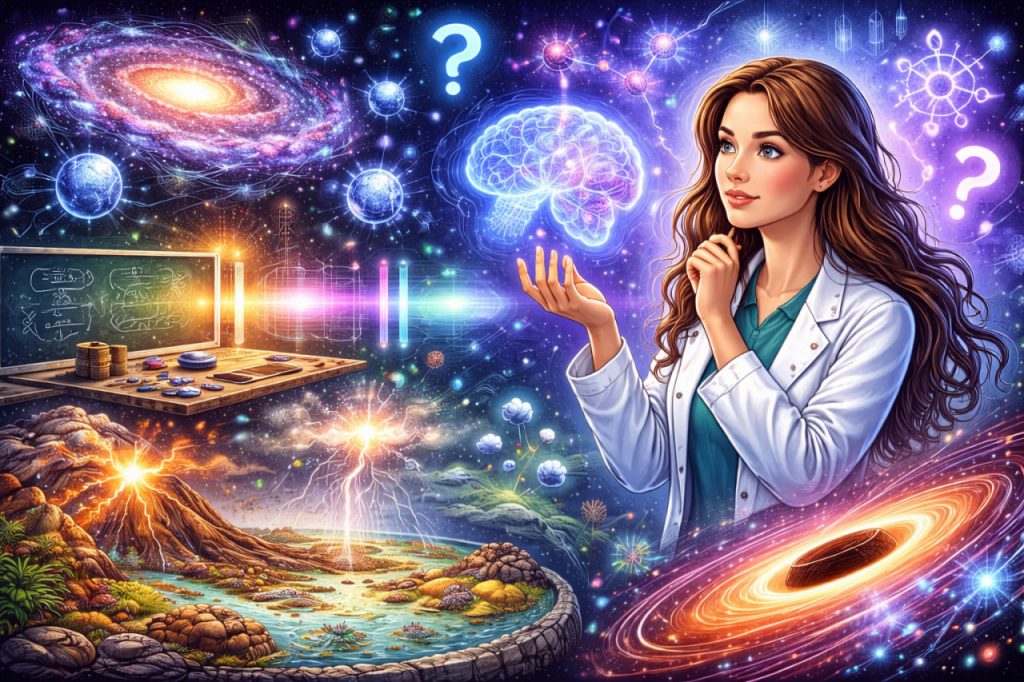
Unsolved Problems of Modern Science: Questions That Still Challenge Humanity
Posted inBe Smart Science

Unsolved Problems of Modern Science: Questions That Still Challenge Humanity

Despite extraordinary technological progress, modern science is still confronted with deep and unresolved questions about the nature of reality, life, and the Universe. These problems persist not because of a…
Posted by deka December 17, 2025
How Artificial Intelligence Learns from Its Mistakes
Posted inAI AI & Ethics Be Smart

How Artificial Intelligence Learns from Its Mistakes

Artificial intelligence systems improve over time by analyzing errors, adjusting internal parameters, and refining predictions based on feedback. Unlike humans, AI does not “realize” mistakes emotionally, but it mathematically measures…
Posted by deka February 17, 2026
Emotional AI: How Machines Learn to Recognize and Imitate Emotions
Posted inAI AI & Ethics Be Smart

Emotional AI: How Machines Learn to Recognize and Imitate Emotions

Emotional artificial intelligence, often called affective computing, refers to systems designed to detect, interpret, and simulate human emotions. Unlike traditional AI that focuses on logic, numbers, or patterns, emotional AI…
Posted by deka February 17, 2026
AI Regulation: Do We Need Laws Like Those for Nuclear Technology?
Posted inAI AI & Ethics Be Smart

AI Regulation: Do We Need Laws Like Those for Nuclear Technology?

Artificial intelligence is rapidly transforming industries, governments, and everyday life, raising an important question: should AI be regulated with strict global laws similar to those governing nuclear technologies? While AI…
Posted by deka February 17, 2026
AI Transparency and Explainability: Why Did the Model Make That Decision?
Posted inAI AI & Ethics Be Smart

AI Transparency and Explainability: Why Did the Model Make That Decision?

As artificial intelligence systems increasingly influence finance, healthcare, hiring, and public policy, one critical question emerges: why did the model make that decision? Transparency and explainability have become central themes…
Posted by deka February 17, 2026
Diffusion Models: How Midjourney and Similar Systems Generate Images
Posted inAI AI & Ethics Be Smart

Diffusion Models: How Midjourney and Similar Systems Generate Images

Diffusion models are a class of artificial intelligence systems designed to generate images by gradually transforming noise into structured visuals. In recent years, they have become the foundation of many…
Posted by deka February 16, 2026
Multimodal Models: AI That Sees, Hears, and Understands
Posted inAI AI & Ethics Be Smart

Multimodal Models: AI That Sees, Hears, and Understands

Multimodal models are a new generation of artificial intelligence systems capable of processing and integrating multiple types of data—such as text, images, audio, and sometimes video—within a single framework. Unlike…
Posted by deka February 16, 2026
Interstellar Travel: The Breakthrough Starshot Project and Other Concepts
Posted inCosmic Innovations Hi-Tech Smart Technology

Interstellar Travel: The Breakthrough Starshot Project and Other Concepts

Interstellar travel—the journey beyond our solar system to other stars—has long been a dream of scientists and science fiction writers alike. Unlike missions to Mars or Jupiter, traveling to another…
Posted by deka February 12, 2026
Light Sail Technology: How Spacecraft Can Travel Using Light
Posted inCosmic Innovations Inventions New Discoveries

Light Sail Technology: How Spacecraft Can Travel Using Light

Light sail technology is one of the most innovative propulsion concepts in modern space exploration. Unlike traditional rockets that rely on fuel combustion, light sails use radiation pressure from photons—particles…
Posted by deka February 12, 2026
Radiation Protection During Long-Duration Space Travel
Posted inCosmic Innovations Hi-Tech Solar System

Radiation Protection During Long-Duration Space Travel

Long-duration space missions expose astronauts to radiation levels far higher than those experienced on Earth. Unlike our planet, which is protected by a magnetic field and thick atmosphere, deep space…
Posted by deka February 12, 2026
Cosmic Rays: High-Energy Particles From Deep Space
Posted inNew Discoveries Space Stories Universe

Cosmic Rays: High-Energy Particles From Deep Space

Cosmic rays are high-energy particles that travel through space at nearly the speed of light and constantly bombard Earth from all directions. Despite their name, they are not actually rays…
Posted by deka February 12, 2026

Posts navigation

1 2 3 … 71 Next page
Recent Posts
  • How Artificial Intelligence Learns from Its Mistakes
  • Emotional AI: How Machines Learn to Recognize and Imitate Emotions
  • AI Regulation: Do We Need Laws Like Those for Nuclear Technology?
  • AI Transparency and Explainability: Why Did the Model Make That Decision?
  • Diffusion Models: How Midjourney and Similar Systems Generate Images
Categories
  • AI
  • AI & Ethics
  • Be Smart
  • Bioengineering
  • Cosmic Innovations
  • Earth & Moon
  • Hi-Tech
  • History
  • Inventions
  • Neuro-Tech
  • New Discoveries
  • Science
  • Smart Home
  • Smart Technology
  • Solar System
  • Space Stories
  • Star Wars
  • Tesla
  • Universe
  • What if?
You May Have Missed
Posted inAI AI & Ethics Be Smart

How Artificial Intelligence Learns from Its Mistakes

Posted by deka February 17, 2026
Posted inAI AI & Ethics Be Smart

Emotional AI: How Machines Learn to Recognize and Imitate Emotions

Posted by deka February 17, 2026
Posted inAI AI & Ethics Be Smart

AI Regulation: Do We Need Laws Like Those for Nuclear Technology?

Posted by deka February 17, 2026
Posted inAI AI & Ethics Be Smart

AI Transparency and Explainability: Why Did the Model Make That Decision?

Posted by deka February 17, 2026
Copyright 2026 — Science Observer. All rights reserved. Bloghash WordPress Theme
Scroll to Top