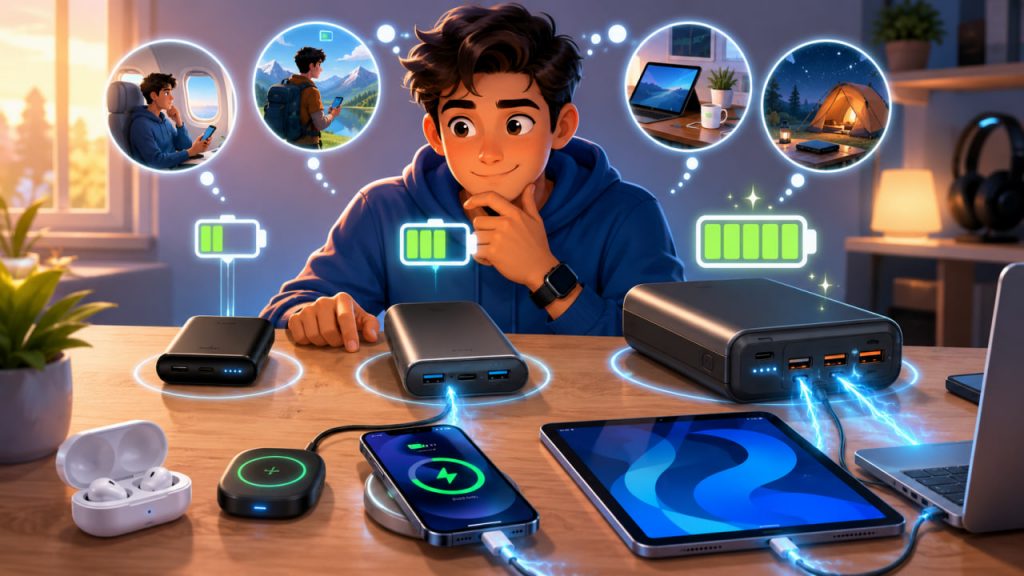
A power bank is one of those small gadgets that becomes essential the moment your phone battery drops to 3% outside the house. It is a portable rechargeable battery designed to store electricity and later charge your smartphone, tablet, earbuds, camera, handheld console, or even a laptop.
Modern power banks are no longer just emergency phone chargers. Some are slim magnetic packs for everyday carry. Some support fast USB-C charging. Some can charge laptops. Some are powerful enough for travel, work, filming, camping, and long commutes.
The best power bank is not simply the one with the biggest number on the box. The right choice depends on capacity, charging speed, ports, size, battery safety, and the devices you plan to charge.
What Is a Power Bank?
A power bank is an external battery with built-in charging electronics.
It usually contains:
- Lithium-ion or lithium-polymer battery cells
- USB-C, USB-A, or wireless charging outputs
- A charging input for recharging the power bank itself
- A protection circuit against overheating, overload, and short circuits
- Sometimes a screen, built-in cable, flashlight, or magnetic wireless charger
When you plug in your phone, the power bank transfers stored energy into the phone battery. When the power bank runs low, you recharge it from a wall charger, laptop, car charger, or sometimes a solar panel.
In simple terms, a power bank is electricity in your pocket.
Understanding Capacity: What Does mAh Mean?
The most visible number on a power bank is usually capacity, written as mAh, or milliamp-hours.
Common sizes include:
- 5,000 mAh
- 10,000 mAh
- 20,000 mAh
- 25,000 mAh
- 27,000 mAh
A 10,000 mAh power bank sounds like it should fully charge a 5,000 mAh phone twice. In reality, it usually will not. Energy is lost during voltage conversion, heat generation, cable resistance, and charging management.
That is why watt-hours, or Wh, are often more accurate for comparison. A recent power bank buying guide in WSJ Buy Side notes that mAh represents potential capacity, while Wh accounts for voltage and gives a better comparison between models.
For everyday phone use, 10,000 mAh is the practical sweet spot. It is usually compact enough to carry and powerful enough to recharge most phones at least once, often more than once depending on the model.
How Much Capacity Do You Need?
A small power bank is easier to carry. A large one lasts longer. The best choice depends on your routine.
A 5,000 mAh model is good for emergencies, slim bags, nights out, and people who only need a partial top-up.
A 10,000 mAh model is the best everyday choice for most users. It can handle a phone, earbuds, and occasional travel without becoming too heavy.
A 20,000 mAh model is better for long trips, students, photographers, delivery workers, gamers, and people who charge several devices.
A 25,000–27,000 mAh model is useful for laptops, tablets, flights, remote work, and multi-day travel. But it is heavier and may approach airline battery limits.
For home emergency use, a large power bank can keep phones, lights, and small USB devices alive, but it is not the same as a portable power station.
Charging Speed: Why Watts Matter
Capacity tells you how much energy the power bank stores. Wattage tells you how fast it can deliver that energy.
A basic 10 W power bank charges slowly. A 20 W model can fast-charge many modern phones. A 30 W model is useful for tablets and some compact laptops. A 45–65 W model is better for laptops. High-end models may offer 100 W or more through USB-C.
Modern smartphones from Apple, Google, Samsung, and other brands commonly use USB-C Power Delivery for faster charging, and recent charger guidance notes that USB-C Power Delivery is now a major fast-charging standard for phones.
USB-IF, the organization behind USB standards, describes USB Power Delivery as a charging system designed to work alongside standard USB battery charging and support compliant USB charging products.
If you want fast charging, look for USB-C PD and at least 20 W output for phones.
Ports: USB-C, USB-A, Wireless, and Built-In Cables
The best modern power banks usually include USB-C.
USB-C can often handle both input and output, meaning the same port can recharge the power bank and charge your phone or laptop. USB-A is still useful for older cables, but it is becoming less important.
Wireless power banks are convenient, especially for phones that support magnetic charging. They reduce cable clutter, but they are usually slower and less efficient than wired charging.
Built-in cables are useful for travel because you do not need to carry extra cords. The downside is that if the cable breaks, the power bank becomes less useful.
Choose ports based on your devices:
- iPhone with USB-C: USB-C PD
- Older iPhone with Lightning: USB-C plus a Lightning cable, or built-in Lightning
- Android phone: USB-C PD or compatible fast charging
- Laptop: USB-C PD, usually 45 W, 65 W, or higher
- Earbuds and small accessories: almost any USB output
- Multiple devices: at least two output ports
Can a Power Bank Charge a Laptop?
Yes, but only if it has enough output.
Many laptops need at least 45 W or 65 W USB-C Power Delivery. Larger laptops may need 90 W, 100 W, or more. A normal 10,000 mAh phone power bank usually will not be enough.
For laptop charging, look for:
- USB-C PD output
- 45 W minimum for small laptops
- 65 W or more for better compatibility
- 20,000 mAh or higher capacity
- A cable rated for the required wattage
Tom’s Hardware notes that most modern laptop chargers use some kind of USB Power Delivery, but not all USB-PD devices support the same maximum wattage, so checking wattage is important.
For laptops, do not buy by capacity alone. Buy by wattage and USB-C PD support.
Airline Rules: Can You Take a Power Bank on a Plane?
Yes, but there are limits.
The FAA states that spare lithium batteries, including power banks and phone charging cases, must be carried in carry-on baggage only. Rechargeable lithium-ion batteries are generally limited to 100 Wh per battery. Larger 101–160 Wh batteries may be limited to two spare batteries per person and require airline approval.
This is why many travel power banks stay around 20,000–27,000 mAh. Depending on voltage, that range is usually near or below the 100 Wh travel threshold.
Never pack a loose power bank in checked luggage when flying. Keep it in your carry-on bag.
Also avoid traveling with swollen, damaged, overheating, or recalled batteries. The FAA warns that damaged or recalled lithium batteries can create heat, sparks, or fire risks and should not be carried unless made safe according to rules.
Safety Features to Look For
A good power bank should protect both itself and your devices.
Look for:
- Overcharge protection
- Overcurrent protection
- Short-circuit protection
- Temperature control
- Reputable brand and warranty
- Clear capacity and Wh labeling
- Certified or compliant USB-C charging behavior
Avoid suspiciously cheap high-capacity models from unknown sellers. If a tiny power bank claims impossible capacity, it is probably misleading.
Battery quality matters more than flashy design. A reliable 10,000 mAh model is better than a fake 50,000 mAh unit.
Expert Perspective
Technology reviewers increasingly recommend choosing power banks by real use case rather than headline capacity. WSJ Buy Side’s 2026 guide emphasizes the difference between mAh and Wh and tests power banks by charging real devices, showing why practical performance matters more than marketing numbers.
That is the best buying philosophy: choose the power bank that matches your device, charging speed, and daily carry needs — not the one with the biggest printed number.
Best Power Bank Choice by User Type
For most people, the best all-around choice is a 10,000 mAh USB-C PD power bank with 20–30 W output. It is portable, affordable, and powerful enough for everyday phone charging.
For travelers, choose 20,000 mAh with USB-C PD, multiple ports, and clear Wh labeling.
For laptop users, choose 20,000–27,000 mAh with 65 W or higher USB-C PD output.
For minimalists, choose 5,000 mAh slim or magnetic power bank.
For families, choose a large multi-port model that can charge several phones at once.
For creators and remote workers, choose a high-output USB-C PD model with enough capacity for phones, cameras, tablets, and laptops.
Practical Buying Checklist
Before buying, answer these questions:
- What device will I charge most often?
- Do I need phone charging only, or laptop charging too?
- Is portability more important than capacity?
- Do I need fast charging?
- Do I need USB-C, USB-A, wireless charging, or built-in cables?
- Will I take it on flights?
- Is the brand reliable and clearly labeled?
- Does the capacity match real use, not just marketing numbers?
For most users, the best answer is simple: buy a reputable 10,000 mAh USB-C PD power bank for daily life, and a 20,000 mAh or larger model for travel or laptop use.
Interesting Facts
- Power banks are usually allowed on planes only in carry-on baggage, not checked luggage.
- A 10,000 mAh power bank does not deliver 10,000 mAh directly into your phone because energy is lost during conversion.
- Wired charging is usually faster and more efficient than wireless charging.
- USB-C can often charge both the power bank and your device through the same port.
- Some power banks can charge laptops, but only if they support enough USB-C PD wattage.
- A power bank with built-in cables is convenient but may be harder to repair if the cable fails.
- Watt-hours are better than milliamp-hours for comparing batteries with different voltages.
Glossary
- Power Bank — A portable rechargeable battery used to charge electronic devices.
- mAh — Milliamp-hour, a common battery capacity rating.
- Wh — Watt-hour, a more complete measure of stored energy because it includes voltage.
- USB-C — A modern reversible connector used for charging and data transfer.
- USB-A — An older rectangular USB connector still found on many chargers and cables.
- USB Power Delivery — A USB-C fast-charging standard that can deliver different power levels.
- Watt (W) — A unit of power showing how fast energy is delivered.
- Fast Charging — Charging at a higher wattage than basic USB charging.
- Wireless Charging — Charging without a cable by placing a compatible device on or near a charging coil.
- Lithium-Ion Battery — A rechargeable battery type commonly used in phones, laptops, and power banks.
- Carry-On Baggage — Luggage taken into the aircraft cabin, where power banks must usually be kept during flights.