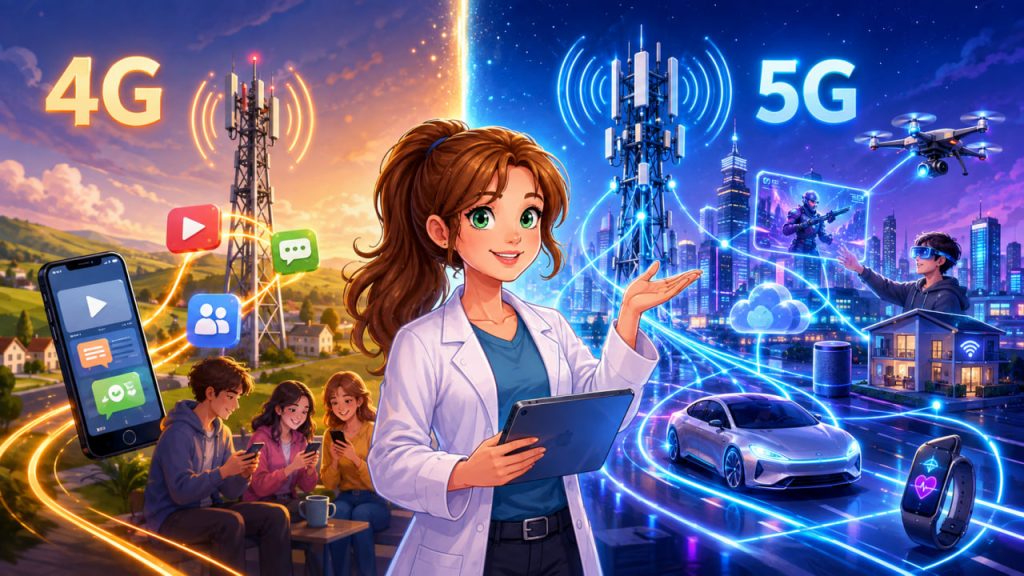
Mobile networks have evolved dramatically over the past two decades. From the early days of basic internet access on smartphones to today’s ultra-fast wireless connections, each new generation has transformed how people communicate, work, and enjoy digital content.
The transition from 4G to 5G is one of the biggest upgrades in wireless technology. While both allow users to browse the internet, stream videos, and make video calls, 5G introduces significant improvements in speed, latency, capacity, and reliability.
But does everyone actually need 5G? And how different is it from the well-established 4G network?
Let’s explore the technology behind both generations and understand what truly sets them apart.
What Is 4G?
Fourth Generation (4G) wireless technology became widely available around 2010 and quickly replaced slower 3G networks.
Its primary goal was to provide broadband-speed mobile internet, making smartphones far more capable than before.
Typical 4G allows users to:
- Browse websites quickly
- Stream HD videos
- Use social media smoothly
- Make video calls
- Play many online games
- Download apps in seconds
Depending on network conditions, real-world 4G download speeds often range from 20 to over 100 Mbps, although peak theoretical speeds can be much higher.
For many everyday activities, 4G remains fast enough.
What Is 5G?
Fifth Generation (5G) is the latest major evolution of cellular communication.
Rather than simply increasing internet speed, 5G was designed to support an entirely new generation of connected devices and services.
Its goals include:
- Extremely high data rates
- Very low latency
- Massive device connectivity
- Improved energy efficiency
- Greater network reliability
In ideal conditions, 5G can deliver download speeds exceeding 1 Gbps, with laboratory demonstrations reaching several gigabits per second.
However, actual speeds depend on spectrum, network deployment, signal strength, and carrier infrastructure.
Speed: The Most Noticeable Difference
The first thing most users notice is speed.
While 4G is already capable of smooth streaming and browsing, 5G dramatically reduces download times.
For example:
- A large movie that may take several minutes on 4G could download in under a minute on a fast 5G connection.
- Cloud backups finish much faster.
- Large software updates install more quickly.
- High-resolution video uploads become significantly easier.
This speed advantage becomes especially noticeable when transferring very large files.
Latency: Faster Responses
Latency measures how quickly information travels between your device and a server.
Lower latency means faster responses.
Typical latency:
- 4G: around 30–50 milliseconds
- 5G: often 10 milliseconds or less, with advanced deployments targeting under 1 millisecond for specialized applications.
Lower latency makes digital experiences feel more responsive.
Examples include:
- Cloud gaming
- Augmented reality
- Virtual reality
- Remote-controlled machines
- Autonomous vehicle communication
- Industrial automation
Even ordinary web browsing can feel slightly more immediate.
Network Capacity
One major challenge for 4G appears during crowded events.
Imagine:
- Stadiums
- Music festivals
- Airports
- Large conferences
- City centers
Thousands of people may attempt to use the network simultaneously.
4G networks can become congested.
5G was designed to support far more connected devices without dramatically reducing performance.
This is increasingly important as smart devices continue to multiply.
Frequency Bands
One reason 5G performs differently is that it uses several frequency ranges.
These generally include:
- Low-band 5G
- Wide coverage
- Similar speeds to advanced 4G
- Excellent rural performance
- Mid-band 5G
- Good balance between speed and coverage
- Currently the most widely deployed option in many countries
- High-band (mmWave) 5G
- Extremely fast
- Limited range
- Easily blocked by buildings, trees, or even heavy rain
- Mostly useful in dense urban environments
Because of these differences, not all 5G networks provide the same experience.
Better Support for the Internet of Things
The Internet of Things (IoT) connects billions of devices to the internet.
Examples include:
- Smart watches
- Traffic sensors
- Security cameras
- Industrial robots
- Smart agriculture equipment
- Medical monitoring devices
While 4G supports connected devices, 5G was specifically engineered to manage millions of devices within relatively small geographic areas.
This capability is expected to play a major role in future smart cities.
Energy Efficiency
Although 5G infrastructure is more complex, it was designed with improved efficiency in mind.
Many connected sensors can remain active for years while consuming very little power.
This matters for:
- Environmental monitoring
- Utility meters
- Industrial sensors
- Agricultural systems
Improved energy management also benefits large-scale IoT deployments.
Do You Need a New Phone?
Yes.
A smartphone must include 5G-compatible hardware to access 5G networks.
A 4G phone cannot simply receive a software update to become a 5G device because the required radio hardware is different.
Fortunately, most new smartphones released today already support 5G.
Are There Any Disadvantages?
Although 5G offers impressive benefits, it also has some limitations.
These include:
- Coverage is still expanding in many regions.
- High-frequency signals travel shorter distances.
- More cellular base stations may be required.
- Performance varies depending on local infrastructure.
- Some users may notice little difference if they primarily browse the web or use messaging apps.
For light internet users, 4G often remains more than sufficient.
Which Technology Is Better?
The answer depends on your needs.
4G remains an excellent technology for:
- Streaming videos
- Video conferencing
- Social media
- Navigation
- Online shopping
- Everyday mobile internet
5G becomes increasingly valuable for:
- Heavy downloads
- Cloud computing
- Competitive online gaming
- AI-powered mobile applications
- Smart factories
- Connected vehicles
- Future digital infrastructure
Rather than replacing 4G overnight, 5G complements and gradually expands upon existing networks.
For many years, both technologies will continue operating together.
Expert Perspective
According to Dr. Andrea Goldsmith, a renowned wireless communications engineer and professor at Princeton University, the significance of 5G extends far beyond faster smartphone downloads. She has emphasized that the technology represents a new communications platform capable of supporting autonomous systems, massive machine-to-machine communication, and next-generation industrial applications. Her work highlights that the true value of 5G lies in enabling entirely new services rather than simply increasing consumer internet speeds.
Interesting Facts
- The first commercial 4G LTE networks launched around 2009–2010.
- 5G can theoretically support up to one million connected devices per square kilometer under the IMT-2020 performance targets.
- Many 5G networks initially rely on existing 4G infrastructure through a deployment model known as Non-Standalone (NSA).
- Some airlines and factories are deploying private 5G networks for secure, high-performance communication.
- Streaming an 8K video is much more practical over a strong 5G connection than over many 4G networks.
- Researchers are already developing 6G, which is expected to integrate artificial intelligence even more deeply into wireless communication.
Glossary
- 4G (Fourth Generation) – The fourth generation of mobile network technology that introduced broadband-speed mobile internet.
- 5G (Fifth Generation) – The latest generation of cellular technology designed for higher speeds, lower latency, and massive device connectivity.
- Latency – The delay between sending and receiving data across a network.
- Bandwidth – The amount of data that can be transmitted over a network within a given period.
- LTE (Long-Term Evolution) – The most common standard used for 4G mobile networks.
- Millimeter Wave (mmWave) – Very high-frequency radio spectrum capable of extremely high speeds but limited coverage.
- Internet of Things (IoT) – A network of physical devices connected to the internet that collect and exchange data.
- Base Station – Equipment that provides wireless communication between mobile devices and the cellular network.
- Non-Standalone (NSA) 5G – A deployment architecture in which 5G radio access works together with an existing 4G core network.
- Standalone (SA) 5G – A fully independent 5G architecture using a dedicated 5G core network, enabling the technology’s full capabilities.