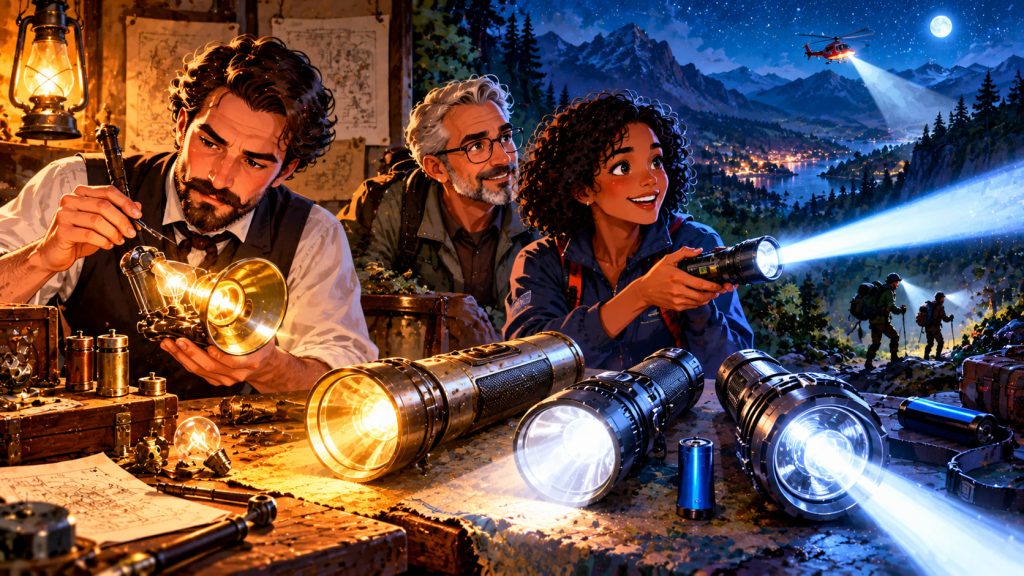
A flashlight is one of those inventions we rarely think about until the electricity goes out. Small enough to fit in a pocket, it can illuminate a dark room, guide rescuers through dangerous terrain, or reveal objects hundreds of meters away.
Yet the history of the flashlight is a remarkable story of scientific progress. In just over 125 years, portable lighting has evolved from fragile battery-powered devices into powerful electronic instruments.
Modern flashlights can produce thousands of lumens, use rechargeable batteries, and project concentrated beams over extraordinary distances.
How did this transformation happen, and what makes the latest flashlight technology in 2026 so impressive?
Before the Flashlight: How People Carried Light
For thousands of years, humans relied on fire for portable illumination.
Torches, candles, and oil lanterns provided light but also produced heat, smoke, and dangerous open flames.
The nineteenth century brought major advances in electricity and battery technology.
One crucial invention was the dry-cell battery, which used an electrolyte held in a paste-like substance rather than freely flowing liquid.
These batteries were easier to transport and helped make portable electric lighting practical.
Who Invented the First Flashlight?
British inventor David Misell is widely credited with creating an early practical handheld flashlight.
His design received US Patent No. 617,592 on January 10, 1899.
The device contained batteries, a miniature incandescent bulb, and a reflector inside a tubular housing.
Entrepreneur Conrad Hubert helped commercialize the invention through the company associated with the Ever Ready brand.
Early flashlights were relatively weak.
Their batteries provided limited power, and primitive bulbs converted much of their electrical energy into heat.
Nevertheless, the invention introduced something revolutionary: portable electric illumination without an open flame.
How Flashlights Improved During the Twentieth Century
During the following decades, improvements in batteries, bulbs, reflectors, and manufacturing made flashlights increasingly practical.
Metal housings improved durability, while better reflectors concentrated light more effectively.
Alkaline batteries became commercially important during the late 1950s, offering advantages over older zinc-carbon designs.
Rechargeable flashlights also emerged, reducing dependence on disposable batteries.
By the late twentieth century, flashlights were essential equipment for police officers, firefighters, mechanics, campers, and emergency workers.
However, the greatest technological transformation was still ahead.
The LED Revolution Changed Everything
The development of efficient light-emitting diodes fundamentally transformed portable lighting.
An LED produces light through an electronic process inside a semiconductor rather than by heating a metal filament.
Early visible LEDs were unsuitable for bright white illumination.
Breakthroughs in efficient blue LEDs during the 1990s made modern white LED lighting possible.
Many white LEDs use a blue light source and a phosphor material that converts part of the blue light into other wavelengths.
In 2014, scientists Isamu Akasaki, Hiroshi Amano, and Shuji Nakamura received the Nobel Prize in Physics for their work on efficient blue LEDs.
Their achievement helped make powerful, energy-efficient flashlights possible.
Why Lumens Are Not Everything
Flashlight manufacturers often advertise extremely high brightness figures.
Brightness is commonly described using luminous flux, measured in lumens.
A typical household flashlight may provide several hundred lumens, while specialized models can produce thousands or even tens of thousands.
However, total brightness does not determine how far a flashlight can illuminate.
Candela measures luminous intensity in a particular direction.
A concentrated beam with high candela can reach much farther than a broad floodlight with higher total lumens.
This difference is particularly important for search-and-rescue equipment.
Rechargeable Batteries Made Flashlights More Powerful
Modern high-performance flashlights frequently use a lithium-ion battery.
This technology combines substantial energy storage with relatively low weight and repeated rechargeability.
Common cylindrical battery formats include 18650 and 21700 cells.
Many flashlights now feature USB-C charging, battery indicators, and electronic protection systems.
Some models even function as emergency power banks.
However, powerful batteries require careful handling.
Using incompatible chargers, damaged batteries, or unsuitable replacement cells can create overheating and fire hazards.
What Are the Latest Flashlight Innovations in 2026?
The flashlight industry continues developing increasingly sophisticated equipment.
In March 2026, Fenix introduced its C7 PRO rechargeable flashlight, featuring a manufacturer-rated maximum output of 4,600 lumens.
Another remarkable development appeared in July 2026.
ACEBEAM introduced the Terminator M1 2.0, combining conventional LED illumination with laser-excited phosphor technology.
This system uses a laser to excite a phosphor material, producing a highly concentrated white beam.
ACEBEAM advertises a maximum beam distance of 1,620 meters and an additional LED floodlight producing up to 3,900 lumens.
Such figures describe standardized or manufacturer-reported performance rather than equally bright illumination across the entire distance.
The emerging trend is versatility: combining long-range precision, broad illumination, and compact construction in one device.
Smart Electronics and Better Heat Management
Modern flashlights are increasingly sophisticated electronic systems.
High-output LEDs generate substantial heat, especially when operating at maximum brightness.
Electronic thermal regulation reduces power when internal temperatures approach unsafe levels.
This protects components and helps prevent overheating.
Advanced models can also offer programmable brightness levels, multiple beam patterns, battery monitoring, and automatic brightness adjustment.
The ANSI/PLATO FL 1-2025 performance standard introduced updated testing provisions for short-duration high-brightness modes.
This helps distinguish brief maximum output from illumination that can be maintained for extended periods.
Flashlights for Extreme Conditions
Modern portable lighting is designed for environments ranging from underwater exploration to freezing mountain trails.
An IP rating describes protection against dust and water under specified testing conditions.
For example, IP67 indicates dust-tight protection and resistance to temporary immersion under defined conditions.
Professional flashlights may also feature impact-resistant housings, magnetic mounts, replaceable batteries, and hands-free operation.
Search teams increasingly use powerful headlamps, while mechanics benefit from compact lights with adjustable beam angles.
Different activities require different combinations of brightness, durability, weight, and runtime.
What Might the Flashlight of the Future Look Like?
Future flashlights will likely become more efficient, adaptable, and integrated with other technologies.
Improvements in battery chemistry could extend operating time without increasing size.
Better optics may allow users to switch between narrow beams and broad illumination more precisely.
Advanced sensors could automatically adjust light output according to surrounding conditions.
The next major breakthrough may not be an enormous increase in brightness.
It may be a flashlight that delivers exactly the right illumination, for exactly as long as needed, with minimal wasted energy.
Interesting Facts
- David Misell’s famous flashlight patent was granted in January 1899.
- Early handheld flashlights sometimes used cardboard or fiber housings.
- Modern LEDs can operate for tens of thousands of hours under suitable conditions.
- Some flashlights produce more light than automobile headlights, although beam patterns differ substantially.
- A flashlight’s advertised maximum brightness may last only briefly before its electronics reduce output.
- The ANSI/PLATO flashlight standard measures beam distance at an illumination level of 0.25 lux.
- Specialized flashlights can combine white light, ultraviolet illumination, and laser-based beams in one housing.
Glossary
- Dry-Cell Battery — A portable battery containing an electrolyte that does not flow freely.
- Incandescent Bulb — A lamp that produces light by heating a filament with electricity.
- LED — A semiconductor device that emits light when electrical current passes through it.
- Phosphor — A material that absorbs energy and emits light at different wavelengths.
- Luminous Flux — The total quantity of visible light emitted by a source, measured in lumens.
- Candela — The unit used to measure luminous intensity in a particular direction.
- Lithium-Ion Battery — A rechargeable battery that uses lithium ions to store and release electrical energy.
- Laser-Excited Phosphor — Lighting technology that produces visible light by directing laser energy onto a phosphor material.
- Thermal Regulation — Electronic control of power and brightness to prevent excessive heating.
- IP Rating — A classification describing equipment protection against dust and water.