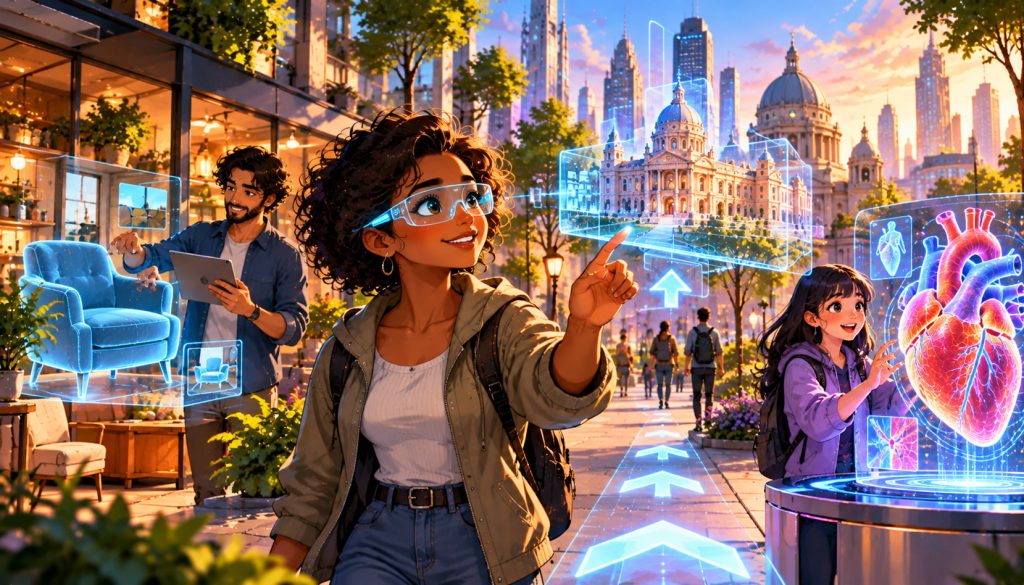
Imagine walking through an unfamiliar city while navigation arrows appear directly on the streets ahead. Or choosing furniture for your home and seeing exactly how it would look before buying anything.
These experiences are becoming possible through augmented reality (AR), one of the most promising technologies for changing how humans interact with the physical world.
Unlike virtual reality, which creates a simulated environment, augmented reality adds digital information to the surroundings we already see.
From education and healthcare to shopping, entertainment, and communication, AR is gradually moving beyond experimental demonstrations.
The biggest revolution may be a world where useful digital information becomes part of everyday experience rather than something we constantly search for on screens.
What Is Augmented Reality?
Augmented reality combines physical surroundings with computer-generated images, information, or interactive objects.
A smartphone camera can show a real room while software places a virtual sofa inside it.
More advanced systems use AR Glasses to present digital information within the user’s field of view.
These experiences can involve three-dimensional objects, navigation instructions, educational models, or interactive animations.
The difference between augmented reality and Virtual Reality (VR) is important.
Virtual reality immerses users in a computer-generated environment. Augmented reality keeps the physical world visible while adding digital elements.
Some devices offer Mixed Reality (MR), allowing virtual objects to interact more meaningfully with physical surroundings.
How Does Augmented Reality Actually Work?
AR systems combine cameras, motion sensors, computer vision, and specialized software.
The device first analyzes its surroundings and estimates where the user is located.
A technique called Simultaneous Localization and Mapping (SLAM) allows certain devices to build a map of an environment while tracking their position within it.
The software can then place virtual objects at appropriate locations.
Spatial Mapping helps identify surfaces, walls, furniture, and other physical structures.
For example, a virtual chair should appear to stand on the floor rather than float randomly in the air.
Advanced systems also use Occlusion, which allows real objects to visually block digital objects when appropriate.
These processes help digital content appear naturally integrated into real environments.
Navigation Could Become Much Easier
One of the most practical applications of augmented reality is navigation.
Traditional maps require users to interpret symbols and compare them with nearby streets.
AR navigation can place directional indicators directly over a live camera view.
Google Maps already offers camera-based walking guidance through Lens in Maps.
Apple Maps also supports augmented reality walking directions on compatible iPhones in supported locations.
Future glasses could make similar experiences more convenient without requiring users to hold a smartphone.
Travelers might see directions toward a railway station, airport terminal, or museum entrance.
AR could make navigation more intuitive by connecting instructions directly to the places they describe.
Shopping Without Guesswork
Augmented reality is already changing online shopping.
One major application is Virtual Try-On, which allows customers to preview products digitally.
Depending on the application, shoppers can experiment with eyewear, cosmetics, shoes, or clothing styles.
Furniture shopping offers another example.
IKEA Kreativ allows customers to scan rooms and experiment with furniture arrangements digitally.
This helps people understand dimensions, placement, and the visual relationship between objects.
However, virtual previews cannot perfectly reproduce material texture, comfort, or every lighting condition.
AR can improve purchasing decisions, but it does not completely replace examining physical products.
Education Could Become More Interactive
Traditional education relies heavily on textbooks, diagrams, and videos.
Augmented reality adds the possibility of exploring digital objects in three-dimensional space.
Students could examine a rotating human heart, explore a model of the solar system, or study the internal structure of a machine.
Instead of imagining complex structures from flat illustrations, learners could move around them.
In chemistry, AR could help demonstrate molecular arrangements.
In biology, students could examine anatomical structures from different angles.
Historical education could also benefit from digital reconstructions of buildings, artifacts, and ancient environments.
The greatest educational benefit may come from making difficult spatial concepts easier to understand.
Healthcare and Medical Training
Medical professionals increasingly investigate augmented reality for training and clinical assistance.
AR can help medical students visualize anatomy and practice procedures within controlled learning environments.
A 2026 systematic review involving 11 studies and 347 participants found that augmented reality training improved at least one objective technical performance measure in nine studies.
The benefits were particularly notable for surgical beginners.
Researchers are also exploring ways to overlay medical imaging information during procedures.
However, clinical applications require extensive validation because inaccurate positioning or distracting information could create risks.
For now, AR should be understood primarily as a promising assistance and training technology rather than an automatic replacement for established medical methods.
How AR Could Change the Workplace
Augmented reality has applications far beyond entertainment.
Industrial workers can use digital instructions while assembling, inspecting, or repairing equipment.
A technician could see a virtual diagram positioned beside the component that requires maintenance.
This reduces the need to repeatedly consult printed manuals or separate computer screens.
Remote specialists may also guide workers by viewing shared camera footage and providing visual annotations.
Similar systems are being explored for aviation, logistics, manufacturing, and infrastructure maintenance.
These applications could improve training and reduce errors when digital instructions are accurate and appropriately designed.
Smart Glasses and the Future of Communication
Smart glasses could eventually become an important alternative to smartphones.
In September 2025, Meta introduced Ray-Ban Display glasses with a small full-color screen integrated into one lens.
The glasses can display messages, translations, navigation information, and AI-generated assistance.
They also work with a wristband that recognizes subtle muscle signals to control certain functions.
However, these glasses are not equivalent to fully immersive AR eyewear that anchors elaborate holograms throughout a physical environment.
More advanced AR prototypes can display spatial digital content, but comfortable, affordable, all-day devices remain a major engineering challenge.
The long-term ambition is to make information accessible without constantly looking down at a phone.
Tourism and Entertainment Could Become More Immersive
Imagine visiting ancient Rome and seeing historical buildings reconstructed over their surviving ruins.
Or walking through a museum where an extinct animal appears as an animated three-dimensional model.
AR could enrich tourism by placing historical and scientific information directly into relevant surroundings.
Entertainment has already demonstrated the appeal of location-based augmented experiences.
Pokémon GO, released in 2016, introduced millions of players to digital creatures associated with real-world locations.
Future AR experiences could make parks, museums, and public spaces more interactive.
However, useful applications must avoid distracting people from traffic, hazards, or other real-world activities.
Accessibility and Everyday Assistance
Augmented reality also offers possibilities for people with disabilities.
Visual instructions could help some users complete tasks independently.
Live captions and translation features may support communication for people with hearing difficulties or language barriers.
Object recognition and audio descriptions can also assist certain users with visual impairments, although these functions do not always require AR displays.
Different accessibility needs demand different technologies.
The most useful systems will offer personalized assistance rather than assuming that one interface works for everyone.
Expert Perspective: What Makes Augmented Reality Truly Effective?
Computer scientist Ronald Azuma helped establish a widely used understanding of augmented reality in his influential 1997 research.
He identified three essential characteristics: combining real and virtual content, enabling real-time interaction, and aligning digital information with three-dimensional surroundings.
These principles remain important today.
A digital image floating randomly in front of someone’s eyes is not the same as information accurately attached to a physical object.
For augmented reality to become genuinely useful, digital information must appear in the right place, at the right moment, and respond correctly to the physical world.
What Is Preventing AR From Becoming Universal?
Despite impressive progress, augmented reality still faces several obstacles.
- Battery life: Advanced displays and sensors consume considerable energy.
- Comfort: Glasses must remain lightweight enough for extended use.
- Visual quality: Bright sunlight and limited viewing areas can affect visibility.
- Privacy: Always-available cameras and sensors raise concerns about recording people and surroundings.
- Accuracy: Tracking errors can cause digital objects to appear in incorrect positions.
- Cost: Sophisticated optical components remain expensive.
Developers must also consider information overload.
An environment filled with unnecessary notifications could become distracting rather than helpful.
The most successful systems will prioritize useful information and allow people to control what appears in their surroundings.
A Future Where Digital and Physical Worlds Work Together
Augmented reality is unlikely to replace every smartphone, computer, or conventional display in the immediate future.
Instead, different AR applications may gradually become part of everyday activities.
Navigation could become more intuitive. Medical training could become more visual. Shopping could become more informative, while workplaces benefit from hands-free instructions.
As optical technology, artificial intelligence, and spatial computing improve, AR devices may become smaller and more practical.
The ultimate goal is not to cover reality with digital graphics, but to make the physical world easier to understand, navigate, and interact with.
Interesting Facts
- One of the earliest head-mounted augmented reality systems was developed by Ivan Sutherland and Bob Sproull in 1968.
- The early experimental headset was so heavy that it required an overhead supporting structure.
- Pokémon GO helped popularize location-based augmented experiences after its 2016 launch.
- Some smartphone applications can position virtual furniture inside a real room.
- Certain AR navigation systems use buildings and visual landmarks to help determine the user’s orientation.
- Modern display-equipped smart glasses can show messages and translation information without requiring users to hold a phone.
- Medical researchers have demonstrated improvements in selected technical training tasks using augmented reality.
Glossary
- AR Glasses — Wearable eyewear that presents digital information within the user’s field of view.
- Virtual Reality (VR) — Technology that immerses users in a computer-generated environment.
- Mixed Reality (MR) — Technology combining physical and digital environments with interactive spatial content.
- Simultaneous Localization and Mapping (SLAM) — A technique used to map surroundings while estimating a device’s position.
- Spatial Mapping — The process of identifying and digitally representing physical surfaces and structures.
- Occlusion — A visual effect in which nearer objects block the view of objects behind them.
- Virtual Try-On — Technology that allows users to preview how products might look through digital visualization.