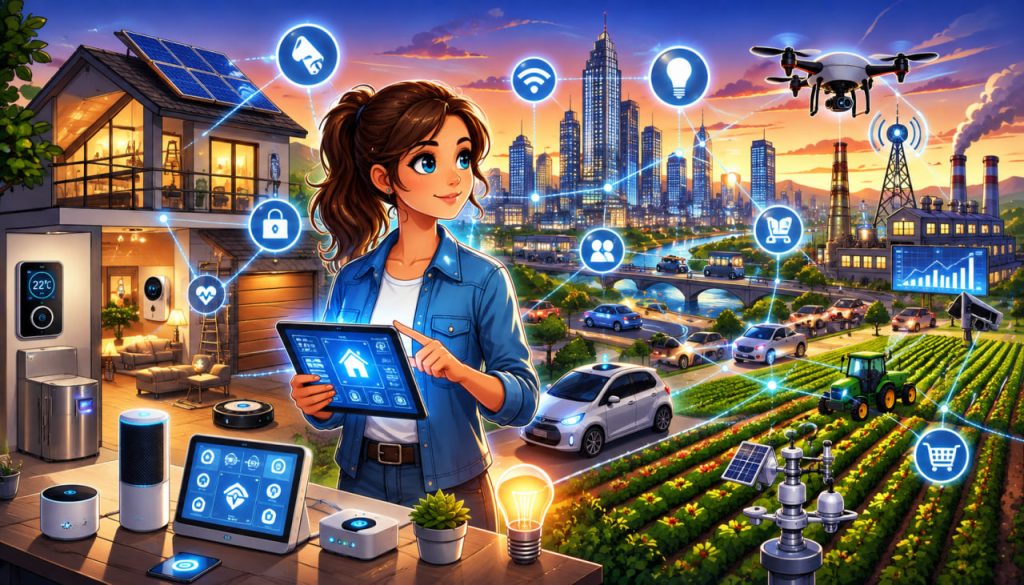
The Internet of Things, commonly known as IoT, is one of the most important technologies shaping modern life. It connects everyday physical objects to the internet so they can collect data, communicate, and sometimes make automatic decisions.
A smart thermostat that adjusts room temperature, a fitness watch that tracks your heart rate, a factory sensor that detects machine failure, and a connected car that monitors traffic are all examples of IoT in action.
At its core, IoT turns ordinary objects into intelligent, data-driven systems.
This technology is already transforming homes, healthcare, transportation, agriculture, manufacturing, energy, and entire cities. Yet many people still hear the term “IoT” without fully understanding what it means or why it matters.
What Is IoT?
IoT stands for Internet of Things.
It refers to a network of physical devices connected to the internet. These devices contain sensors, software, processors, and communication tools that allow them to collect and exchange information.
An IoT device can be almost anything:
- A smart refrigerator
- A security camera
- A wearable fitness tracker
- A medical monitor
- A traffic light
- A delivery vehicle
- A factory robot
- A soil moisture sensor on a farm
The key idea is simple: IoT devices sense something in the physical world and send that information to digital systems.
Some devices only collect data. Others also respond automatically.
For example, a smart irrigation system can detect dry soil and turn on watering without a person pressing a button.
How IoT Works
Most IoT systems follow a basic structure.
First, a device uses sensors to collect information. This could include temperature, movement, pressure, location, humidity, light, vibration, or health data.
Next, the device sends that data through a network. It may use Wi-Fi, Bluetooth, 4G, 5G, satellite, or specialized low-power networks.
Then, the data is processed. This may happen on the device itself, on a nearby computer, or in the cloud.
Finally, the system produces an action or insight.
For example:
- A smartwatch warns you about an unusual heart rhythm.
- A smart lock lets you open a door remotely.
- A factory system predicts when a machine needs repair.
- A smart meter helps reduce electricity waste.
- A logistics company tracks vehicles in real time.
IoT is powerful because it connects physical reality with digital intelligence.
IoT in Smart Homes
Smart homes are one of the most familiar uses of IoT.
Common smart home devices include:
- Smart speakers
- Smart lights
- Smart thermostats
- Video doorbells
- Security cameras
- Smart locks
- Robot vacuum cleaners
- Connected appliances
These devices make homes more convenient, efficient, and secure.
A smart thermostat can learn your habits and reduce energy use. Smart lights can turn off automatically when no one is in the room. A video doorbell can send a notification when someone approaches your house.
However, smart homes also raise important questions about privacy and cybersecurity.
Every connected device can become a potential entry point for hackers if it is poorly protected.
IoT in Healthcare
Healthcare is one of the most promising areas for IoT.
Connected medical devices can monitor patients continuously instead of only during hospital visits.
Examples include:
- Wearable heart monitors
- Glucose sensors
- Smart inhalers
- Remote blood pressure monitors
- Fall detection devices for elderly people
- Hospital equipment tracking systems
These tools can help doctors detect problems earlier and personalize treatment.
Remote monitoring is especially valuable for people with chronic conditions. Instead of waiting for symptoms to become severe, healthcare providers can receive data in real time and respond sooner.
IoT can shift healthcare from reactive treatment toward preventive care.
IoT in Industry
Industrial IoT, often called IIoT, is changing factories, warehouses, mines, ports, and energy systems.
Industrial sensors can monitor machines, production lines, temperature, vibration, fuel use, and equipment performance.
This allows companies to:
- Reduce downtime
- Predict equipment failures
- Improve worker safety
- Optimize energy use
- Track inventory more accurately
- Increase production efficiency
One of the most valuable industrial uses is predictive maintenance.
Instead of repairing a machine only after it breaks, sensors detect early warning signs. The company can then schedule maintenance before a costly failure occurs.
This saves money, time, and resources.
IoT and Smart Cities
Smart cities use IoT to improve urban life.
Connected systems can help manage:
- Traffic lights
- Public transport
- Street lighting
- Waste collection
- Air quality monitoring
- Water systems
- Parking spaces
- Emergency response
For example, smart traffic systems can adjust signals based on real-time congestion. Smart streetlights can dim when streets are empty and brighten when movement is detected.
Environmental sensors can monitor air pollution and help city planners make better decisions.
IoT helps cities become more responsive instead of relying only on fixed schedules and outdated data.
IoT in Agriculture
Agriculture is becoming more connected through IoT.
Farmers can use sensors to monitor soil moisture, crop health, weather conditions, livestock location, and irrigation needs.
This is often called smart farming or precision agriculture.
With IoT, farmers can use water, fertilizer, and energy more efficiently. They can detect plant stress earlier and improve crop yields.
For example, a field sensor can show that one area needs watering while another does not. This avoids waste and supports more sustainable farming.
The Role of 5G in IoT
5G is important for the future of IoT because it can support faster communication, lower latency, and a larger number of connected devices.
This matters for applications such as:
- Autonomous vehicles
- Smart factories
- Remote-controlled machinery
- Advanced medical systems
- Real-time city infrastructure
- Augmented reality devices
Not every IoT device needs 5G. A simple temperature sensor may work perfectly with a low-power network.
But advanced IoT systems that require rapid response and high reliability can benefit greatly from 5G.
Benefits of IoT
IoT offers several major advantages.
It improves efficiency by automating tasks and reducing waste. It supports better decision-making by providing real-time data. It can improve safety by detecting risks earlier. It also creates more personalized experiences for users.
For businesses, IoT can reduce operational costs and improve productivity.
For individuals, it can make daily life more convenient.
The biggest value of IoT is not just connectivity. It is the ability to turn data into useful action.
Risks and Challenges of IoT
IoT also comes with serious challenges.
The most important risks include:
- Cybersecurity threats
- Personal data collection
- Device compatibility problems
- Dependence on internet connectivity
- Short device lifespans
- Poor software updates
- Lack of clear standards
Security is especially important. Many IoT devices are small, inexpensive, and designed for convenience rather than strong protection.
Weak passwords, outdated firmware, and insecure networks can expose users and organizations to attacks.
Privacy is another major concern. Smart devices may collect sensitive information about behavior, location, health, and daily routines.
A connected world must also be a protected world.
Expert Perspective
Kevin Ashton, the technology pioneer widely credited with coining the term “Internet of Things,” argued that computers become far more useful when they can gather information from the physical world without relying entirely on human input.
This idea remains central to IoT today. The technology is not simply about connecting gadgets. It is about giving digital systems a more accurate view of real-world conditions.
That is why IoT is so influential in industries where timing, location, measurement, and automation matter.
The Future of IoT
The future of IoT will likely be shaped by artificial intelligence, edge computing, 5G, stronger cybersecurity, and more energy-efficient devices.
AI will help IoT systems detect patterns and make smarter decisions. Edge computing will allow data to be processed closer to the device, reducing delays. Better security standards will make connected systems safer.
In the coming years, IoT will become less visible but more deeply integrated into daily life.
Many systems will work quietly in the background, optimizing buildings, transport, healthcare, energy, and supply chains.
The most successful IoT products will be those that solve real problems without making life more complicated.
Interesting Facts
- The term Internet of Things was popularized by Kevin Ashton in the late 1990s.
- Some IoT sensors can operate for years on a small battery.
- Smart agriculture systems can reduce water waste by watering crops only when needed.
- Industrial IoT can predict machine failures before they happen.
- A modern smart city may use thousands of sensors to manage traffic, lighting, pollution, and utilities.
- Not all IoT devices need high-speed internet; many only send tiny amounts of data.
- Cybersecurity is one of the biggest challenges facing the IoT industry.
Glossary
- IoT — Internet of Things; a network of physical devices connected to the internet.
- Sensor — A device that detects physical information such as temperature, motion, pressure, or light.
- Smart Device — A connected device that can collect data, communicate, or respond automatically.
- Cloud Computing — Processing and storing data on remote internet-based servers.
- Edge Computing — Processing data near the device instead of sending everything to the cloud.
- IIoT — Industrial Internet of Things, used in factories, energy systems, logistics, and heavy industry.
- Predictive Maintenance — Using data to detect early signs of equipment failure before breakdowns occur.
- Firmware — Built-in software that controls how a device operates.
- Latency — The delay between sending data and receiving a response.
- Smart City — An urban area that uses connected technology to improve services, infrastructure, and efficiency.