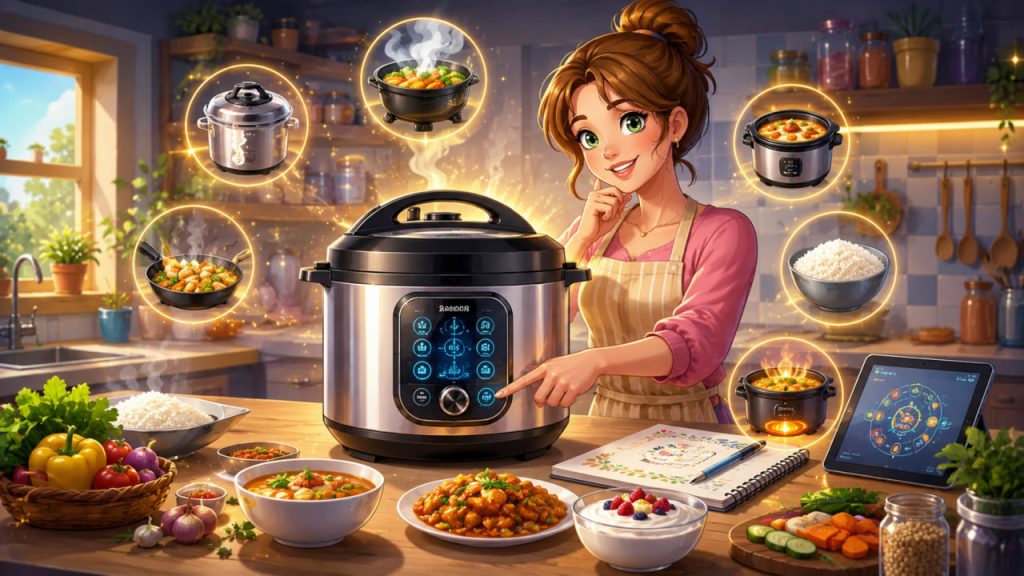
A multicooker can become one of the most useful appliances in a home kitchen. It combines several cooking methods in one compact device and helps prepare soups, stews, grains, meat, vegetables, yogurt, and even desserts with less supervision.
For a homemaker who cooks regularly, the best multicooker is not simply the most expensive model. The right choice depends on family size, cooking habits, safety features, bowl quality, cleaning convenience, and the functions you will actually use.
Modern multicookers can replace or reduce the need for several appliances: a rice cooker, slow cooker, pressure cooker, steamer, yogurt maker, and food warmer. Some models also include air-frying lids or sous-vide programs, although not every household needs those extras.
A good multicooker should make daily cooking easier, not more complicated.
What Is a Multicooker?
A multicooker is an electric kitchen appliance that uses a controlled heating element, a removable inner pot, built-in cooking programs, and often a sealed lid.
Depending on the model, it may cook by:
- Pressure cooking
- Slow cooking
- Steaming
- Sautéing
- Simmering
- Rice cooking
- Yogurt fermentation
- Food warming
- Baking-style heating
- Air frying with a special lid
The biggest advantage is automation. You add ingredients, choose a program, and the device controls time and temperature.
For everyday home cooking, this saves attention, reduces stress, and makes meal planning easier.
Pressure Multicooker or Classic Multicooker?
There are two main types.
A classic multicooker works like an electric pot with preset programs. It is good for porridge, soups, rice, stews, baking, and slow cooking.
A pressure multicooker cooks food under pressure, which raises the boiling point of water and speeds up cooking. This is especially useful for beans, tough meat, broths, chickpeas, stews, and dishes that normally take a long time.
For most modern homes, a pressure multicooker is the more versatile choice.
It can usually work as both a pressure cooker and a regular multicooker. However, users should carefully follow the manual, especially when using pressure modes.
Choose the Right Capacity
Capacity is one of the most important buying decisions.
A multicooker that is too small will be frustrating. A model that is too large may take extra counter space and feel inconvenient for small meals.
A practical guide:
- 3 liters / 3 quarts — suitable for one person or a couple
- 5–6 liters / 5–6 quarts — best for most families of 3–5 people
- 7–8 liters / 7–8 quarts — better for large families, batch cooking, or frequent guests
For a typical homemaker cooking for a family, the most balanced size is usually 5–6 liters.
It is large enough for soups, stews, rice, meat, and meal prep, but not too bulky for daily use.
Bowl Material Matters
The inner pot is where all the cooking happens, so its quality matters.
Common options include:
- Nonstick aluminum
- Ceramic-coated nonstick
- Stainless steel
Nonstick bowls are convenient because food releases easily and cleaning is simple. However, coatings can scratch over time, especially if metal utensils are used.
Stainless steel bowls are more durable and often better for sautéing, browning, and long-term use. They do not have a coating that can peel, but food may stick more easily.
For long-term durability, stainless steel is often the best choice. For maximum easy cleaning, a high-quality nonstick bowl may feel more convenient.
A dishwasher-safe inner pot is a major advantage for busy households.
Safety Features Are Essential
Safety is especially important if you choose a pressure multicooker.
Look for features such as:
- Secure lid locking
- Pressure release valve
- Overheat protection
- Automatic pressure control
- Lid position detection
- Anti-blockage vent design
- Automatic shutoff
Instant Pot, one of the most recognizable multicooker brands, highlights lid position detection as one of its safety systems: if the lid is not properly positioned for pressure cooking, the cooker should not allow the pressure program to start.
This is exactly the kind of feature that makes a multicooker more comfortable for home use.
A homemaker should never choose a pressure multicooker based only on price. Safety systems and build quality matter more.
Which Functions Are Actually Useful?
Many multicookers advertise 10, 15, or even 25 cooking programs. More buttons do not always mean better cooking.
The most useful functions for everyday family meals are:
- Pressure cook
- Rice or grains
- Soup
- Stew
- Steam
- Sauté
- Slow cook
- Keep warm
- Delay start
- Yogurt
Good Housekeeping’s Kitchen & Cooking Lab notes that popular multicookers such as the Instant Pot Duo combine pressure cooking, slow cooking, rice cooking, steaming, sautéing, warming, and yogurt-making in one appliance.
For most households, these core functions are enough.
Air frying, sous-vide, sterilizing, and app control can be useful, but they should not be the main reason to buy a device unless you know you will use them often.
Ease of Cleaning
A multicooker that is hard to clean will eventually stay in the cupboard.
Before buying, check whether these parts are removable and easy to wash:
- Inner pot
- Sealing ring
- Steam valve
- Condensation collector
- Lid insert
- Air-fryer basket, if included
A removable lid insert is especially helpful because steam, oil, and food aromas can collect there.
The sealing ring can absorb strong smells from garlic, meat, spices, and soups. Some users keep separate rings for sweet and savory dishes.
The easier the cleaning process, the more often the appliance will be used.
Food Safety and Slow Cooking
Multicookers are convenient, but safe cooking practices still matter.
The USDA Food Safety and Inspection Service explains that slow cookers cook food safely through direct heat, long cooking time, and steam trapped inside the covered pot. It also advises keeping hot food at at least 140°F when serving.
The USDA also warns that cooking frozen foods in a slow cooker is not recommended because thawing inside the slow cooker can keep food in an unsafe temperature range for too long.
For homemakers, this means one important rule: do not treat a multicooker as magic. Use safe food handling, proper thawing, and correct temperatures.
Energy Use and Kitchen Efficiency
A multicooker can be more efficient than turning on a large oven for small or medium meals because it heats a compact cooking chamber.
It can also reduce the need to use multiple burners at once.
Energy efficiency depends on the exact model, cooking mode, recipe, and cooking time. ENERGY STAR notes that certified appliances meet strict energy-efficiency specifications set by the U.S. Environmental Protection Agency or Department of Energy, although not all household multicookers carry an ENERGY STAR category label.
For daily cooking, the practical benefit is simple: a multicooker often keeps heat concentrated and reduces kitchen overheating.
This is especially useful in summer or in small apartments.
Best Choice for a Homemaker
For most homemakers, the ideal multicooker has:
- 5–6 liter capacity
- Pressure cooking mode
- Stainless steel or high-quality nonstick bowl
- Reliable lid locking
- Automatic pressure release or controlled release
- Sauté function
- Slow cook function
- Rice and grain programs
- Keep-warm mode
- Easy-to-remove washable parts
- Clear buttons and a readable display
The best all-around choice is usually a 5–6 liter pressure multicooker with strong safety features and a durable inner pot.
This size and feature set works well for soups, stews, rice, porridge, meat, vegetables, broths, and weekly meal prep.
A compact 3-liter model is better for a single person or a couple. A large 8-liter model is better for big families or batch cooking.
Expert Perspective
Kitchen appliance testing organizations usually emphasize performance, ease of use, and cleaning rather than only the number of programs. Good Housekeeping’s Kitchen & Cooking Lab, for example, tests multicookers for practical cooking performance and user-friendly features, not just advertised specifications.
This reflects an important buying principle: a multicooker should be judged by how reliably it helps with real meals, not by how impressive the control panel looks.
For a homemaker, the best appliance is the one that saves time every week and feels safe, simple, and easy to maintain.
Interesting Facts
- A multicooker can often replace several separate appliances in a small kitchen.
- Pressure cooking can significantly reduce cooking time for beans, broth, and tough cuts of meat.
- The sealing ring in a pressure multicooker can absorb food odors, so many users buy extra rings.
- A 5–6 liter multicooker is usually the most practical size for an average family.
- Some multicookers can make yogurt by maintaining a controlled low temperature.
- Stainless steel inner pots are more durable, while nonstick pots are often easier to clean.
- Delay-start programs are convenient for grains and porridge, but should be used carefully with perishable foods.
Glossary
- Multicooker — An electric appliance that combines several cooking methods in one device.
- Pressure Cooking — Cooking food in a sealed pot under pressure to speed up the process.
- Slow Cooking — Cooking food at low heat for a long time.
- Inner Pot — The removable bowl inside a multicooker where food is cooked.
- Nonstick Coating — A surface layer designed to prevent food from sticking.
- Stainless Steel — A durable metal often used for long-lasting cookware.
- Sauté Function — A program that allows browning or frying ingredients before pressure cooking or simmering.
- Keep Warm Mode — A function that keeps cooked food warm after the main program ends.
- Sealing Ring — A flexible ring that helps close the lid tightly during pressure cooking.
- Pressure Release Valve — A valve that releases steam and reduces pressure after cooking.