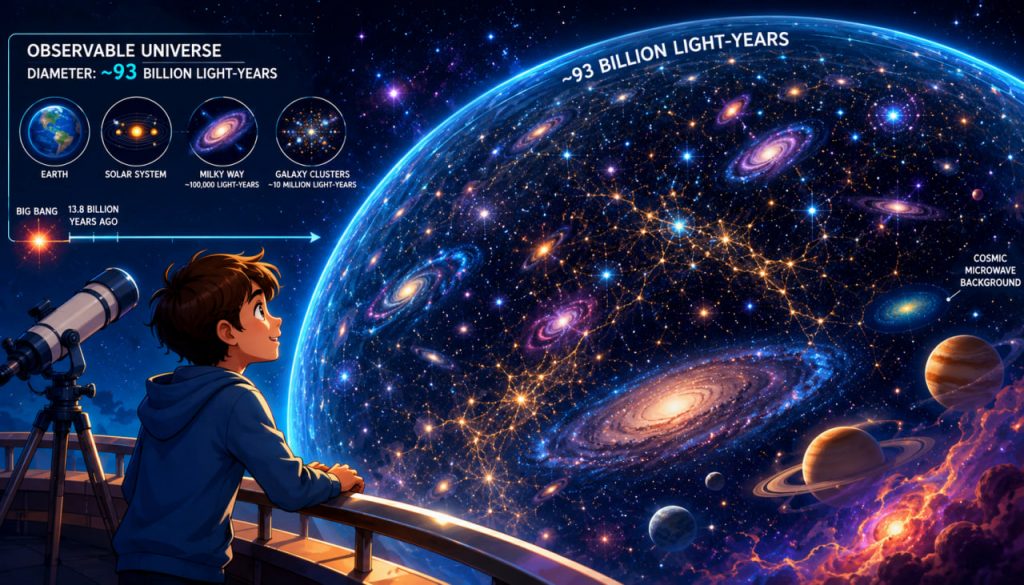
The universe is so large that ordinary distance words stop working. A city is big. Earth is huge. The Solar System is enormous. But the universe exists on a scale where even light, the fastest thing in nature, needs billions of years to cross the distances we observe.
The simplest answer is this: the observable universe is about 92–93 billion light-years across. That is the region from which light has had enough time to reach us since the Big Bang. NASA gives an estimate of about 92 billion light-years across, while the commonly used rounded figure is about 93 billion light-years.
But that is not the whole universe. It is only the part we can observe.
What Does “Observable Universe” Mean?
The observable universe is the cosmic sphere around Earth from which light, radiation, or other signals have had time to reach us.
The universe is about 13.8 billion years old, according to measurements from missions such as ESA’s Planck space telescope, which studied the cosmic microwave background — the ancient afterglow of the Big Bang.
At first, it may seem that the observable universe should be only 13.8 billion light-years in radius. After all, if light has traveled for 13.8 billion years, should the farthest visible things not be 13.8 billion light-years away?
The answer is no, because space itself has expanded while the light was traveling.
A galaxy whose ancient light is reaching us now was much closer when that light began its journey. During billions of years of cosmic expansion, the distance between us and that galaxy increased. Today, the farthest observable regions are roughly 46 billion light-years away in every direction, giving the observable universe its roughly 92–93 billion-light-year diameter.
Why the Universe Is Bigger Than Its Age Sounds
A light-year is not a unit of time. It is a unit of distance.
One light-year is the distance light travels in one year. NASA describes one light-year as about 6 trillion miles.
So when we say the observable universe is about 93 billion light-years across, we are talking about distance, not age.
The confusion comes from cosmic expansion. The universe is not an explosion expanding into empty space from a central point. Instead, space itself is stretching, increasing the distance between galaxies on large scales.
A useful analogy is raisin bread dough. As the dough rises, every raisin moves farther from every other raisin. No single raisin is the center of expansion. From each raisin’s point of view, the others appear to move away.
The universe behaves in a similar way on the largest scales.
Is Earth at the Center of the Universe?
No.
The observable universe is centered on us only because we observe it from here.
An alien civilization in a galaxy billions of light-years away would also see itself at the center of its own observable universe. Its cosmic horizon would overlap with ours in some places and include regions we can never see.
Being at the center of the observable universe is not the same as being at the center of all existence.
Modern cosmology does not identify a physical center of the universe. The Big Bang was not a bomb going off at one location. It was the early hot, dense state of all space.
How Far Can We Actually See?
The farthest light we can detect does not come from ordinary stars or galaxies. It comes from the cosmic microwave background, often called the CMB.
The CMB is ancient radiation left over from a time when the universe became transparent, about 380,000 years after the Big Bang. Before that, the universe was filled with hot plasma that scattered light constantly.
When the universe cooled enough for atoms to form, light could finally travel freely. That light has been stretched by cosmic expansion into microwave radiation, and we can detect it across the sky today.
Planck mapped this radiation with high precision, helping refine our understanding of the universe’s age, contents, and early structure.
In a sense, the CMB is the universe’s oldest visible photograph.
How Big Is the Whole Universe?
This is the deeper question — and the honest answer is: we do not know.
The whole universe may be much larger than the observable universe. It may even be infinite.
NASA’s public explanation of space emphasizes that scientists have measured billions of light-years in every direction without reaching an edge, and that the true size of space remains unknown.
If the universe is finite, it may still be so large that the observable universe is only a tiny fraction of it. If it is infinite, then the observable universe is simply our local visible bubble inside an endless cosmos.
Current observations suggest that the universe is very close to spatially flat on large scales. A flat universe can be infinite, although “flat” does not automatically prove infinity. It means that, geometrically, parallel lines remain almost parallel across cosmic distances.
How Many Galaxies Are Out There?
The observable universe contains an enormous number of galaxies.
Estimates vary because many galaxies are faint, distant, hidden, or too small to detect clearly. NASA notes that if galaxies were all the same size, a rough estimate would imply around 10 sextillion stars in the observable universe.
That number is written as:
10,000,000,000,000,000,000,000
And stars are not evenly distributed like grains of sand in a box. They cluster into galaxies, galaxies cluster into groups and clusters, and those structures connect in a vast network called the cosmic web.
On the largest scales, the universe looks like glowing filaments of matter surrounding enormous dark voids.
Expert Perspective
NASA astrophysicist Laura Vega explains the key point clearly: the observable universe is about 93 billion light-years across, but scientists are confident the whole universe extends beyond what we can see.
That distinction is essential.
The observable universe is a measured horizon. The whole universe is a bigger mystery.
This is why cosmologists speak carefully. They do not say, “The universe is exactly 93 billion light-years wide.” They say the observable universe is about that size.
Could We Ever Reach the Edge?
There is no practical way to reach the edge of the observable universe.
Even if a spacecraft could travel near the speed of light, cosmic distances are too vast. Worse, because expansion continues, many distant galaxies are moving away from us so quickly — due to the expansion of space — that their future light may never reach us.
This does not violate the rule that nothing can move through space faster than light. The galaxies are not locally flying through space faster than light. Rather, the space between us and them is expanding.
That means the visible universe is not only huge; it is changing. Over extremely long timescales, some distant regions will become permanently unreachable and eventually invisible.
The Universe Compared With Human Scale
The diameter of Earth is about 12,742 kilometers. Light can circle Earth more than seven times in one second.
Light from the Moon takes about 1.3 seconds to reach us.
Light from the Sun takes about 8 minutes.
Light from the nearest star system beyond the Sun, Alpha Centauri, takes more than 4 years.
Light from the center of the Milky Way takes about 26,000 years.
Light from the nearest large galaxy, Andromeda, takes about 2.5 million years.
And the observable universe is about 93 billion light-years across.
The scale is so extreme that the human brain can understand the numbers but struggles to feel their meaning.
Interesting Facts
- The observable universe is not the whole universe; it is only the part visible from our location.
- The universe can be 13.8 billion years old and still have an observable diameter of about 93 billion light-years because space has expanded.
- The farthest light we can observe is the cosmic microwave background.
- Every observer in the universe has their own observable universe.
- There is no known physical center of the universe.
- The cosmic microwave background is sometimes described as the oldest light we can see.
- The whole universe may be finite or infinite; scientists do not yet know.
- Cosmic expansion affects the distance between galaxy clusters, not objects strongly held together by gravity, such as planets, stars, or galaxies themselves.
Glossary
- Universe — Everything that exists physically: space, time, matter, energy, radiation, and the laws governing them.
- Observable Universe — The region of the universe from which light or signals have had enough time to reach us.
- Light-Year — The distance light travels in one year, about 6 trillion miles.
- Big Bang — The early hot, dense state from which the universe expanded and evolved.
- Cosmic Expansion — The stretching of space over time, increasing distances between faraway galaxies.
- Cosmic Microwave Background — Ancient radiation left over from the early universe, now observed as microwaves.
- Cosmic Horizon — The limit beyond which we cannot currently observe because light has not had time to reach us.
- Galaxy — A large system of stars, gas, dust, dark matter, and other objects bound by gravity.
- Cosmic Web — The large-scale structure of the universe, made of galaxy filaments and vast voids.
- Spatially Flat Universe — A universe whose large-scale geometry behaves approximately like ordinary flat space.