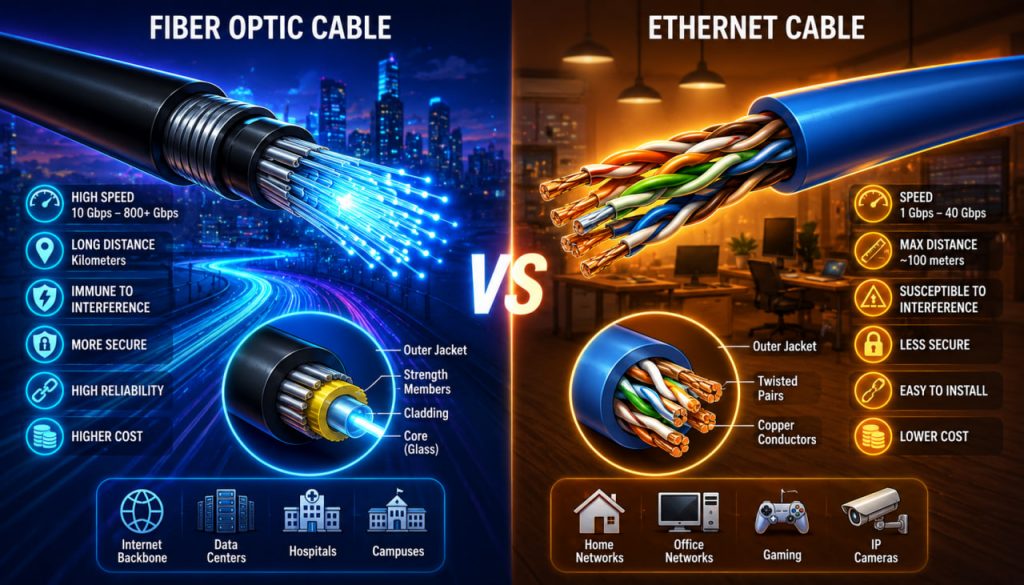
Modern internet and computer networks depend on reliable data transmission. Whether you’re streaming videos, playing online games, managing a data center, or connecting devices in an office, your network ultimately relies on cables to move information from one point to another.
The two most common types are fiber optic cables and Ethernet cables made from copper wiring. Although both serve the same general purpose, they transmit data in completely different ways and are designed for different environments.
Choosing the right cable depends on speed, distance, cost, reliability, and the specific requirements of your network.
What Is an Ethernet Cable?
An Ethernet cable is the most common network cable used in homes and offices.
Instead of light, it transmits data using electrical signals that travel through twisted pairs of copper wires.
The most familiar categories include:
- Cat5e
- Cat6
- Cat6a
- Cat7
- Cat8
Each newer category generally supports higher speeds, greater bandwidth, or better protection against electrical interference.
Because Ethernet cables are inexpensive, easy to install, and compatible with almost all networking equipment, they remain the standard choice for local area networks (LANs).
What Is a Fiber Optic Cable?
A fiber optic cable carries information using pulses of light rather than electricity.
Inside the cable are extremely thin strands of glass or specialized plastic called optical fibers.
Light travels through these fibers by a physical phenomenon known as total internal reflection, allowing data to move over very long distances with very little signal loss.
Unlike copper cables, fiber optics are immune to electromagnetic interference.
This makes them ideal for high-performance communication networks.
How Data Travels
The fundamental difference between the two technologies lies in the method of transmission.
Ethernet cable:
- Electrical signals
- Copper conductors
- Susceptible to electromagnetic interference
Fiber optic cable:
- Light pulses
- Glass or plastic fibers
- Immune to electrical interference
Because light travels with extremely low attenuation inside optical fibers, fiber can maintain high performance over distances that would be impossible for ordinary copper cables.
Speed Comparison
Both technologies have become remarkably fast.
Modern Ethernet standards support:
- 1 Gbps
- 2.5 Gbps
- 5 Gbps
- 10 Gbps
- 25 Gbps
- 40 Gbps (specialized environments)
Fiber optic networks can support:
- 10 Gbps
- 40 Gbps
- 100 Gbps
- 200 Gbps
- 400 Gbps
- 800 Gbps and beyond in advanced telecommunications and data centers
Although high-end copper technologies continue improving, fiber optics currently offer the highest practical bandwidth for long-distance and enterprise-scale networking.
Distance Makes a Huge Difference
Distance is where fiber truly excels.
Standard Ethernet cables are generally limited to about 100 meters (328 feet) for reliable operation under Ethernet standards.
Beyond this distance, signal quality degrades and additional networking equipment is required.
Fiber optic cables can transmit data over:
- Several hundred meters
- Several kilometers
- Tens of kilometers
- Hundreds or even thousands of kilometers using optical amplification and long-haul communication systems
This capability makes fiber the backbone of the global internet.
Resistance to Interference
Copper cables act like electrical conductors.
Nearby electrical equipment, motors, radio transmitters, or power lines may introduce electromagnetic interference (EMI).
Although modern Ethernet cables use twisted pairs and shielding to reduce interference, they cannot eliminate it completely.
Fiber optic cables carry only light.
As a result, they are naturally immune to:
- Electromagnetic interference
- Radio-frequency interference
- Lightning-induced electrical noise
- Ground loops
This makes fiber especially valuable in industrial environments and hospitals.
Durability and Security
Both cable types are durable when installed correctly, but they differ in important ways.
Fiber optic cables:
- Cannot conduct electricity
- Are difficult to tap without specialized equipment
- Do not create electromagnetic emissions that can be intercepted
Copper Ethernet cables:
- Are mechanically more flexible
- Usually tolerate tighter bends
- Can deliver electrical power through Power over Ethernet (PoE)
PoE allows devices such as surveillance cameras, wireless access points, and VoIP phones to receive both power and data through a single cable—something standard fiber cables cannot do.
Installation and Cost
Ethernet remains the more economical option for most home and office installations.
Advantages include:
- Lower cable costs
- Less expensive connectors
- Simpler installation
- Affordable networking equipment
Fiber installations often require:
- Precision connectors
- Specialized splicing tools
- Optical transceivers
- Greater installation expertise
Although fiber equipment has become much more affordable in recent years, total installation costs are still generally higher.
Where Each Cable Is Used
Ethernet cable is commonly used for:
- Home networks
- Office computers
- Gaming systems
- Smart TVs
- Security cameras
- Wi-Fi routers
Fiber optic cable is widely used for:
- Internet service provider backbone networks
- Data centers
- University campuses
- Hospital networks
- Telecommunications infrastructure
- Inter-building connections
Many organizations actually combine both technologies.
Fiber carries traffic between buildings or network switches, while Ethernet distributes connections to individual devices.
Which Cable Should You Choose?
There is no universal winner.
If you are wiring a typical home or small office, Ethernet is usually the most practical solution because it offers excellent performance, low cost, and straightforward installation.
If you require:
- Extremely high bandwidth
- Very long cable runs
- Maximum resistance to interference
- Future scalability
then fiber optics become the superior choice.
The best network designs often use fiber where its strengths matter most and copper Ethernet where simplicity and cost efficiency are priorities.
Expert Perspective
Computer scientist Robert Metcalfe, the inventor of Ethernet, helped establish the networking technology that still connects billions of devices worldwide. Although Ethernet originally relied exclusively on copper cabling, modern Ethernet standards also operate over fiber optics, allowing the same networking protocols to scale from small home networks to global data centers. Today, networking professionals view copper and fiber not as competing technologies but as complementary solutions, each optimized for different performance and deployment requirements.
Interesting Facts
- Light traveling through optical fiber can carry enormous amounts of information using multiple wavelengths simultaneously, a technique called wavelength-division multiplexing (WDM).
- The first commercial fiber optic communication systems appeared in the late 1970s.
- A single optical fiber is often thinner than a human hair.
- Most international internet traffic crosses oceans through submarine fiber optic cables rather than satellites.
- Ethernet’s standard maximum cable length of approximately 100 meters has remained largely unchanged for many common copper standards.
- Modern Power over Ethernet (PoE) can deliver enough power for devices such as IP cameras, wireless access points, and some digital displays using a single Ethernet cable.
Glossary
- Fiber Optic Cable — A cable that transmits data as pulses of light through thin glass or plastic fibers.
- Ethernet Cable — A network cable that carries data using electrical signals through copper conductors.
- Bandwidth — The maximum amount of data that can be transmitted over a connection in a given time.
- Gigabit per Second (Gbps) — A data transfer rate equal to one billion bits per second.
- Electromagnetic Interference (EMI) — Electrical noise that can disrupt electronic communication.
- Power over Ethernet (PoE) — A technology that delivers electrical power and network data through the same Ethernet cable.
- Optical Fiber — A transparent strand that guides light for communication.
- Attenuation — The gradual loss of signal strength as it travels through a transmission medium.
- Optical Transceiver — A device that converts electrical signals into optical signals and vice versa.
- Wavelength-Division Multiplexing (WDM) — A technology that increases fiber capacity by transmitting multiple wavelengths of light simultaneously.