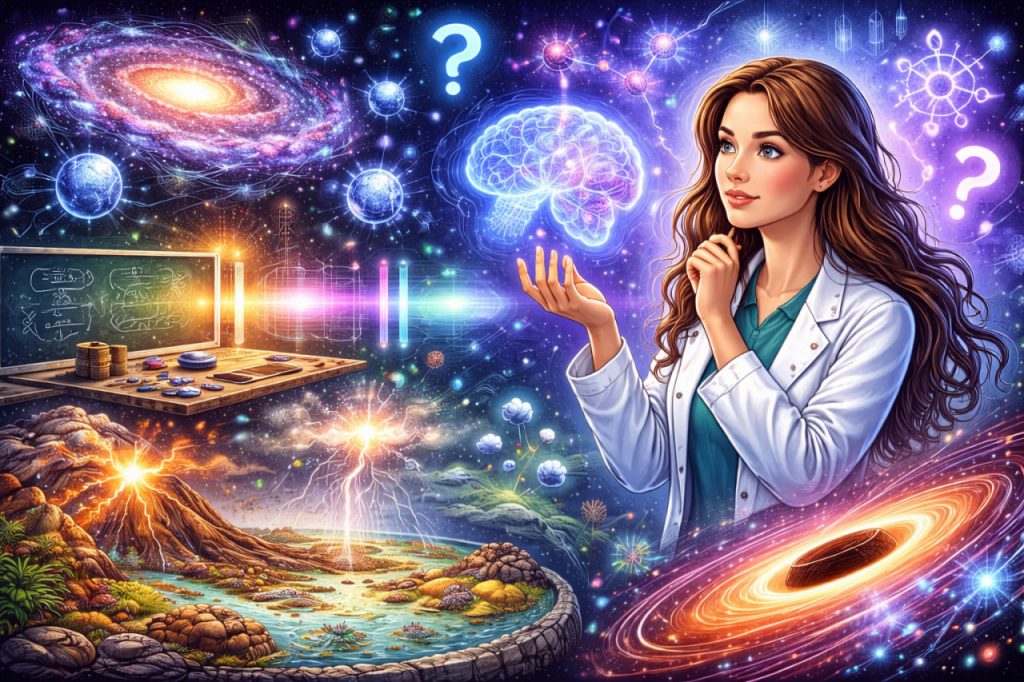
Despite extraordinary technological progress, modern science is still confronted with deep and unresolved questions about the nature of reality, life, and the Universe. These problems persist not because of a lack of intelligence or effort, but because they lie at the very limits of current knowledge and experimental capability. Many of these mysteries influence multiple scientific disciplines at once, linking physics, biology, chemistry, and philosophy. Solving them could radically transform our understanding of the world and unlock entirely new technologies. At the same time, these open questions remind us that science is an ongoing process rather than a finished body of knowledge. The unknown continues to drive discovery forward.
The Nature of Dark Matter and Dark Energy
One of the greatest mysteries in modern physics is the true nature of dark matter and dark energy, which together make up about 95% of the Universe. Dark matter appears to shape galaxies through gravity, yet it does not emit or absorb light. Dark energy, even more mysterious, drives the accelerated expansion of the Universe. Despite decades of observation, scientists still do not know what these components are made of. According to cosmologist Dr. Elena Foster:
“We can measure the effects of dark matter and dark energy with precision,
yet their fundamental nature remains completely unknown.”
This gap highlights how much of the Universe lies beyond direct observation.
Unifying Gravity With Quantum Mechanics
Another unresolved problem is the lack of a unified theory that connects general relativity and quantum mechanics. General relativity describes gravity and large-scale structures with extraordinary accuracy, while quantum mechanics governs particles at the smallest scales. However, the two frameworks are mathematically incompatible. Scientists continue to search for a theory of quantum gravity that can reconcile these approaches. This challenge becomes especially important in extreme environments such as black holes and the early Universe. A successful unification would reshape the foundations of physics.
The Origin of Life
The question of how life first emerged from non-living matter remains unanswered. While scientists understand many chemical building blocks of life, the transition from simple molecules to self-replicating systems is still unclear. Competing hypotheses involve deep-sea hydrothermal vents, shallow ponds, and extraterrestrial delivery of organic compounds. According to biochemist Dr. Marcus Hill:
“We know the ingredients of life,
but not the precise recipe that turned chemistry into biology.”
Understanding life’s origin would deepen insights into biology and guide the search for life beyond Earth.
Consciousness and the Mind
Consciousness is one of the most profound unresolved problems spanning neuroscience, psychology, and philosophy. While scientists can map brain activity and neural networks, how subjective experience arises from physical processes remains unknown. Questions about awareness, free will, and perception resist purely mechanical explanations. Researchers debate whether consciousness emerges from complexity alone or requires new theoretical frameworks. Solving this problem would redefine how humanity understands itself.
Limits of Knowledge and Future Discoveries
Modern science also grapples with questions about its own limits. Are there phenomena that cannot be experimentally tested or fully known? Technological constraints, ethical boundaries, and the scale of the Universe all impose limits on investigation. At the same time, history shows that many “unsolvable” problems eventually yield to new methods and ideas. Unsolved problems are not failures of science, but signposts pointing toward future revolutions.
Interesting Facts
- Dark matter was proposed because galaxies rotate too fast to be held together by visible matter alone.
- No experiment has yet directly detected a dark matter particle.
- The laws of physics work differently at cosmic and quantum scales.
- Consciousness has no universally accepted scientific definition.
- Many past scientific mysteries were solved only after new tools were invented.
Glossary
- Dark Matter — invisible matter inferred from gravitational effects in the Universe.
- Dark Energy — an unknown form of energy driving cosmic expansion.
- Quantum Gravity — a hypothetical theory unifying gravity and quantum mechanics.
- Consciousness — subjective awareness and experience of the mind.
- General Relativity — Einstein’s theory describing gravity as curved space-time.