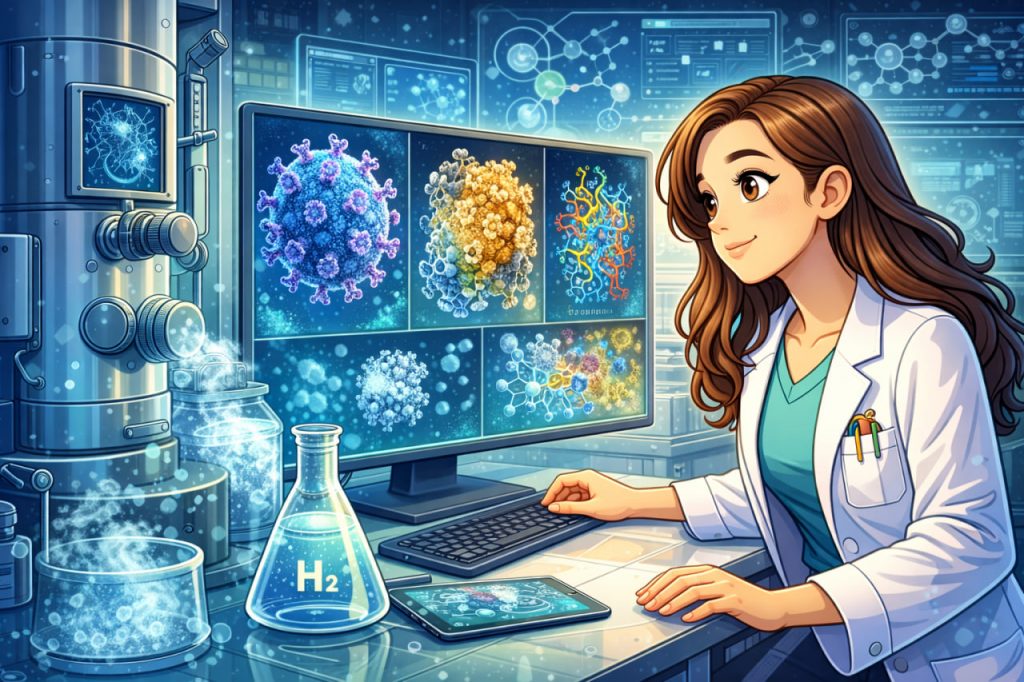
Cryo-electron microscopy, often called cryo-EM, is one of the most powerful imaging technologies in modern science, allowing researchers to visualize biological structures in extraordinary detail. Unlike traditional microscopy techniques, cryo-EM makes it possible to study molecules in a state that is extremely close to their natural environment. By rapidly freezing samples, scientists can preserve delicate biological structures without the need for chemical fixation or staining. This breakthrough has transformed structural biology, enabling discoveries that were impossible just a few decades ago. Cryo-EM plays a crucial role in understanding viruses, proteins, and cellular machinery at near-atomic resolution. Its impact on medicine, biology, and chemistry continues to grow rapidly.
What Is Cryo-Electron Microscopy
Cryo-electron microscopy is a technique in which biological samples are flash-frozen at extremely low temperatures and then imaged using a beam of electrons. Freezing occurs so rapidly that water forms a glass-like state rather than ice crystals, preserving the natural structure of molecules. The electron beam passes through the sample, creating images that capture fine structural details. Thousands or even millions of these images are computationally combined to reconstruct three-dimensional models. According to structural biologist Dr. Michael Anders:
“Cryo-EM allows us to observe biological machines
almost exactly as they exist inside living cells.”
This ability to preserve native structure is what sets cryo-EM apart from earlier methods.
Why Freezing Is So Important
The rapid freezing step is central to cryo-EM’s success. Biological molecules are extremely sensitive to radiation and environmental changes. Traditional preparation methods often distort or damage samples, leading to incomplete or misleading results. Cryogenic temperatures protect samples from radiation damage and lock molecules in place. This enables scientists to capture multiple structural states of the same molecule, offering insights into how biological processes actually work. Cryo-EM therefore reveals not just static shapes, but functional dynamics.
From Blurry Images to Atomic Models
Early electron microscopy struggled with image noise and low resolution. Advances in direct electron detectors, improved microscopes, and powerful computational algorithms revolutionized the field. Modern cryo-EM can now achieve resolutions fine enough to distinguish individual atoms in some cases. Image processing software aligns and averages vast datasets, filtering out noise and enhancing true structural signals. This computational component is just as important as the microscope itself, turning raw data into detailed molecular models.
Applications in Medicine and Biology
Cryo-EM has become indispensable in virology, drug discovery, and molecular biology. Scientists use it to visualize viruses, protein complexes, and membrane proteins that are difficult to study by other techniques. This has accelerated the understanding of how viruses enter cells and how drugs interact with their targets. Cryo-EM structures guide the design of more precise therapeutic strategies by revealing molecular interactions in detail. Importantly, the method does not require crystallization, which was a major limitation of older techniques.
Why Cryo-EM Changed Science
The impact of cryo-electron microscopy was so profound that it was recognized with the 2017 Nobel Prize in Chemistry. The technique reshaped structural biology by making high-resolution imaging accessible for a wide range of biological systems. Cryo-EM continues to evolve, with improvements in automation, artificial intelligence, and sample preparation. Its success demonstrates how combining physics, biology, and computation can unlock entirely new ways of observing life.
Interesting Facts
- Cryo-EM samples are cooled to about -196°C, the temperature of liquid nitrogen.
- The technique helped reveal the structure of many viruses and viral proteins.
- Cryo-EM does not require crystal formation, unlike X-ray crystallography.
- Modern cryo-EM relies heavily on advanced algorithms and AI.
- The field grew so rapidly that it is often called the “resolution revolution.”
Glossary
- Cryo-Electron Microscopy (Cryo-EM) — an imaging technique that studies frozen biological samples using electrons.
- Vitrification — ultra-fast freezing that prevents ice crystal formation.
- Electron Beam — a stream of electrons used to generate high-resolution images.
- Structural Biology — the study of the molecular structure of biological systems.
- Direct Electron Detector — a sensor that captures electron signals with high efficiency.