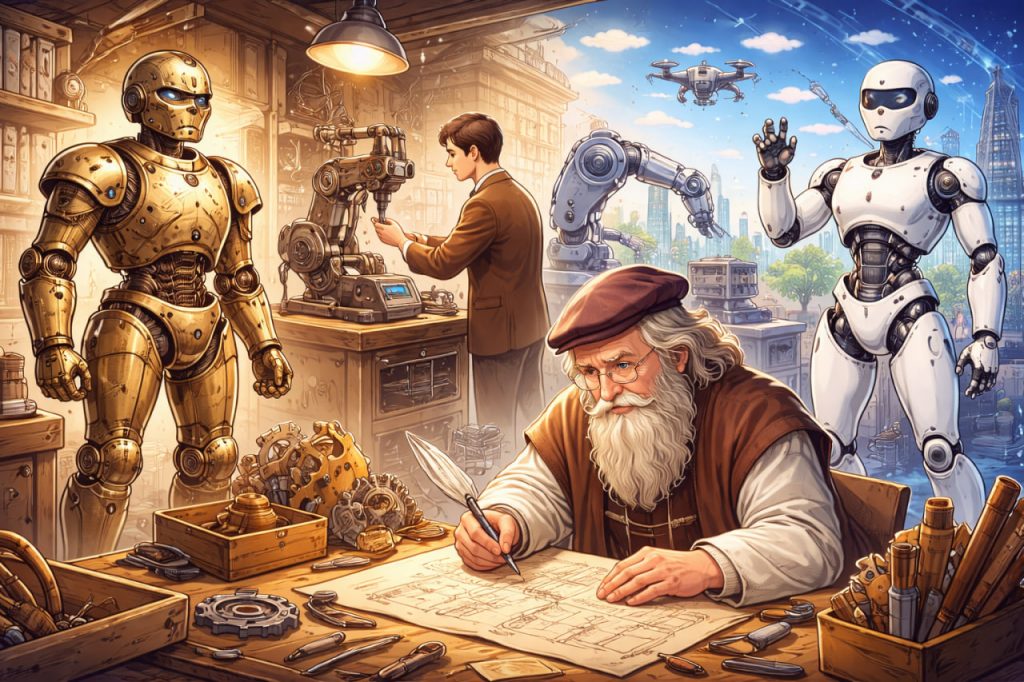
Robotics is often associated with futuristic technology, but its roots stretch deep into human history. Long before computers and artificial intelligence existed, people imagined and built mechanical devices that could imitate living beings or perform tasks automatically. Over centuries, these ideas evolved from simple mechanical toys into complex machines capable of perception, movement, and decision-making. The history of robotics reflects humanity’s desire to extend physical abilities, reduce labor, and explore the boundary between machines and life. Understanding this history helps explain how modern robots emerged and where the field may be heading next.
Ancient and Medieval Origins
The earliest concepts of robots appeared in ancient civilizations, where inventors created automata—self-operating mechanical devices powered by water, air, or weights. In ancient Greece, engineers like Hero of Alexandria described machines that could move, open doors, or perform simple actions automatically. These devices were not robots in the modern sense, but they demonstrated early understanding of mechanics and control systems. In the Middle Ages, similar mechanisms appeared in clocks, fountains, and religious displays across Europe and the Islamic world. These creations blended engineering with art and symbolism, laying the conceptual foundation for later developments.
Renaissance Innovation and Mechanical Thinking
During the Renaissance, interest in anatomy, mechanics, and mathematics fueled more advanced mechanical designs. One of the most famous examples is Leonardo da Vinci’s mechanical knight, a humanoid automaton designed to move its arms and head. Although never built in his lifetime, the design revealed a deep understanding of joints, gears, and coordinated motion. This period marked a shift from purely decorative automata toward machines inspired by the structure of the human body. Engineers began to think systematically about motion, balance, and control—key concepts in modern robotics.
The Industrial Age and Automation
The Industrial Revolution brought a major transformation in how machines were used. Automation moved from novelty to necessity, as factories sought efficiency and consistency. Mechanical looms, steam-powered machines, and assembly-line systems replaced manual labor in many industries. While these machines were not robots, they introduced the idea of programmable mechanical behavior, especially through devices like punch cards. This era established the link between machines and large-scale production, setting the stage for programmable automation.
The Birth of Modern Robotics
The word “robot” was first introduced in 1920 by Czech writer Karel Čapek, describing artificial workers in his play. However, real modern robotics began in the mid-20th century with the rise of electronics and computers. In the 1950s and 1960s, the first industrial robots were developed to perform repetitive tasks such as welding and assembly. These robots operated in controlled environments and followed predefined instructions. Engineer Dr. Alan Richards notes:
“The first true robots were not intelligent,
but they were reliable—and reliability changed industry forever.”
Industrial robots revolutionized manufacturing and demonstrated the practical value of robotic systems.
Robotics Meets Computing and AI
As computers became more powerful, robots gained the ability to process information and respond to their environment. Sensors allowed machines to detect position, pressure, light, and sound. Software enabled decision-making and adaptive behavior. In the late 20th century, robotics expanded into research labs, medicine, and space exploration. Robots were sent to other planets, used in surgery, and designed to assist humans rather than replace them. This period marked the beginning of intelligent robotics, where machines could learn, adapt, and collaborate.
Robots in the Modern World
Today, robots are part of everyday life, even when they are not easily recognizable. They operate in factories, hospitals, warehouses, homes, and laboratories. Some robots are humanoid, while others are specialized tools designed for specific tasks. Advances in artificial intelligence, machine learning, and materials science continue to expand what robots can do. Modern robotics focuses not only on efficiency, but also on safety, ethics, and human–machine interaction.
The Future Shaped by the Past
The history of robotics shows a steady progression from imagination to engineering reality. Each era built upon earlier ideas, refining mechanisms, control, and intelligence. Future robots will likely become more autonomous, adaptable, and integrated into daily life. By studying the past, engineers and scientists gain insight into how innovation evolves and how human values shape technological progress.
Interesting Facts
- The idea of self-moving machines is over 2,000 years old.
- The first industrial robots appeared in factories in the 1960s.
- The term “robot” comes from a word meaning forced labor.
- Some early robots were controlled using punch cards.
- Space exploration relies heavily on robotic systems.
Glossary
- Robot — a machine capable of carrying out tasks automatically.
- Automaton — an early self-operating mechanical device.
- Industrial Robot — a programmable machine used in manufacturing.
- Artificial Intelligence — computer systems that perform tasks requiring human-like reasoning.
- Automation — the use of machines to perform tasks with minimal human intervention.