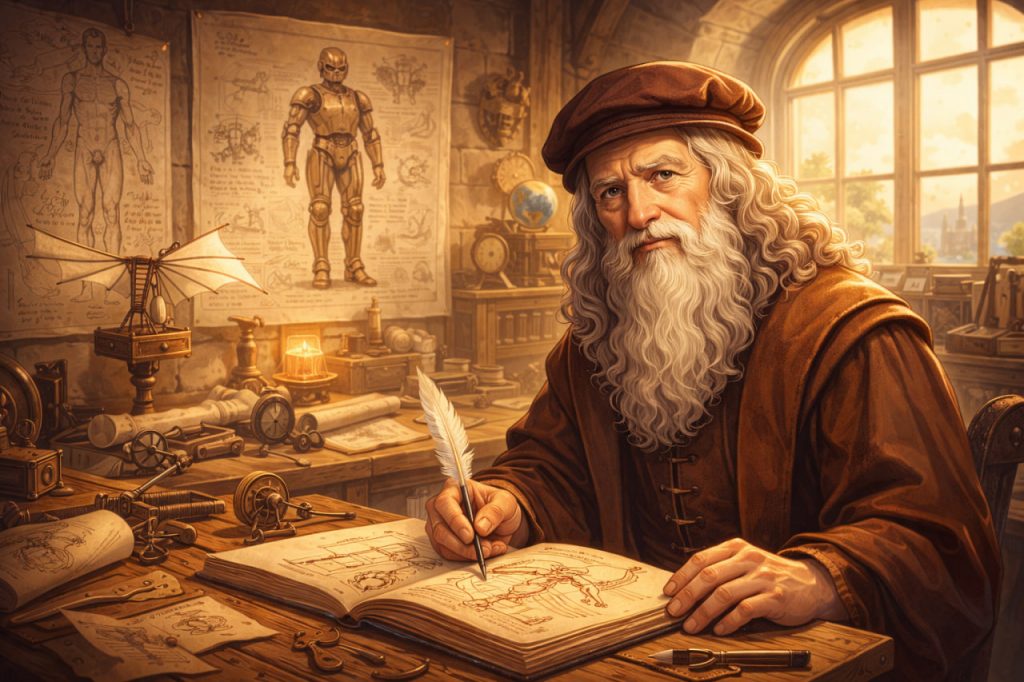
Leonardo da Vinci is widely regarded as one of the most extraordinary minds in human history, a figure whose influence extends far beyond art alone. Living during the Renaissance, he embodied the ideal of the universal genius, mastering painting, anatomy, engineering, architecture, and natural science. Leonardo approached the world with relentless curiosity, believing that direct observation and experimentation were the keys to understanding reality. His notebooks reveal a mind constantly questioning how nature works, how the human body moves, and how machines could imitate life. Even centuries after his death, Leonardo remains a symbol of the limitless potential of human creativity and intellect.
Early Life and Formation of a Genius
Leonardo was born in 1452 in the small town of Vinci in Italy. As an illegitimate child, he did not receive a formal classical education, but this limitation became an advantage rather than an obstacle. Free from rigid academic traditions, Leonardo developed an independent way of thinking based on observation and experimentation. He was apprenticed to the Florentine artist Andrea del Verrocchio, where he learned painting, sculpture, mechanics, and materials science. This environment nurtured his multidisciplinary interests and laid the foundation for his future achievements. From an early age, Leonardo showed an exceptional ability to combine artistic skill with scientific curiosity.
Art as a Science
Leonardo did not see art as separate from science. For him, painting was a method of investigation, a way to understand light, anatomy, perspective, and emotion. His most famous works demonstrate extraordinary realism and psychological depth, achieved through careful study of human expression and natural phenomena. Techniques such as sfumato, which creates soft transitions between colors and tones, allowed Leonardo to depict lifelike forms with unprecedented subtlety. He believed that a painter must understand the internal structure of the body to represent it accurately, which led him to conduct detailed anatomical studies rarely attempted by artists of his time.
Anatomy and the Study of the Human Body
Leonardo’s anatomical drawings are among the most precise and insightful studies produced before modern medicine. He dissected human corpses to understand muscles, bones, organs, and circulation, recording his observations in detailed sketches accompanied by notes. These studies were not only artistic references but scientific investigations. Leonardo sought to understand how the body functioned as a mechanical system, with muscles acting as levers and joints as pivots. Many of his discoveries anticipated later scientific findings, although they remained unpublished during his lifetime and therefore unknown to contemporaries.
Engineering and Mechanical Imagination
Beyond art and anatomy, Leonardo was a visionary engineer. He designed flying machines, armored vehicles, bridges, hydraulic systems, and mechanical automata. His concepts were often far ahead of the available technology, making many of them impossible to build at the time. Nevertheless, they reveal a deep understanding of physics, mechanics, and materials. Leonardo’s designs were not random inventions; they were carefully reasoned solutions based on natural principles. His Mechanical Knight, flying devices, and studies of gears and motion are now considered early foundations of robotics and mechanical engineering.
Nature, Observation, and Scientific Method
Leonardo believed that nature followed universal laws that could be discovered through observation. He studied water flow, cloud formation, plant growth, and geology with the same intensity he applied to art. Unlike many scholars of his era, he relied less on ancient texts and more on direct experience. This empirical approach aligns closely with what would later become the scientific method. Leonardo’s notebooks show experiments, hypotheses, corrections, and revisions, reflecting a dynamic and self-critical intellect constantly refining its understanding of the world.
Notebooks and the Hidden Legacy
Much of Leonardo’s genius remained hidden during his lifetime. He filled thousands of pages with sketches and mirror-written notes, recording ideas across multiple disciplines. These notebooks were not organized for publication, but served as personal tools for thinking and exploration. After his death, many of these writings were scattered or lost, delaying recognition of his scientific contributions. Today, surviving notebooks are considered priceless documents that offer direct insight into the workings of an extraordinary mind.
Influence and Lasting Impact
Leonardo da Vinci’s influence extends across centuries and disciplines. Artists study his techniques, scientists admire his observational rigor, and engineers draw inspiration from his mechanical imagination. He represents a model of integrated thinking, where art and science reinforce each other rather than compete. In a modern world often divided into narrow specializations, Leonardo’s life reminds us of the power of curiosity, interdisciplinary learning, and creative freedom.
Interesting Facts
- Leonardo wrote most of his notes using mirror writing, readable only with a mirror.
- He designed flying machines 400 years before aviation became possible.
- Many of his scientific discoveries were unknown during his lifetime.
- Leonardo believed that experience was more important than theory.
- Fewer than 20 paintings are confidently attributed to him today.
Glossary
- Renaissance — a cultural period marked by renewed interest in art, science, and human potential.
- Polymath — a person with expertise in many different fields.
- Sfumato — a painting technique using soft transitions between colors.
- Anatomical Study — the scientific examination of the structure of the human body.
- Empirical Observation — knowledge gained through direct experience and experimentation.