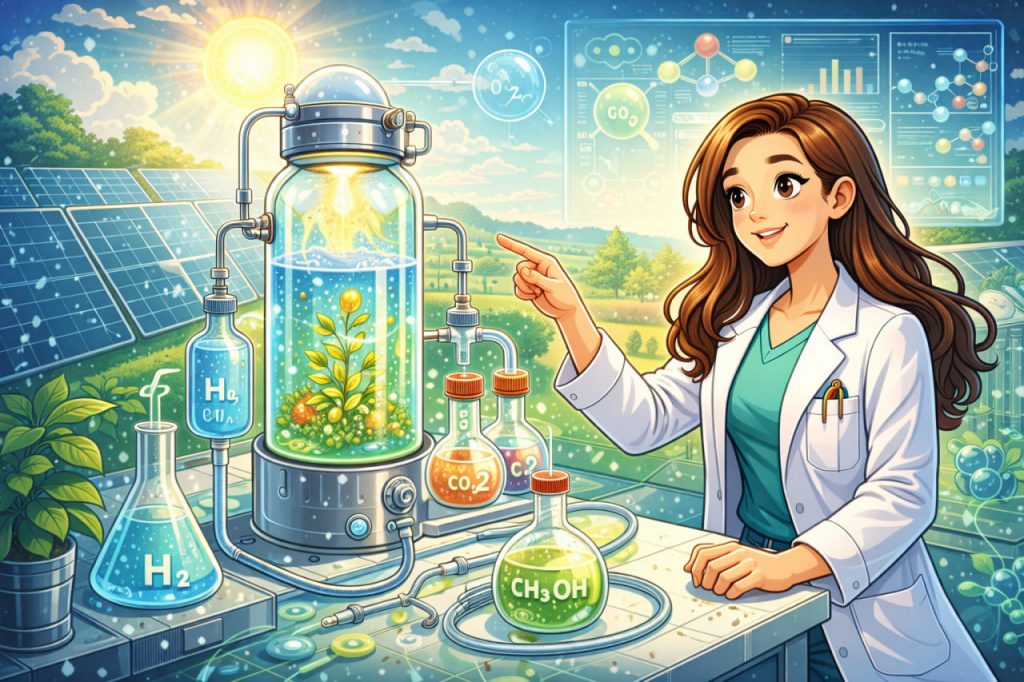
Artificial photosynthesis is a cutting-edge scientific concept that seeks to replicate one of nature’s most powerful processes: the conversion of sunlight, water, and carbon dioxide into usable energy. In natural photosynthesis, plants transform solar energy into chemical bonds that sustain life on Earth. Scientists aim to imitate and improve this process using advanced materials, catalysts, and engineering systems. The goal is to produce clean fuels and valuable chemicals while reducing carbon emissions. Artificial photosynthesis represents a bridge between renewable energy, chemistry, and environmental sustainability. Understanding this technology reveals why it is considered a potential cornerstone of a future low-carbon economy.
How Natural Photosynthesis Inspires Technology
Natural photosynthesis occurs in plants, algae, and some bacteria through a highly efficient sequence of light-driven reactions. Pigments absorb sunlight, water molecules are split, and carbon dioxide is converted into energy-rich compounds. Artificial photosynthesis systems mimic these steps using light absorbers, catalysts, and reaction chambers. According to chemical physicist Dr. Amelia Carter:
“Nature provides the blueprint.
Artificial photosynthesis is about translating that blueprint into durable and scalable technology.”
While artificial systems are not yet as efficient as biological ones, they offer greater control and adaptability.
Core Components of Artificial Photosynthesis
An artificial photosynthesis system typically consists of three main elements: a light-harvesting unit, a catalyst for water splitting, and a catalyst for carbon dioxide reduction. The light-harvesting component captures solar energy, while catalysts drive chemical reactions that store this energy in molecular form. Water splitting produces hydrogen and oxygen, and carbon dioxide reduction can yield fuels such as methanol or carbon monoxide. These fuels store solar energy in a transportable and storable form. Designing stable and efficient catalysts remains one of the central scientific challenges.
Solar Fuels and Energy Storage
One of the greatest advantages of artificial photosynthesis is its ability to create solar fuels. Unlike electricity, which must be used immediately or stored in batteries, chemical fuels can be stored long-term and transported easily. Hydrogen produced through artificial photosynthesis can serve as a clean energy carrier, while carbon-based fuels may integrate with existing infrastructure. This approach addresses one of the main limitations of renewable energy: intermittency. Solar fuels provide a way to store sunlight captured during the day for use at any time.
Environmental and Climate Benefits
Artificial photosynthesis offers significant potential benefits for climate mitigation. By using carbon dioxide as a raw material, these systems could help reduce greenhouse gas concentrations while producing useful energy carriers. Unlike fossil fuels, artificial photosynthesis relies on sunlight and abundant raw materials. Researchers emphasize that the overall environmental impact depends on system efficiency, material sustainability, and scalability. If developed responsibly, artificial photosynthesis could complement solar panels, wind energy, and other renewable technologies.
Challenges and Future Outlook
Despite its promise, artificial photosynthesis faces major scientific and engineering hurdles. Current systems often require rare or expensive materials, and long-term stability remains a concern. Scaling laboratory prototypes into industrial-scale solutions is another significant challenge. Nevertheless, rapid advances in nanotechnology, materials science, and computational modeling continue to accelerate progress. Many experts view artificial photosynthesis as a long-term solution with transformative potential rather than a short-term replacement for existing energy systems.
Interesting Facts
- Natural photosynthesis inspired scientists more than 100 years ago to study solar chemistry.
- Artificial photosynthesis can produce hydrogen directly from sunlight and water.
- Some experimental systems use nanostructured catalysts to increase efficiency.
- Solar fuels can store energy for months or even years.
- Artificial photosynthesis combines principles from physics, chemistry, and biology.
Glossary
- Artificial Photosynthesis — a technology that mimics natural photosynthesis to produce energy-rich chemicals.
- Catalyst — a substance that accelerates a chemical reaction without being consumed.
- Solar Fuel — a chemical fuel produced using energy from sunlight.
- Water Splitting — a reaction that separates water into hydrogen and oxygen.
- Carbon Dioxide Reduction — chemical conversion of CO₂ into energy-containing molecules.