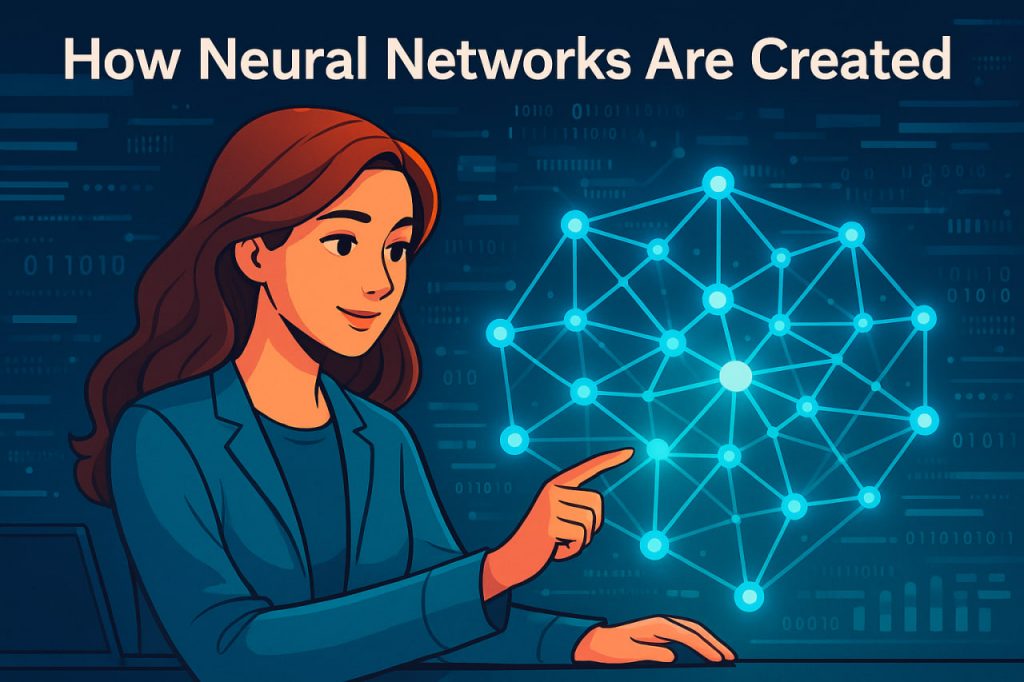
Neural networks are at the heart of modern artificial intelligence (AI), powering everything from voice assistants and facial recognition to medical diagnostics and self-driving cars. These complex systems are inspired by the human brain and designed to recognize patterns, make predictions, and learn from experience. While the concept may sound futuristic, the creation of neural networks is rooted in mathematics, data, and programming. Understanding how they are built helps us grasp how machines are learning to think, adapt, and even create—reshaping technology and human life in the process.
The Inspiration: The Human Brain
Neural networks are modeled after the structure and function of the human brain. The brain contains billions of nerve cells, or neurons, which communicate with one another through electrical signals. Similarly, an artificial neural network (ANN) consists of interconnected nodes—digital “neurons”—that process information. Each node receives input, performs a simple computation, and passes its output to other nodes in the network. Over time, these networks learn by adjusting the weights of the connections between nodes, improving their accuracy and decision-making ability. As AI researcher Dr. Laura Chen explains, “Artificial neural networks mimic the way humans learn from experience—through trial, error, and adaptation.”
The Building Blocks of Neural Networks
The structure of a neural network is composed of three main layers:
- Input Layer — Receives raw data, such as images, text, or sound.
- Hidden Layers — Perform complex calculations and pattern recognition using mathematical transformations.
- Output Layer — Produces the final prediction or classification result, such as identifying a cat in a photo.
Each connection between nodes carries a numerical value known as a weight, which determines the importance of that signal. The network adjusts these weights during training to minimize errors. The more layers and nodes a network has, the more complex and capable it becomes—a design known as deep learning.
The Training Process: Teaching Machines to Learn
Creating a neural network is only the beginning; teaching it to think requires vast amounts of data and computational power. The training process typically involves three main steps:
- Data Collection — The network needs thousands or even millions of examples to learn from. For instance, to recognize faces, it must analyze countless photos labeled as “face” or “not face.”
- Forward Propagation — Data flows through the network, generating an initial output.
- Backpropagation — The system compares its output to the correct answer, calculates the error, and adjusts the weights to reduce future mistakes.
This process repeats thousands of times until the network can make accurate predictions on new, unseen data. Machine learning engineer Dr. Ethan Morales explains, “A neural network learns by failing repeatedly—and that’s its greatest strength. Each mistake brings it closer to perfection.”
Types of Neural Networks
Different kinds of neural networks are designed for different tasks:
- Feedforward Neural Networks (FNN) — The simplest type, where data moves in one direction from input to output.
- Convolutional Neural Networks (CNN) — Specialized for image and video analysis; used in facial recognition and autonomous vehicles.
- Recurrent Neural Networks (RNN) — Designed to process sequential data, such as speech, text, and music.
- Generative Adversarial Networks (GANs) — Capable of creating new content, such as realistic images, music, or art.
Each type uses the same underlying principles but differs in how data is processed, remembered, or generated. These variations allow neural networks to mimic not just perception, but creativity and reasoning as well.
Challenges in Creating Neural Networks
Building and training neural networks is a demanding process that requires significant resources. Training large models can consume enormous amounts of energy and data, raising environmental and ethical concerns. Another challenge is bias—if a network is trained on biased data, it can produce unfair or inaccurate results. Moreover, the “black box” nature of neural networks makes it difficult to explain how they arrive at certain decisions. AI ethicist Dr. Priya Ahmed warns, “We must build AI systems that are transparent and accountable, not just intelligent. Understanding how neural networks make decisions is vital to ensuring fairness and trust.”
The Future of Neural Network Development
As technology advances, neural networks are becoming faster, more efficient, and more capable of understanding complex information. Researchers are developing quantum neural networks that use quantum computing principles to process vast amounts of data simultaneously. Others are working on neuromorphic chips that physically mimic brain cells to make AI more energy-efficient. These innovations may soon enable AI systems that can learn and adapt with minimal human supervision, opening new frontiers in science, art, and medicine. The creation of neural networks is not just a technical achievement—it is a step toward understanding intelligence itself.
Interesting Facts
- The first artificial neuron model, called the Perceptron, was created in 1958 by psychologist Frank Rosenblatt.
- A single large AI model today can have billions of parameters, making it more complex than the human brain in terms of connections.
- Neural networks can now generate realistic human speech, write poetry, and even paint digital artworks.
- The human brain still outperforms AI in creativity and emotional understanding.
- AI training often relies on powerful GPUs (graphics processing units) originally designed for video games.
Glossary
- Neuron — A basic unit in both the human brain and neural networks that processes and transmits information.
- Weight — A numerical value that determines the strength of a connection between neurons.
- Backpropagation — A training method where the network adjusts its parameters to reduce prediction errors.
- Deep learning — A subset of AI involving neural networks with multiple hidden layers for complex pattern recognition.
- Bias — An unintended prejudice in AI systems resulting from skewed or incomplete training data.