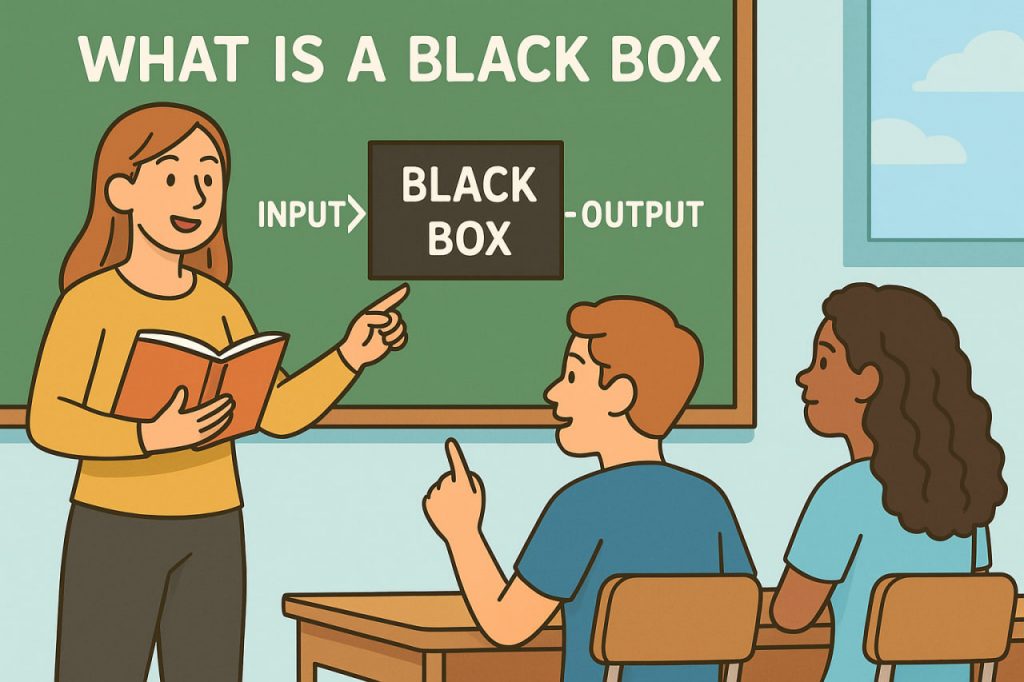
A black box is a system or process that can be observed from the outside, but its internal workings are hidden or not easily understood. You can see what goes in and what comes out, but you cannot clearly explain how the result was produced. This concept is used in many fields, including computer science, artificial intelligence, engineering, and even psychology. In modern technology, black box systems often appear when algorithms become too complex for humans to interpret step by step. Understanding the idea of a black box is important because it affects how we trust, evaluate, and control the tools we use every day.
How Black Boxes Work
A black box receives input, processes it internally, and produces an output. The internal process might be hidden intentionally or simply too complex to explain easily. For example, a smartphone’s facial recognition system takes a picture of your face and unlocks the phone if it matches its stored data. You see the input and the output, but the exact pattern-matching process is deeply complex and not visible to the user. This makes black boxes efficient and powerful, but also difficult to analyze. As a result, they can be difficult to troubleshoot and may require expert knowledge to understand or improve.
Black Boxes in Artificial Intelligence
In artificial intelligence, especially in neural networks, black boxes are common because the system learns patterns based on large amounts of data. These models can identify faces, translate languages, or recommend products, yet the reasoning behind their decisions is not always directly interpretable. Researchers and developers often use explainable AI methods to better understand how these systems make decisions. However, full transparency is not always possible due to complexity. Because of this, people who work with AI are careful to test models thoroughly, monitor performance, and avoid relying on results without proper evaluation.
Why Black Boxes Can Be Useful
Even though black boxes may lack transparency, they are often extremely effective. Many technologies that rely on black box structures perform tasks faster and more accurately than systems designed for clarity. For example, machine learning models for medical imaging can detect subtle patterns that are difficult for humans to see. Engineers and scientists sometimes accept a lack of explanation if the results are consistently reliable and safe. However, when dealing with critical decisions—such as medical treatment or legal evaluation—experts emphasize the importance of human oversight.
Interesting Facts
- The term “black box” originally came from aviation, referring to flight recorders that were sealed during operation.
- Some black box AI systems can achieve better accuracy than human experts in tasks like image detection.
- Researchers are developing “explainable AI” tools to make complex systems more transparent.
Glossary
- Black Box – A system whose internal workings cannot be directly observed or explained.
- Neural Network – A type of artificial intelligence inspired by the brain that learns patterns through data.
- Explainable AI – Methods used to make complex models more understandable to humans.
- Input/Output – Information entering and leaving a system during operation.