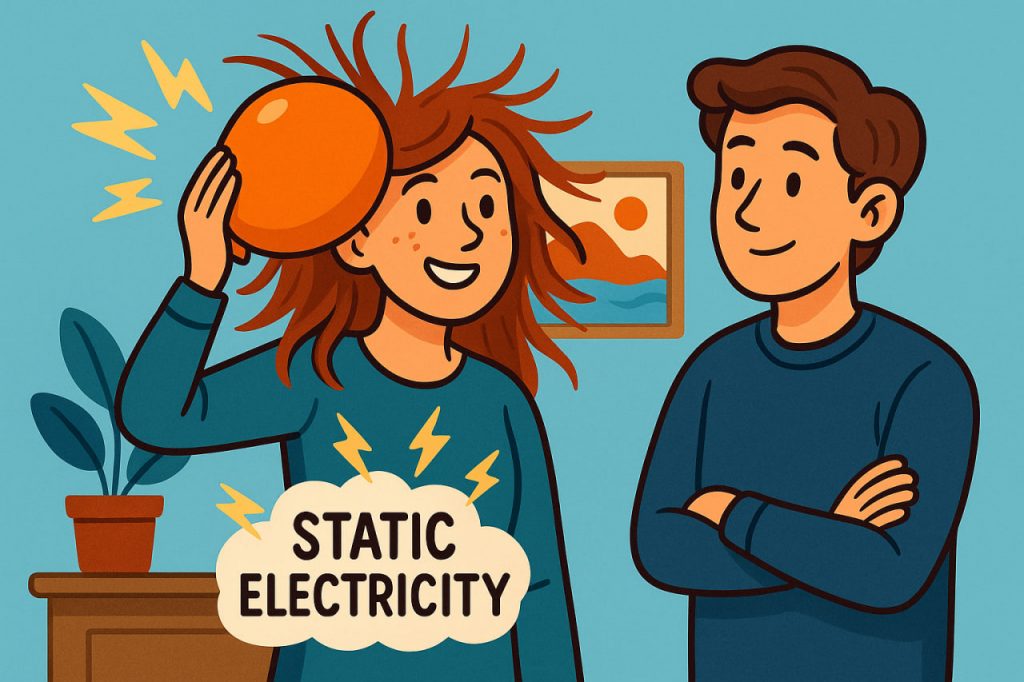
Static electricity is a form of electrical energy that builds up on the surface of objects due to an imbalance of charges. Unlike the steady flow of electricity in wires, static electricity occurs when electrons move from one material to another, creating either a positive or negative electrical charge. This effect can be observed in everyday life, such as when hair stands up after rubbing it with a balloon or when you feel a small shock after touching a metal doorknob. The buildup usually occurs in dry environments where electrons transfer more easily, making winter months a common time to notice static effects. While static electricity might seem simple, it plays an important role in physics and technology. Understanding how it works helps explain lightning, photocopiers, and even some industrial machinery.
What Causes Static Electricity?
Static electricity is caused by the transfer of electrons between materials that come into contact. Different materials have varying tendencies to gain or lose electrons, a concept known as the triboelectric effect. When two materials rub against one another, electrons may move from one object to the other, leaving one positively charged and the other negatively charged. Because charged particles naturally seek balance, the charge will remain in place until it is released, usually when the charged object touches a conductor. According to physicist Dr. Karen Blake, small everyday static discharges are harmless, but the same principles can lead to powerful natural phenomena like lightning when the charge buildup occurs on a massive scale in clouds.
Everyday Examples and Applications
Static electricity appears in many common situations. For instance, clothes can cling together after being dried in a machine because fabrics rub against one another, transferring electrons. Balloons rubbed on hair stick to walls because the balloon becomes charged and attracts neutral surfaces. In industrial settings, static electricity must be carefully managed, since a spark in environments with flammable gases or dust can pose risks. On the positive side, static principles are used in technologies like photocopiers, where charged toner particles are attracted to specific parts of a page to create text and images.
Safety and Environmental Considerations
While everyday static electricity is usually mild, it requires caution in certain contexts. Large electrical discharges, such as lightning, can be extremely dangerous. Indoor environments with electronic equipment often use grounding and humidity control to prevent harmful jolts that could damage circuits. In scenarios where static may ignite flammable substances, workers wear grounding straps or antistatic clothing to reduce charge buildup. People should consult trained professionals in any situation involving high voltage or industrial environments to ensure proper safety.
Interesting Facts
Lightning is one of the most powerful examples of static electricity on Earth.
Rubbing amber with fur to produce static charge was documented as early as ancient Greece.
Some printers and air purifiers use static charge to attract and trap dust particles.
Glossary
- Triboelectric Effect — The process of charge transfer when two objects are rubbed together.
- Conductor — A material that allows electrical charges to move freely.
- Discharge — The release of built-up electrical energy, often seen as a spark.
- Grounding — The process of safely transferring electrical charge into the Earth to prevent static buildup.