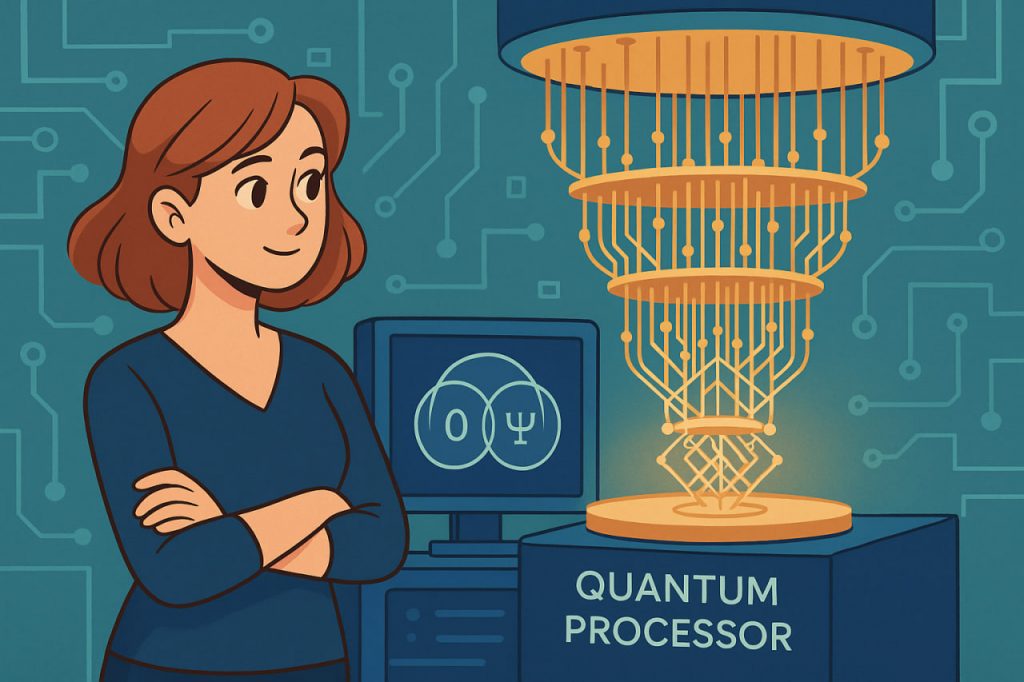
Quantum processors represent one of the most revolutionary advancements in modern computing, offering capabilities far beyond those of classical processors. Instead of using traditional bits that store information as 0 or 1, quantum processors use qubits, which can exist in multiple states simultaneously through a phenomenon known as superposition. This allows quantum computers to process massive amounts of data in parallel, solve complex problems more efficiently, and tackle challenges that classical systems cannot handle within a realistic timeframe. Quantum processors hold the potential to transform cryptography, materials science, artificial intelligence, climate modeling, and pharmaceutical development. Their power comes from the fundamental laws of quantum mechanics, where particles behave in unpredictable yet mathematically precise ways.
The field of quantum computing is still in its early stages, but rapid progress has brought the world closer to practical quantum systems. Companies and research institutions are racing to build stable qubits, reduce error rates, and scale processors to usable sizes. While quantum processors are not ready to replace everyday computers, they are expected to become essential tools for industries that rely on large-scale calculations and high-precision modeling.
How Quantum Processors Work
Quantum processors rely on three key principles of quantum physics:
- Superposition — qubits can be simultaneously 0 and 1, dramatically increasing computational power.
- Entanglement — qubits become linked, allowing instantaneous correlation of states.
- Quantum interference — enhances correct computational pathways and cancels incorrect ones.
These properties allow quantum processors to explore multiple solutions at once, making them extremely powerful for tasks such as factorization, optimization, and simulation. According to quantum engineer Dr. Samuel Richter:
“A quantum processor does not compute faster —
it computes in a fundamentally different universe of possibilities.”
This difference gives quantum systems unique advantages over classical hardware.
Types of Quantum Processors
Several competing technologies are used to build qubits:
- Superconducting qubits — used by IBM and Google; fast and scalable but require ultra-cold temperatures.
- Trapped ions — extremely stable qubits manipulated by lasers; slower but more precise.
- Photonic qubits — based on particles of light; promising for long-distance quantum networks.
- Topological qubits — a theoretical approach aiming for naturally error-resistant qubits.
Each type has strengths and weaknesses, and researchers continue exploring hybrid models to improve performance.
Applications of Quantum Processors
Quantum processors will not replace classical CPUs; instead, they will complement them by solving specialized tasks, including:
- Drug discovery through molecular simulation
- Predicting chemical reactions with high accuracy
- Optimizing logistics for transportation and energy grids
- Designing advanced materials, such as superconductors
- Breaking or replacing encryption methods
- Climate modeling beyond classical computing capabilities
- Enhancing artificial intelligence, especially optimization algorithms
These applications demonstrate why many governments and industries view quantum computing as a strategic priority.
Challenges and Limitations
Despite their promise, quantum processors face significant challenges:
- Qubit instability — qubits are extremely sensitive to noise and temperature.
- High error rates — quantum calculations require error-correction systems far more complex than classical ones.
- Cryogenic requirements — many quantum processors must operate near absolute zero.
- Scalability issues — building large, reliable processors is technologically demanding.
Overcoming these challenges is crucial for quantum computers to become practical tools.
The Future of Quantum Processing
Researchers foresee a future where quantum processors work alongside classical computers, forming hybrid systems that combine the strengths of both technologies. As error-correction improves and qubit numbers grow, quantum processors will move from experimental labs to industrial and commercial use. They may one day handle global-scale simulations, unlock new scientific discoveries, and create technologies previously thought impossible.
Interesting Facts
- A qubit can represent 0 and 1 at the same time, unlike a classical bit.
- Google’s quantum processor Sycamore performed a task in 200 seconds that would take classical supercomputers thousands of years.
- Quantum entanglement was famously described by Einstein as “spooky action at a distance.”
- Some quantum processors must operate at –273°C, just above absolute zero.
- Quantum computers could help discover new medicines by simulating molecular behavior precisely.
Glossary
- Qubit — the basic unit of quantum information capable of existing in multiple states.
- Superposition — the ability of a qubit to be in several states simultaneously.
- Entanglement — a quantum connection between particles that links their behavior.
- Error Correction — systems that protect quantum computations from environmental noise.
- Quantum Advantage — the point at which quantum processors outperform classical computers.