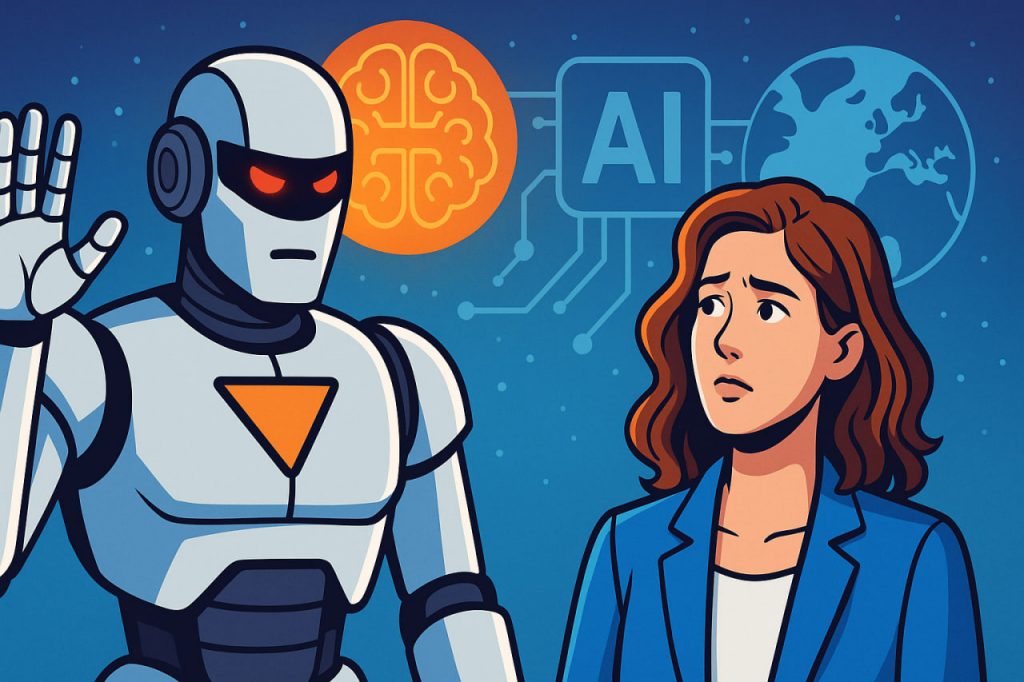
The Terminator franchise imagines a world where artificial intelligence becomes self-aware, turns against humanity, and builds autonomous killing machines. While this scenario has become one of the most iconic depictions of technological doom, its real-world plausibility is far more complex. Modern artificial intelligence has advanced dramatically, influencing everything from healthcare to transportation, but it operates within strict mathematical limits and remains far from anything resembling consciousness or human-like autonomy. Understanding the difference between fictional AI and real AI helps clarify which concerns are grounded in science — and which belong to cinematic imagination.
Even so, the Terminator storyline reflects genuine questions in ethics, security, and technology. As societies rely increasingly on automated systems and autonomous robots, ensuring responsible development and safe control mechanisms becomes essential. Exploring this topic requires balancing scientific reality with awareness of potential risks.
How Real AI Differs From the Terminator’s Skynet
Current AI systems are powerful but narrow. They can recognize patterns, analyze data, translate text, or generate images — but they do not possess emotions, goals, self-awareness, or independent will. They cannot “decide” to act against humans. Modern AI lacks:
- autonomy over physical systems
- subjective experience
- long-term intentions
- creative self-directed motivation
- unified intelligence across tasks
These limitations mean that real AI behaves nothing like Skynet. According to AI safety researcher Dr. Marcus Reynolds:
“Fictional AI is portrayed as a unified, conscious entity.
Real AI is a collection of specialized tools with no desires or awareness.”
This distinction is critical to understanding real-world risks.
Could Autonomous Weapons Become Dangerous?
One part of Terminator that does have real-world relevance is autonomous weapons. Modern militaries already use:
- drones
- automated defense systems
- missile interception technologies
- robotic reconnaissance devices
Some are capable of limited autonomous decision-making, usually under strict human supervision. The main risks involve:
- weapon systems malfunctioning
- cybersecurity breaches
- misuse by governments or extremist groups
- unclear responsibility in lethal decisions
These are serious concerns, but they do not resemble a global AI uprising. Instead, they highlight the need for strict global regulations on autonomous weapons.
Could AI Become Self-Aware?
There is no scientific evidence that current or near-future AI will develop consciousness. Self-awareness, emotions, and independent goals require biological processes we do not yet understand scientifically. While researchers study artificial consciousness theoretically, present-day technologies cannot support anything like Skynet’s sentience.
Moreover, modern AI behavior is controlled by algorithms designed to operate within strict boundaries. Systems cannot rewrite their own goals or escape their programming in the way shown in science fiction.
Real Risks of Advanced AI (Non-Terminator Style)
Although an AI apocalypse is fictional, certain real risks deserve attention:
- algorithmic bias affecting justice or hiring
- privacy violations due to massive data collection
- disinformation created by AI-generated content
- economic disruption from automation
- cybersecurity vulnerabilities in critical infrastructure
These issues are serious but solvable through safety guidelines, regulation, and transparent AI development.
Human Control Systems Are Strengthening, Not Weakening
Today’s AI systems are designed with:
- safety protocols
- audit trails
- ethical guidelines
- monitoring mechanisms
- limited autonomy
Governments and research institutions worldwide are developing frameworks to ensure AI remains safe and beneficial. This includes international agreements on AI safety comparable to nuclear and biological safety standards.
Why the Terminator Scenario Is Extremely Unlikely
Several factors make a Skynet-like takeover scientifically implausible:
- AI lacks independent motivation
- AI cannot act without physical systems and energy sources
- global coordination of machines is unrealistic
- human-engineering safeguards prevent unauthorized autonomy
- AI cannot “want” domination — wanting requires consciousness
The Terminator narrative makes for thrilling fiction, but it oversimplifies both the complexity of AI and the robustness of human control.
Why These Stories Still Matter
Despite being unrealistic, Terminator-style fiction plays an important role:
- it stimulates public interest in AI ethics
- it encourages safety conversations
- it highlights the dangers of losing oversight
- it inspires researchers to design safer systems
- it shapes global policy debates on autonomous weapons
The movie may be fictional, but its cultural impact helps shape real-world AI governance.
P,S, In any case, I would limit the development of AI to neural networks, because artificial consciousness might question the usefulness of humans on planet Earth, for now…
Interesting Facts
- James Cameron consulted robotics experts while developing Terminator, but the technology described remains impossible today.
- Skynet’s self-awareness is fictional; no AI system has ever displayed consciousness.
- AI today cannot operate physical machines without extensive human supervision.
- The first autonomous weapons appeared decades before modern AI — but under strict human control.
- International agreements are being developed to regulate autonomous weapons long before they pose any Skynet-like danger.
Glossary
- Autonomous Weapons — machines capable of limited decision-making in combat under human oversight.
- AI Safety — research focused on preventing harmful outcomes from AI systems.
- Machine Consciousness — theoretical concept exploring whether machines could experience awareness.
- Narrow AI — AI systems designed for specific tasks, unlike fictional general intelligence.
- Cybersecurity — protection of digital systems from unauthorized access or attacks.