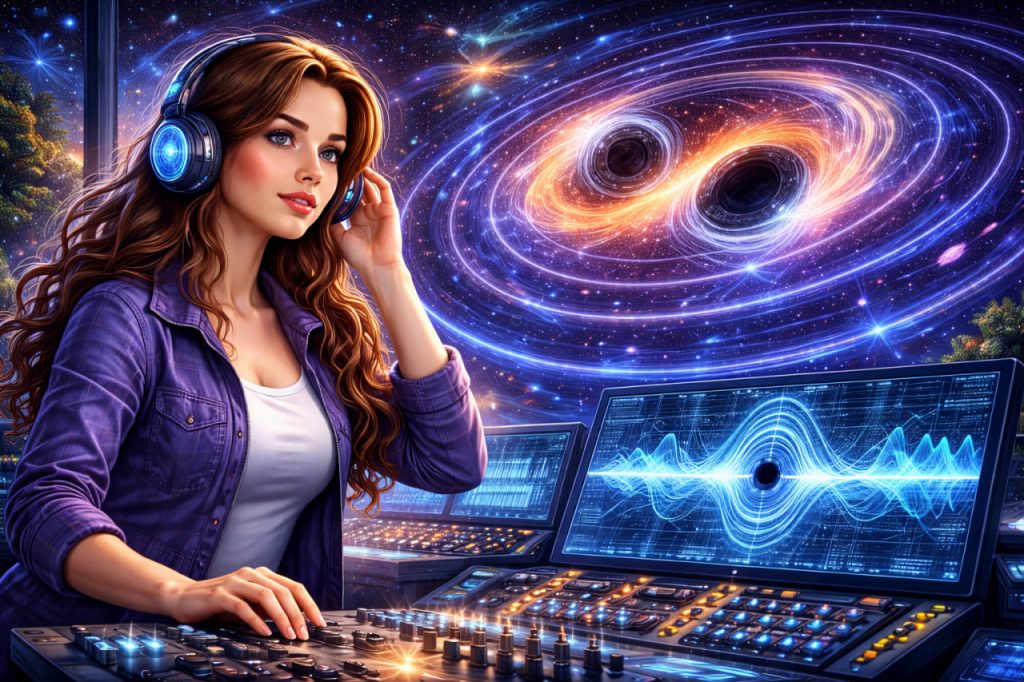
Gravitational waves are one of the most extraordinary discoveries in modern physics, allowing humanity to observe the universe in a completely new way. Unlike light or radio signals, gravitational waves carry information through tiny distortions of spacetime itself, produced by some of the most violent cosmic events imaginable. When black holes collide, they do not emit sound in the traditional sense, yet scientists often describe these events as being “heard” rather than seen. This metaphor reflects how detectors translate spacetime vibrations into measurable signals. Understanding how gravitational waves work reveals how researchers study invisible phenomena occurring billions of light-years away. These discoveries have transformed astrophysics and opened a new era of observational astronomy.
What Are Gravitational Waves?
Gravitational waves are ripples in spacetime predicted by Albert Einstein’s theory of general relativity in 1916. They are generated when massive objects accelerate, especially during extreme events such as black hole mergers or neutron star collisions. As these waves propagate outward, they stretch and compress spacetime in perpendicular directions. The effect is extraordinarily subtle by the time the waves reach Earth, changing distances by less than the width of a proton. Despite their weakness, gravitational waves carry pristine information about their sources because they pass through matter almost without interference. This makes them uniquely powerful messengers from the deep universe.
Black Hole Collisions and Cosmic Vibrations
When two black holes orbit each other, they lose energy through gravitational radiation, spiraling closer together over time. As the orbit tightens, the waves increase in frequency and strength, producing a characteristic “chirp” signal. At the moment of collision, spacetime is violently distorted, and a final burst of gravitational energy is released. Astrophysicist Dr. Marco Reynolds explains:
“A black hole merger is not an explosion in space,
but a sudden rearrangement of spacetime itself.”
After the merger, the newly formed black hole settles into a stable shape, emitting weaker waves known as the ringdown phase. Each part of this signal reveals details about mass, spin, and distance.
How Detectors ‘Listen’ to the Universe
Gravitational waves are detected using laser interferometers such as those operated by the LIGO and Virgo observatories. These instruments measure incredibly small changes in distance by comparing laser beams traveling along long perpendicular tunnels. When a gravitational wave passes through Earth, it alters the length of these tunnels by minuscule amounts, creating a measurable interference pattern. Scientists then convert this pattern into a signal that can be analyzed and, for educational purposes, transformed into sound. This is why black hole mergers are often described as being “heard” rather than observed. The process does not involve sound waves in space, but rather data translation from spacetime vibrations into human-interpretable formats.
Why Gravitational Waves Are Different from Light
Traditional astronomy relies on electromagnetic radiation such as visible light, X-rays, or radio waves. Gravitational waves, by contrast, are not blocked or scattered by dust, gas, or stars. This allows scientists to study regions of the universe that are otherwise hidden, including the interiors of dense stellar remnants. Gravitational signals also provide direct information about mass and motion, rather than surface properties. According to theoretical physicist Dr. Elena Navarro:
“Gravitational waves give us access to the dark,
silent side of the universe that light can never reveal.”
This complementary perspective enriches our understanding of cosmic evolution.
From Detection to Discovery
The first direct detection of gravitational waves in 2015 confirmed a century-old prediction and marked a turning point in physics. Since then, dozens of events have been recorded, including black hole mergers and neutron star collisions. Each detection improves models of stellar evolution and tests the limits of general relativity. Researchers also use these signals to estimate cosmic expansion and study the behavior of matter under extreme gravity. As detector sensitivity improves, scientists expect to observe even fainter and more distant events, expanding our cosmic hearing range.
The Future of Gravitational Wave Astronomy
Next-generation observatories, both on Earth and in space, aim to broaden the frequency range of detectable waves. Space-based detectors will be able to observe supermassive black hole mergers and long-period systems invisible to ground instruments. These advancements promise to reveal new classes of astrophysical phenomena. Gravitational wave astronomy is still in its early stages, yet it already reshapes how humanity explores the universe. By listening to spacetime itself, scientists are uncovering stories written into the fabric of reality.
Interesting Facts
- Gravitational waves travel at the speed of light, despite having no mass.
- The strongest signals detected so far came from black holes tens of times more massive than the Sun.
- Earth-based detectors can measure distance changes smaller than one-thousandth the size of a proton.
- Some gravitational waves detected today were created billions of years ago, long before Earth existed.
- Future detectors may observe waves from the early universe, shortly after the Big Bang.
Glossary
- Gravitational Waves — ripples in spacetime produced by accelerating massive objects.
- Black Hole Merger — the collision and combination of two black holes into one.
- Interferometer — a scientific instrument that measures extremely small changes in distance using light.
- Ringdown Phase — the final stage after a merger when a black hole stabilizes.
- General Relativity — Einstein’s theory describing gravity as the curvature of spacetime.