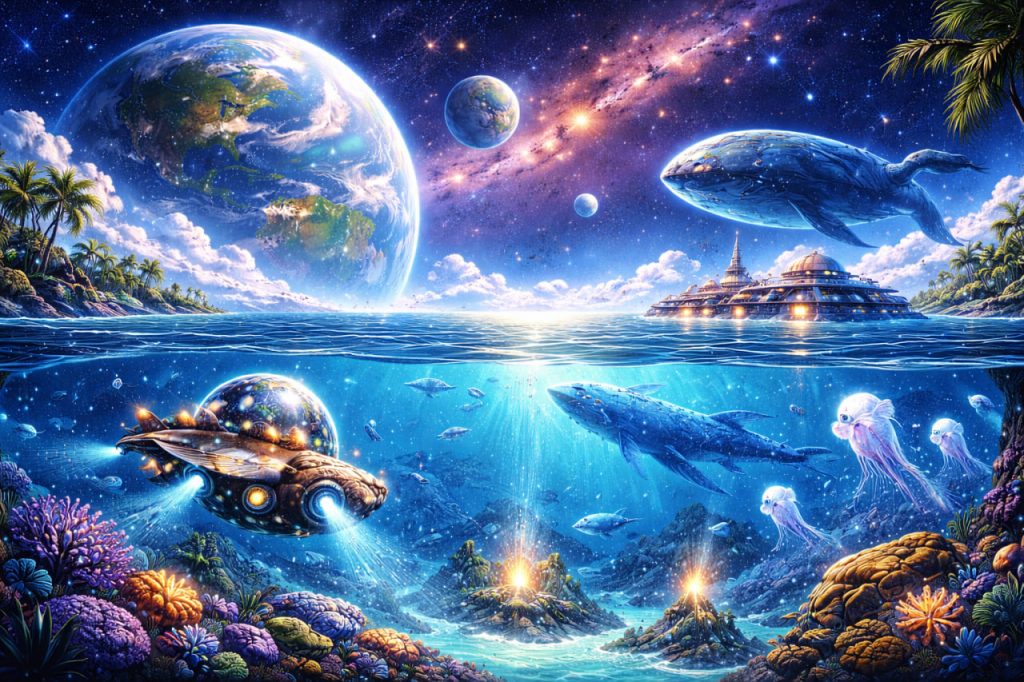
Ocean planets, sometimes called water worlds, are a class of exoplanets almost entirely covered by deep global oceans. Unlike Earth, where oceans coexist with continents, these planets may have little or no exposed land at all. Their vast amounts of liquid water make them especially intriguing in the search for life beyond our Solar System. Scientists consider water one of the most important ingredients for life, but the presence of water alone does not guarantee habitability. Ocean planets challenge traditional ideas about where and how life might develop. Studying them expands our understanding of possible living environments in the universe.
What Are Ocean Planets
Ocean planets are worlds where water dominates the surface and possibly extends hundreds of kilometers deep. Beneath these oceans, extreme pressure may create layers of high-density ice, even though the surface remains liquid. These planets are often larger than Earth and may contain significantly more water than our planet. Their atmospheres could be rich in water vapor and other gases, influencing climate and temperature. Because of their unique structure, ocean planets behave very differently from rocky worlds. Scientists classify them as a distinct planetary type when modeling planetary systems.
How Ocean Planets Form
Ocean planets likely form in regions of planetary systems rich in ice and water-bearing materials. During early planetary formation, these worlds may accumulate large amounts of frozen water that later melt as the planet migrates closer to its star. Some ocean planets may form farther out and retain thick oceans beneath insulating atmospheres. Planetary migration plays a major role in determining whether water remains liquid or freezes entirely. These formation pathways suggest that ocean planets could be relatively common in the galaxy. Their abundance makes them important targets for future observation.
Habitability and Life Potential
From a biological perspective, ocean planets offer both advantages and challenges for life. On the positive side, liquid water provides a stable environment for chemical reactions essential to life. However, the absence of land may limit nutrient cycles that support complex ecosystems. On Earth, interactions between oceans, continents, and atmosphere play a crucial role in sustaining life. Without continents, energy sources such as volcanic activity or hydrothermal vents become especially important. Scientists consider subsurface chemistry and ocean circulation key factors in determining habitability.
Could Intelligent Life Exist on Ocean Planets
The possibility of intelligent life on ocean planets remains highly speculative. While simple life forms might arise in deep oceans, the development of advanced intelligence may face obstacles. The lack of land could limit the use of fire, metallurgy, and large-scale technology as we know it. Communication, tool use, and long-term technological development might follow very different paths compared to Earth. Astrobiologist Dr. Laura Chen notes:
“Ocean planets may support life that is rich and diverse,
but intelligence there could evolve in ways we struggle to imagine.”
This highlights how Earth-based assumptions may not apply universally.
How Scientists Search for Ocean Planets
Astronomers identify potential ocean planets by measuring a planet’s size, mass, and density. Low density often suggests a high water content. Atmospheric studies may reveal water vapor or clouds consistent with global oceans. Future space telescopes aim to analyze exoplanet atmospheres in greater detail, searching for chemical signatures linked to water-rich worlds. While direct observation of oceans remains beyond current technology, indirect evidence continues to improve. Each new discovery helps refine models of these fascinating planets.
Interesting Facts
- Some ocean planets may have oceans hundreds of kilometers deep.
- High-pressure ice can exist beneath liquid oceans on massive water worlds.
- Ocean planets may lack continents entirely.
- Life on such planets might rely on hydrothermal energy, not sunlight.
- Water worlds could be common in the Milky Way.
Glossary
- Ocean Planet — a planet largely or entirely covered by a global ocean.
- Exoplanet — a planet orbiting a star outside our Solar System.
- High-Pressure Ice — dense ice formed under extreme pressure below deep oceans.
- Habitability — the potential of an environment to support life.
- Hydrothermal Vent — a fissure releasing heated, mineral-rich water from a planet’s interior.