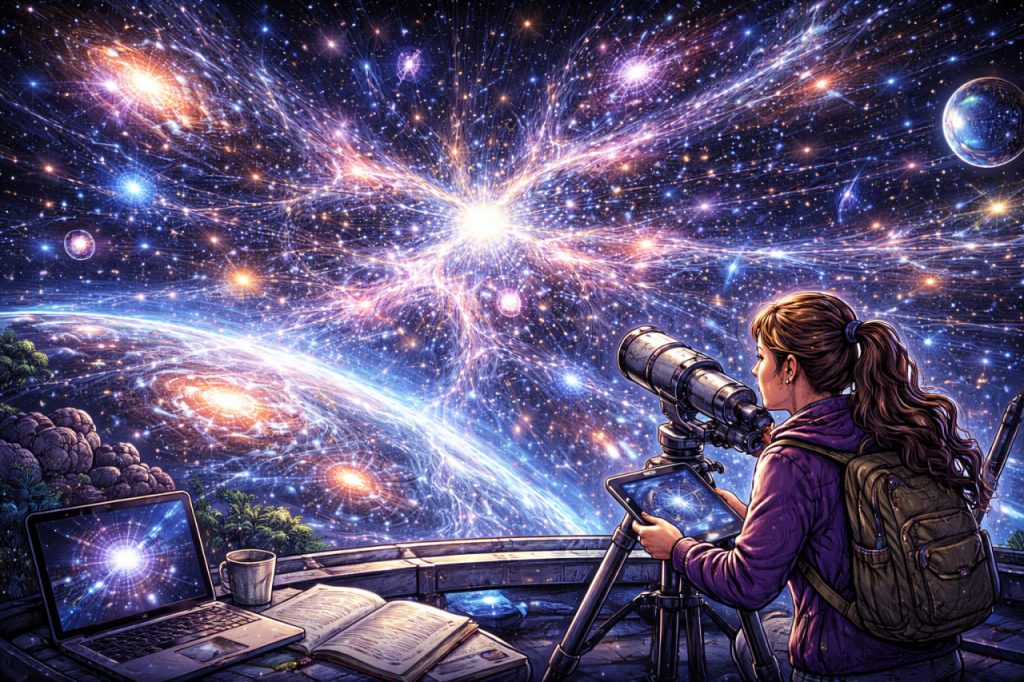
At the largest scales imaginable, the universe appears calm, structured, and surprisingly uniform. Yet this apparent simplicity hides an extraordinary level of complexity that scientists are still working to understand. Modern cosmology does not describe the universe based on visual appearance alone, but through measurements of light, motion, and geometry across billions of light-years. Because no observer can step outside the universe to look at it from afar, its overall shape and structure must be inferred indirectly. As a result, our picture of the universe is built from theory, observation, and mathematical models rather than direct images.
The Observable Universe
When scientists speak about the universe, they usually refer to the observable universe—the region of space from which light has had time to reach Earth since the beginning of cosmic expansion. This region forms a vast sphere around us, approximately 93 billion light-years in diameter. Beyond this boundary, light has not yet arrived, not necessarily because nothing exists there, but because the universe has not existed long enough for signals to reach us. Importantly, this boundary is not an edge of the universe, only a limit of observation.
Large-Scale Structure: Cosmic Web
On the largest scales, matter in the universe is not distributed evenly. Galaxies cluster together into filaments and sheets, separated by enormous voids. This pattern is known as the cosmic web. It emerged from tiny density fluctuations in the early universe, amplified over billions of years by gravity. Galaxies trace these filaments like beads on invisible strings, revealing a structure that resembles a three-dimensional network. According to cosmologist Dr. J. Richard Bond:
“The universe is not random chaos,
but a finely patterned structure shaped by gravity over cosmic time.”
This structure is one of the strongest confirmations of modern cosmological theory.
Is the Universe Flat, Curved, or Closed
One of the most important questions about the universe concerns its overall geometry. Measurements of the cosmic microwave background indicate that, on large scales, the universe is very close to geometrically flat. This does not mean flat like a sheet of paper, but flat in the sense of Euclidean geometry, where parallel lines never meet. Other possibilities include a closed universe (curved like a sphere) or an open universe (curved like a saddle). Current data strongly favor near-flatness, though small deviations cannot yet be ruled out.
Does the Universe Have an Overall Shape
While geometry describes local curvature, the global shape of the universe remains unknown. It may extend infinitely in all directions, or it may be finite but unbounded, looping back on itself in complex ways. Some models propose that traveling far enough in one direction could, in principle, bring you back to your starting point. However, such topologies are extremely difficult to detect observationally. At present, science cannot determine whether the universe is infinite or finite—only that it is much larger than what we can observe.
What Science Does and Does Not Claim
Modern science does not claim to have a final picture of the universe’s full structure. Instead, it offers models that best match available evidence. Observations from space telescopes, galaxy surveys, and background radiation measurements continue to refine these models. What science strongly supports is that the universe is expanding, structured, and governed by consistent physical laws. What lies beyond the observable universe, or whether the universe has a deeper underlying structure, remains an open and active area of research.
Interesting Facts
- The observable universe contains hundreds of billions of galaxies.
- Large-scale galaxy distribution forms a structure called the cosmic web.
- The universe appears the same in all directions on very large scales.
- Current measurements suggest the universe is very close to flat.
- The universe may be far larger than the observable region.
Glossary
- Observable Universe — the region of space from which light has reached Earth since the beginning of expansion.
- Cosmic Web — the large-scale structure formed by galaxy filaments and voids.
- Cosmic Microwave Background — relic radiation from the early universe.
- Geometry of the Universe — the large-scale curvature of space.
- Topology — the possible global shape and connectivity of space.