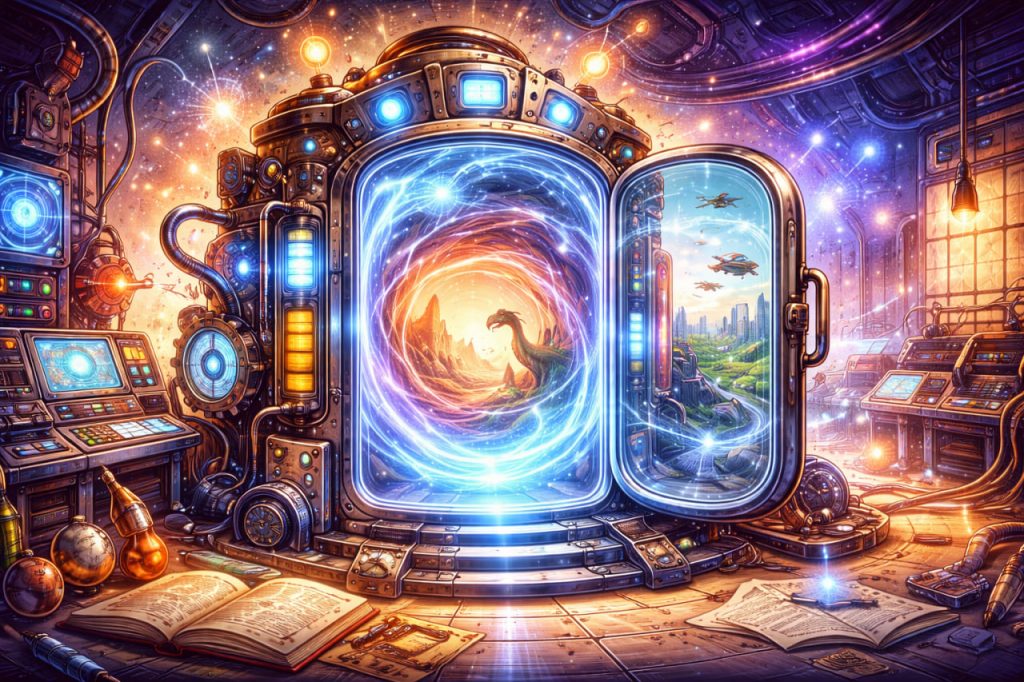
The idea of a time machine has fascinated humanity for centuries, appearing in myths, literature, and modern science fiction. The possibility of traveling into the past or future challenges our understanding of time, causality, and the laws of physics. While popular culture often presents time travel as a mechanical device with buttons and levers, real science treats time as a fundamental dimension governed by strict physical rules. Some concepts associated with time travel are rooted in legitimate physics, while others remain pure speculation. Distinguishing between what science actually allows and what belongs to imagination helps clarify why time machines remain elusive. Exploring these ideas reveals as much about human curiosity as it does about the structure of the universe.
Time Travel in Myths and Fiction
Long before modern physics, cultures imagined journeys through time using magical objects, divine intervention, or altered states of consciousness. In modern fiction, time machines became iconic through novels, films, and television, often depicted as vehicles capable of instant travel across centuries. These stories typically ignore physical constraints, focusing instead on dramatic consequences such as paradoxes and altered timelines. Fictional time travel serves as a narrative tool to explore morality, destiny, and human choice. While these portrayals are imaginative, they often blur the line between entertainment and scientific possibility, contributing to widespread misconceptions about how time actually works.
What Physics Says About Time
In physics, time is not an independent entity that can be freely manipulated like space. According to Einstein’s theory of relativity, time is intertwined with space into a four-dimensional structure known as space-time. One well-established fact is time dilation, where time passes at different rates depending on speed and gravity. Astronauts traveling at high velocities or near massive objects experience time more slowly than those on Earth. Physicist Dr. Leonard Hayes explains:
“Physics already allows one-way time travel into the future,
simply by moving fast or living near strong gravitational fields.”
This form of time travel is real, measurable, and experimentally confirmed, though it does not allow backward travel.
Is Traveling to the Past Possible
Traveling into the past is far more problematic from a scientific perspective. Some theoretical models, such as closed timelike curves or wormholes, mathematically allow paths that loop back in time. However, these models require extreme and unverified conditions, including negative energy or exotic matter. Additionally, backward time travel introduces logical contradictions known as time paradoxes, such as altering events that led to the journey itself. Many physicists believe that unknown physical laws prevent such scenarios from occurring in reality. As a result, backward time travel remains speculative and unsupported by experimental evidence.
Popular Myths About Time Machines
A common myth is that time travel would require only advanced technology, as if it were an engineering problem waiting to be solved. In reality, the barriers are not technological but fundamental, rooted in the structure of space-time. Another misconception is that time is a universal constant flowing identically everywhere, which relativity disproves. Science fiction often assumes perfect control over timelines, ignoring quantum uncertainty and physical instability. These myths persist because they simplify complex physics into intuitive but inaccurate ideas.
Why Time Machines Still Matter Scientifically
Although practical time machines do not exist, studying time travel concepts has scientific value. These discussions push the limits of theoretical physics and help researchers test the consistency of physical laws. Time-related questions also influence cosmology, black hole physics, and quantum gravity research. Philosophically, time machines force us to confront deep questions about determinism, free will, and the nature of reality. Even if time travel remains impossible, the pursuit of understanding time itself continues to shape modern science.
Interesting Facts
- Time dilation has been measured using atomic clocks on satellites and airplanes.
- GPS systems must correct for relativistic time differences to function accurately.
- No experimental evidence supports traveling backward in time.
- Some equations allow time loops, but they require unphysical conditions.
- Science fiction often predicts time travel before physics can test it.
Glossary
- Time Dilation — the slowing of time due to high speed or strong gravity.
- Space-Time — the four-dimensional framework combining space and time.
- Wormhole — a hypothetical tunnel connecting distant regions of space-time.
- Time Paradox — a logical contradiction arising from altering past events.
- Relativity — Einstein’s theory describing how space, time, and gravity interact.