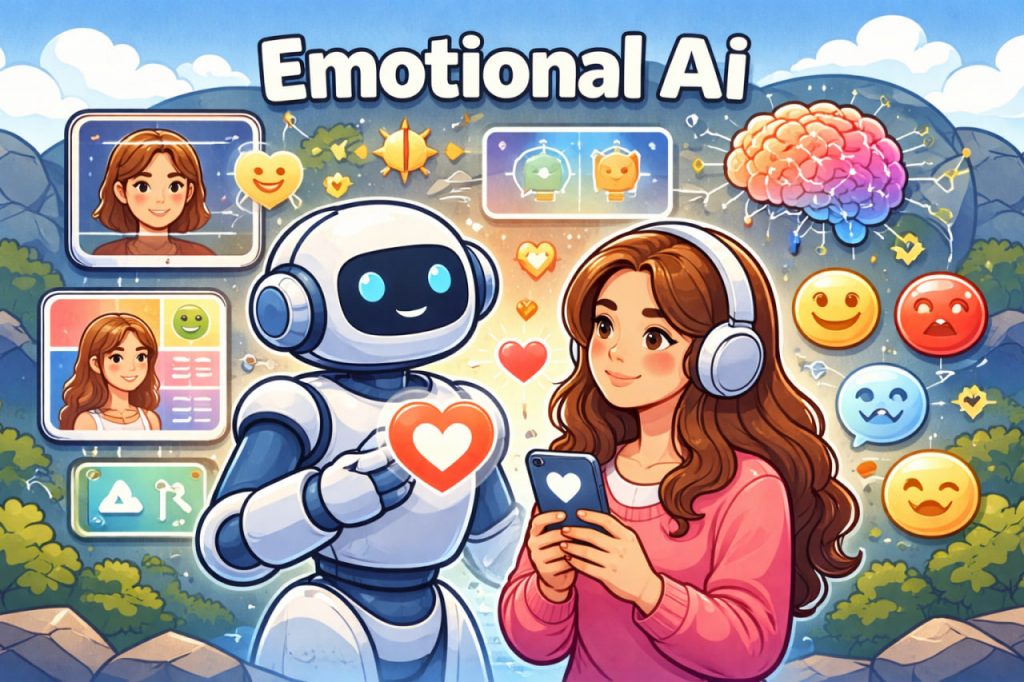
Emotional artificial intelligence, often called affective computing, refers to systems designed to detect, interpret, and simulate human emotions. Unlike traditional AI that focuses on logic, numbers, or patterns, emotional AI attempts to understand subtle human signals such as facial expressions, tone of voice, and body language. These systems do not “feel” emotions, but they analyze measurable cues and convert them into data. By identifying patterns across massive datasets, emotional AI can classify moods, detect stress, or adapt responses to appear empathetic. This technology is increasingly used in customer service, healthcare monitoring, education, and digital assistants. As machines become more interactive, understanding how they process emotional signals becomes essential for evaluating both their benefits and limitations.
How Machines Recognize Emotions
To recognize emotions, AI systems rely on multimodal data analysis, meaning they combine different input types such as images, audio, and text. Facial recognition algorithms analyze micro-expressions by measuring muscle movements around the eyes, mouth, and eyebrows. Speech analysis tools evaluate pitch, rhythm, speed, and pauses to estimate emotional tone. Text-based systems examine word choice, sentence structure, and contextual patterns to infer sentiment. According to computer scientist Dr. Laura Chen:
“Emotional AI does not experience feelings.
It detects statistical patterns in human behavior and assigns probabilities to emotional states.”
By training on labeled datasets where emotions are categorized, these systems learn to associate certain signals with specific emotional outcomes.
Imitating Emotions Through Simulation
Recognition is only one side of emotional AI. Many systems are also designed to simulate emotional responses in order to improve user interaction. Chatbots may adjust tone to sound supportive, while virtual avatars can display facial expressions that mirror user emotions. This imitation is powered by predictive models that determine which response is socially appropriate in a given context. The goal is not authenticity, but improved communication efficiency. For example, a tutoring AI might use encouraging language when detecting frustration in a student. This form of simulation relies heavily on pattern-based dialogue modeling and reinforcement learning strategies.
Machine Learning and Emotional Datasets
Emotional AI systems depend on vast datasets containing thousands or millions of labeled examples of human expressions and speech samples. These datasets are used to train neural networks, which gradually refine their internal parameters to minimize classification errors. However, emotions vary across cultures, contexts, and individuals, making accurate interpretation complex. Researchers use cross-validation techniques to improve generalization and reduce bias. According to AI ethics researcher Dr. Miguel Alvarez:
“The greatest challenge is not technical detection,
but ensuring emotional models reflect cultural diversity and avoid harmful bias.”
Ongoing research aims to make emotional AI more accurate, transparent, and fair.
Applications in Real-World Environments
Emotional AI is already integrated into various industries. In healthcare, systems monitor vocal stress patterns to detect early signs of depression or anxiety. In customer service, AI analyzes caller tone to guide support agents in real time. Automotive companies experiment with emotion-detection systems to identify driver fatigue or distraction. Education platforms use emotional feedback to personalize learning experiences. While these applications promise efficiency and personalization, they also raise privacy concerns regarding biometric data collection and consent.
Ethical Considerations and Future Development
As emotional AI becomes more sophisticated, ethical questions grow more urgent. Can machines truly understand emotions, or are they only approximating them statistically? How should emotional data be stored, protected, and regulated? Researchers emphasize that emotional AI must be transparent about its capabilities to prevent unrealistic expectations. Future development focuses on improving contextual awareness, reducing algorithmic bias, and ensuring responsible deployment. Ultimately, emotional AI does not create genuine empathy—but it demonstrates how computational systems can approximate emotional intelligence through advanced pattern recognition.
Interesting Facts
- The term “affective computing” was popularized in the 1990s by researchers studying emotion-aware systems.
- Some emotion-recognition models analyze over 40 facial muscle movements simultaneously.
- Emotional AI can process speech tone changes in milliseconds, faster than human reaction time.
- Cultural differences significantly influence how emotions are expressed and interpreted.
- Many modern virtual assistants incorporate limited forms of sentiment analysis.
Glossary
- Affective Computing — a field of AI focused on recognizing and simulating human emotions.
- Multimodal Analysis — combining multiple data types such as text, audio, and images for interpretation.
- Neural Network — a machine learning model inspired by biological neural systems.
- Sentiment Analysis — the process of identifying emotional tone in text or speech.
- Algorithmic Bias — systematic error in AI systems caused by unbalanced or incomplete data.