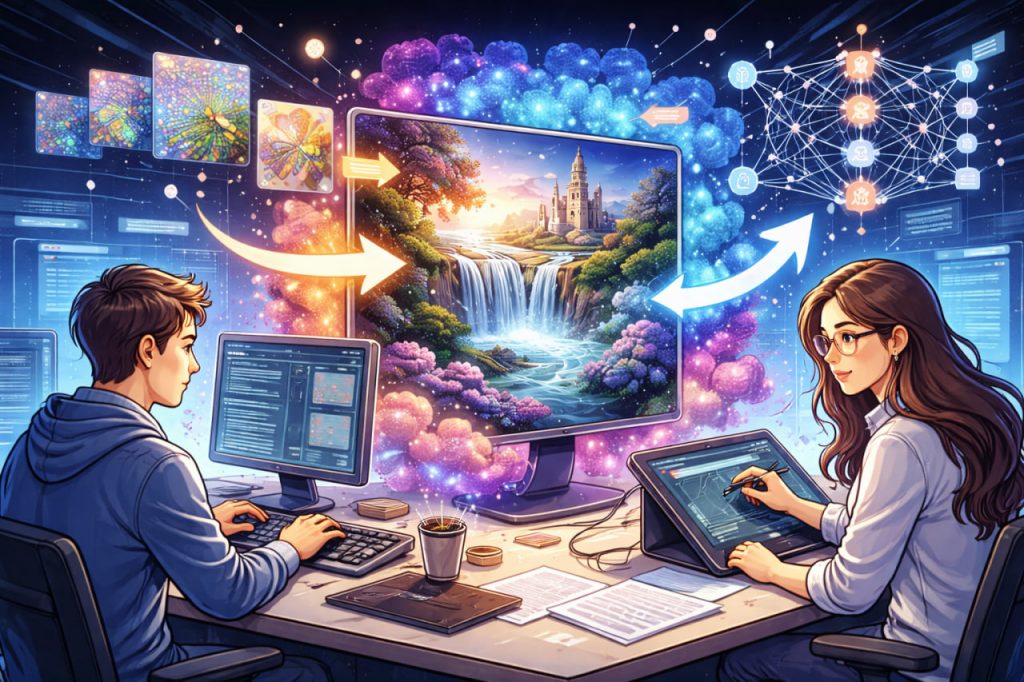
Diffusion models are a class of artificial intelligence systems designed to generate images by gradually transforming noise into structured visuals. In recent years, they have become the foundation of many advanced image-generation tools, including platforms like Midjourney. Unlike earlier generative models that directly predicted pixels in a single pass, diffusion models work through a step-by-step refinement process. They begin with random visual noise and progressively “denoise” it until a coherent image emerges. This approach has significantly improved image realism, artistic flexibility, and prompt responsiveness. Understanding diffusion models helps explain how modern AI art systems function behind the scenes.
The Core Idea Behind Diffusion Models
At their core, diffusion models simulate two opposite processes: forward diffusion and reverse diffusion. In the forward process, an image is gradually corrupted with random noise over many steps until it becomes indistinguishable from static. In the reverse process, a neural network learns how to reconstruct the image by removing noise step by step. AI researcher Dr. Daniel Morris explains:
“Diffusion models learn how to reverse randomness.
They transform chaos into structure through iterative refinement.”
By training on large image datasets, the model learns patterns of shapes, textures, lighting, and composition.
From Text Prompt to Image
When a user provides a text prompt, the system converts the words into numerical representations using a language model. These representations guide the reverse diffusion process, influencing how noise is shaped into a meaningful image. Instead of selecting from stored pictures, the model generates entirely new pixel arrangements based on learned statistical patterns. The result reflects both the training data and the specific prompt conditions.
Why Diffusion Models Produce High-Quality Results
Diffusion models excel because they refine images gradually rather than generating them in a single step. This iterative process allows detailed textures, lighting effects, and complex compositions to emerge naturally. Compared to earlier generative adversarial networks (GANs), diffusion systems often produce more stable and diverse outputs. Their flexibility also enables stylization, blending artistic themes, and high-resolution rendering.
Computational Requirements
Despite their creative output, diffusion models are computationally intensive. Each denoising step requires neural network calculations, often repeated dozens or hundreds of times. High-performance GPUs or specialized hardware are typically required. Optimization techniques such as fewer diffusion steps or model compression can reduce resource demands while maintaining quality.
Limitations and Considerations
Although diffusion models generate impressive visuals, they do not understand meaning in a human sense. They operate on statistical associations learned from data. Complex prompts may produce unpredictable results depending on how the model interprets them numerically. Ethical considerations, dataset transparency, and copyright issues also remain active areas of discussion.
The Future of Diffusion-Based AI
Research continues to improve speed, resolution, and control mechanisms. Hybrid systems combine diffusion models with other architectures to enhance efficiency. As computing power advances, diffusion-based tools may expand beyond images into video, 3D modeling, and scientific simulation. Their development represents a major milestone in generative artificial intelligence.
Interesting Facts
- Diffusion models start from pure random noise.
- The reverse denoising process occurs in multiple iterative steps.
- Text prompts guide image formation through numerical encoding.
- Diffusion models often outperform earlier GAN systems in stability.
- Research now explores diffusion techniques for video generation.
Glossary
- Diffusion Model — AI model that generates data by reversing a noise process.
- Forward Diffusion — gradual addition of noise to training images.
- Reverse Diffusion — learned process of removing noise to create structure.
- Text Encoding — converting words into numerical representations.
- Neural Network — computational system inspired by biological neurons.