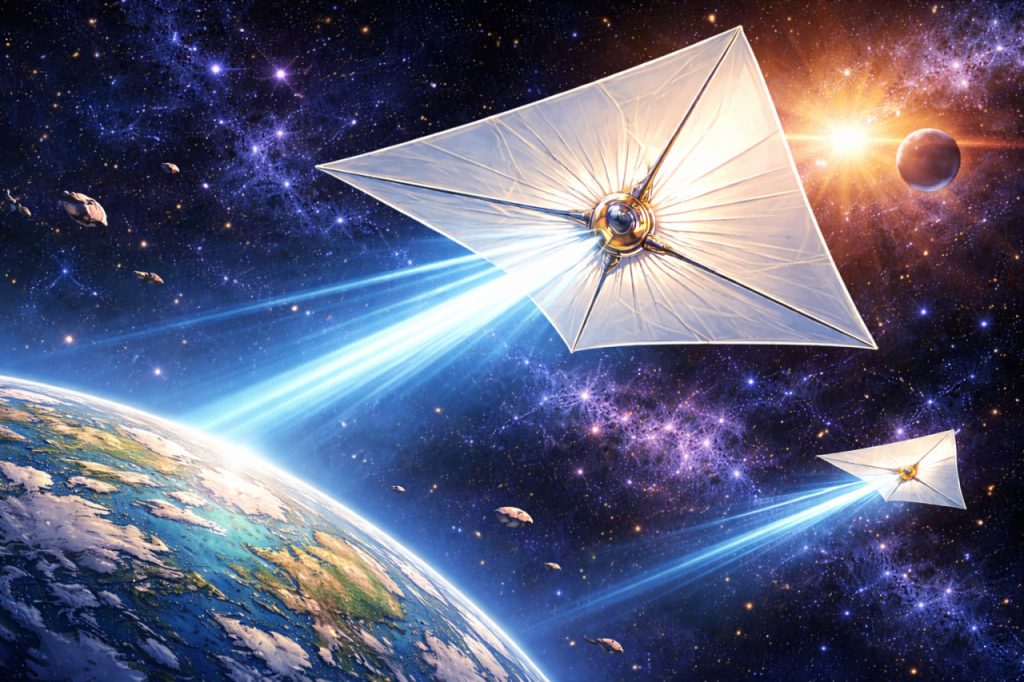
Light sail technology is one of the most innovative propulsion concepts in modern space exploration. Unlike traditional rockets that rely on fuel combustion, light sails use radiation pressure from photons—particles of light—to generate thrust. Although photons have no mass, they carry momentum, and when they strike a reflective surface, they exert a tiny but continuous force. Over time, this gentle push can accelerate a spacecraft to extremely high speeds without carrying heavy fuel. This concept dramatically reduces mass and opens new possibilities for deep-space missions. Light sail propulsion represents a shift from chemical energy to physics-based propulsion, relying on the fundamental properties of light itself.
How Light Sail Propulsion Works
A light sail consists of a large, ultra-thin reflective membrane attached to a small spacecraft. When sunlight—or a powerful laser beam—hits the sail, photons transfer momentum upon reflection. Each individual impact is extremely small, but in space, where there is no atmospheric resistance, continuous photon pressure gradually increases speed. The larger and lighter the sail, the more effective the acceleration. Aerospace physicist Dr. Karen Liu explains:
“A light sail doesn’t burn fuel—it rides momentum.
The acceleration is gentle but persistent, making it ideal for long-duration missions.”
Unlike rockets that provide strong but brief thrust, light sails offer steady acceleration over long periods.
Solar vs. Laser-Driven Sails
There are two primary approaches to light sail propulsion. Solar sails rely on natural sunlight for propulsion and are suitable for missions within our solar system. They are simple in concept but limited by the decreasing intensity of sunlight farther from the Sun. Laser-driven sails, on the other hand, use powerful ground-based or orbital lasers to propel spacecraft at much higher speeds. This approach, proposed in projects like Breakthrough Starshot, could theoretically accelerate tiny probes to a significant fraction of the speed of light. However, building and powering such laser arrays remains a major engineering challenge.
Advantages of Light Sail Technology
One of the greatest advantages of light sails is that they require no onboard fuel, significantly reducing spacecraft weight. This allows more room for scientific instruments or enables ultra-light miniaturized probes. Because propulsion comes from an external energy source, mission duration is not limited by fuel supply. Light sails are also mechanically simple, with fewer moving parts than traditional engines. Their efficiency makes them attractive for long-distance exploration missions.
Engineering and Physical Challenges
Despite its elegance, light sail technology faces serious technical obstacles. The sail material must be extremely thin, lightweight, and highly reflective, while also resistant to radiation and micrometeoroid impacts. Controlling direction and stability is complex, as even slight misalignment can alter trajectory over vast distances. For laser-driven sails, precision targeting over millions of kilometers is required. Additionally, at very high speeds, collisions with dust particles could damage or destroy the spacecraft. These engineering challenges remain areas of active research.
Future Applications
Light sail technology is already being tested in small-scale missions within the solar system. Experimental spacecraft have demonstrated controlled solar sailing, proving the concept viable. In the future, light sails could enable exploration of outer planets, asteroid missions, and even interstellar probes. While human travel using light sails is unlikely in the near future, robotic exploration may greatly benefit from this propulsion method. As materials science and laser technology advance, light sails could become a cornerstone of deep-space exploration.
Interesting Facts
- Light from the Sun continuously pushes objects in space, even without sails.
- Solar sails can theoretically operate indefinitely without fuel.
- Light sail acceleration is slow but can reach very high speeds over time.
- The concept was first seriously studied in the 20th century.
- Laser-driven sails could reach a fraction of light speed under ideal conditions.
Glossary
- Light Sail — a reflective membrane that uses photon pressure for propulsion.
- Photon Pressure — force exerted when light transfers momentum to a surface.
- Solar Sail — a light sail powered by sunlight.
- Laser Propulsion — propulsion generated by focused laser beams.
- Radiation Pressure — the pressure exerted upon surfaces due to electromagnetic radiation.