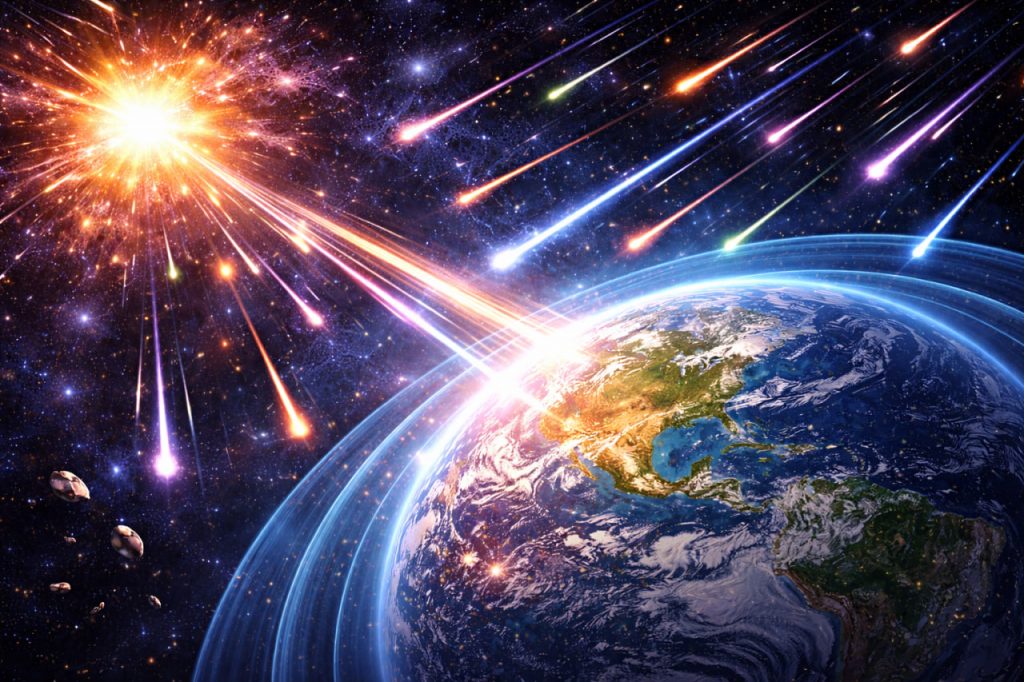
Cosmic rays are high-energy particles that travel through space at nearly the speed of light and constantly bombard Earth from all directions. Despite their name, they are not actually rays of light but mostly atomic nuclei and subatomic particles. These particles originate from powerful astrophysical events such as supernova explosions, active galactic nuclei, and possibly even more extreme cosmic phenomena. When cosmic rays reach Earth, most are deflected by the planet’s magnetic field or absorbed by the atmosphere. However, a small fraction interacts with atmospheric molecules, producing cascades of secondary particles. Studying cosmic rays helps scientists understand the most energetic processes in the universe.
Where Cosmic Rays Come From
Cosmic rays are generally divided into two main categories: galactic cosmic rays and solar cosmic rays. Galactic cosmic rays originate outside our solar system, likely from supernova remnants and other energetic astrophysical sources. Solar cosmic rays are produced by solar flares and coronal mass ejections from the Sun. Some ultra-high-energy cosmic rays may come from distant galaxies, though their exact origins remain under investigation. Astrophysicist Dr. Martin Keller explains:
“Cosmic rays are like messengers from violent cosmic events,
carrying information about processes we cannot observe directly.”
Their study provides indirect insight into extreme environments far beyond Earth.
What Happens When Cosmic Rays Reach Earth
When cosmic rays collide with atoms in Earth’s atmosphere, they create a chain reaction known as an air shower. This cascade produces secondary particles such as muons, electrons, and neutrinos. Most of these particles are absorbed before reaching the surface, which is why life on Earth is largely protected. Earth’s magnetic field and atmosphere serve as natural shields, significantly reducing radiation exposure at ground level. However, at high altitudes—such as in aircraft or in space—exposure increases noticeably.
Why Cosmic Rays Matter
Cosmic rays play an important role in both science and technology. They help researchers study fundamental particle physics, sometimes at energies higher than those produced in human-made accelerators. Cosmic rays may also influence atmospheric chemistry and cloud formation, though this area remains under investigation. In space exploration, cosmic rays are a major concern because they pose health risks to astronauts. Long-term exposure to high-energy particles can damage cells and increase cancer risk.
Detection and Research Methods
Scientists detect cosmic rays using ground-based observatories, balloon experiments, and space-based detectors. Large detector arrays measure particle showers when cosmic rays strike the atmosphere. Underground laboratories also study secondary particles that penetrate deep below the surface. Advances in detector technology have significantly improved our understanding of cosmic ray composition and energy levels. Despite progress, many questions remain about their exact sources and acceleration mechanisms.
Cosmic Rays and Space Exploration
Beyond scientific curiosity, cosmic rays present a practical challenge for deep-space travel. Outside Earth’s magnetic field, astronauts are exposed to higher levels of galactic cosmic radiation. Designing spacecraft with effective shielding is a key engineering challenge for missions to Mars and beyond. Understanding cosmic ray behavior allows better risk assessment and mission planning.
Interesting Facts
- Cosmic rays travel at nearly the speed of light.
- Some cosmic rays carry more energy than particles produced in modern particle accelerators.
- Earth’s atmosphere protects life by absorbing most incoming cosmic radiation.
- High-altitude flights experience higher radiation exposure than ground level.
- The discovery of cosmic rays dates back to the early 20th century.
Glossary
- Cosmic Rays — high-energy particles originating from space.
- Galactic Cosmic Rays — cosmic rays that come from outside the solar system.
- Air Shower — cascade of secondary particles produced when cosmic rays hit the atmosphere.
- Solar Flare — powerful eruption of energy from the Sun.
- Magnetosphere — the region around Earth controlled by its magnetic field.