Interstellar travel—the journey beyond our solar system to other stars—has long been a dream of scientists and science fiction writers alike. Unlike missions to Mars or Jupiter, traveling to another star involves distances so vast that conventional spacecraft would require tens of thousands of years to arrive. However, in recent decades, serious scientific initiatives have begun exploring whether interstellar missions could become technically feasible. Among these efforts, Breakthrough Starshot stands out as one of the most ambitious and innovative concepts. While practical interstellar travel remains far beyond current human capability, research and theoretical engineering continue to push the boundaries of what might be possible in the future.
The Challenge of Interstellar Distances
The nearest star system to Earth, Alpha Centauri, is about 4.37 light-years away. Even the fastest spacecraft ever built would take tens of thousands of years to reach it. Traditional chemical rockets are simply too slow and inefficient for such journeys. The immense distance introduces challenges related to energy requirements, shielding from cosmic radiation, navigation precision, and communication delays. Astrophysicist Dr. Elena Vargas explains:
“Interstellar travel is not just an engineering challenge.
It forces us to rethink propulsion, materials science, and even mission timelines.”
Because of these constraints, scientists are exploring radically different propulsion methods.
Breakthrough Starshot: A Laser-Driven Vision
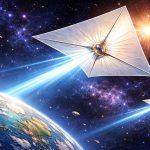
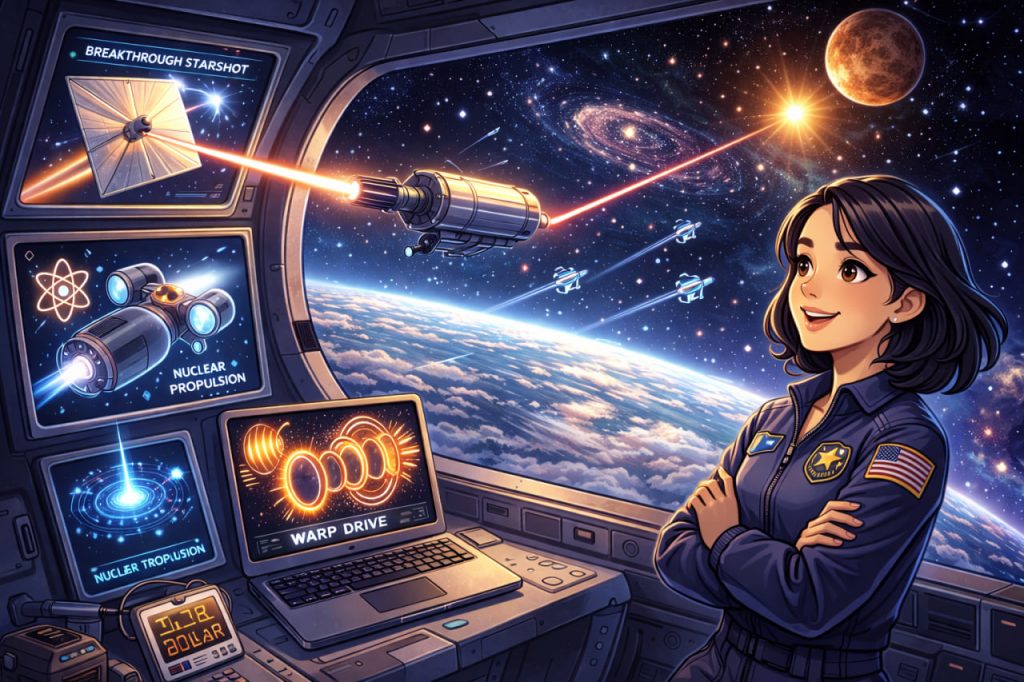
Launched in 2016, Breakthrough Starshot is an initiative aiming to send ultra-light spacecraft to Alpha Centauri within a human lifetime. The concept involves tiny, gram-scale probes attached to reflective light sails. These sails would be accelerated by a powerful Earth-based laser array, potentially reaching speeds of up to 20% the speed of light. At such speeds, the probes could arrive in about 20 years. The spacecraft would capture images and data as they pass through the target system and transmit the information back to Earth using miniature communication systems. Although still theoretical and facing major technical obstacles, Breakthrough Starshot represents a shift from massive spacecraft to miniaturized, high-speed exploration technology.
Other Interstellar Propulsion Concepts
Beyond Starshot, scientists have proposed various alternative propulsion methods. Nuclear pulse propulsion, once explored in Project Orion, suggested using controlled nuclear explosions to propel spacecraft. Fusion-based engines aim to harness the power of nuclear fusion for sustained high-speed travel. Antimatter propulsion, though currently beyond technological reach, could theoretically provide enormous energy output. More speculative ideas include warp drives and space-time manipulation, though these remain purely theoretical and lack experimental support. Each concept faces significant engineering, safety, and economic challenges.
Technological and Physical Barriers
Even if propulsion issues are solved, interstellar travel faces additional obstacles. At high speeds, tiny particles of dust become extremely dangerous, potentially damaging spacecraft. Communication over light-year distances introduces delays of several years between messages. Long-duration missions would require advanced artificial intelligence and autonomous decision-making systems. Power generation and data transmission over vast distances remain major unresolved challenges. Current technology is still far from meeting all these requirements simultaneously.
Human Interstellar Travel: A Distant Goal
Sending humans beyond the solar system presents even greater difficulties. Life-support systems would need to operate for decades or centuries. Concepts such as generation ships, where multiple generations live and die during the journey, raise ethical and social questions. Cryogenic suspension has been proposed, but remains unproven for long-term human preservation. Given present limitations, most experts agree that robotic probes are far more realistic for initial interstellar exploration.
Is Interstellar Travel Realistic?
Interstellar travel is not impossible according to known physical laws, but it remains a long-term scientific ambition rather than a near-term plan. Breakthrough Starshot and similar initiatives demonstrate that serious research is underway. Incremental advances in materials science, propulsion, and miniaturization continue to reduce barriers. While humanity is unlikely to send large spacecraft to another star in the coming decades, small robotic missions may represent the first true steps toward interstellar exploration.
Interesting Facts
- Alpha Centauri is the closest star system to our own.
- Breakthrough Starshot proposes spacecraft weighing only a few grams.
- Traveling at 20% of light speed would still take around 20 years to reach Alpha Centauri.
- Nuclear pulse propulsion was seriously studied during the Cold War era.
- Communication from Alpha Centauri would take over four years to reach Earth.
Glossary
- Interstellar Travel — travel between star systems.
- Breakthrough Starshot — a project proposing laser-propelled light sail probes.
- Light Sail — a reflective surface propelled by photon pressure from lasers or sunlight.
- Nuclear Pulse Propulsion — a propulsion method using controlled nuclear explosions.
- Generation Ship — a hypothetical spacecraft designed for multi-generational human travel.