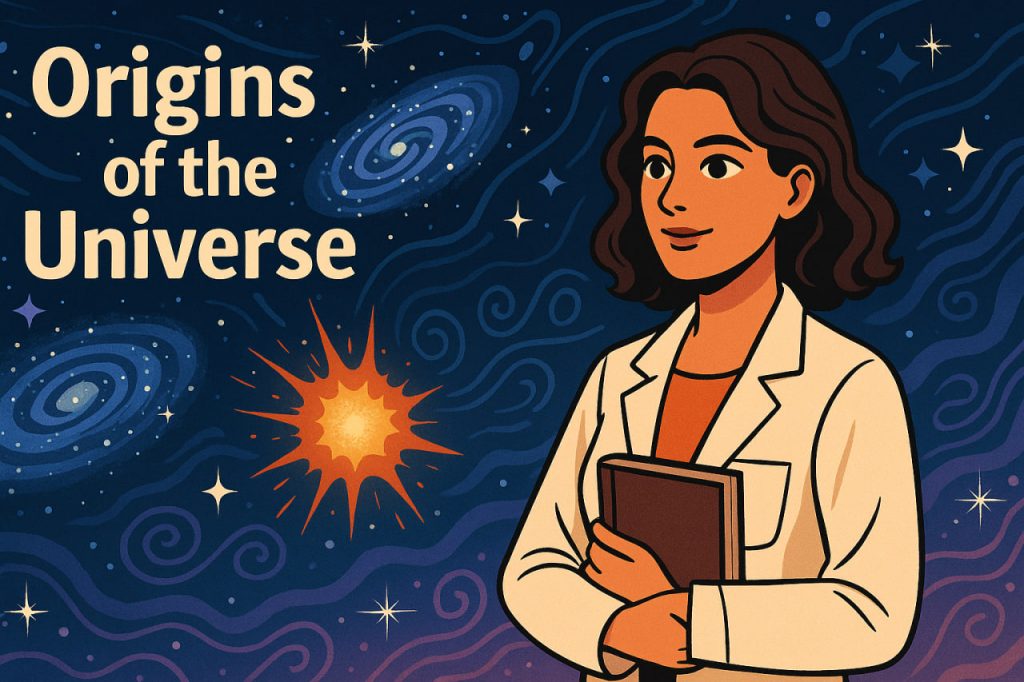
The question of how our universe began has fascinated humanity for millennia, inspiring myths, religions, and scientific inquiry. Modern science now offers several compelling theories that attempt to explain the universe’s origin, structure, and evolution. These theories combine physics, astronomy, and mathematics to describe events that occurred nearly 14 billion years ago. The leading idea—the Big Bang Theory—suggests that the universe expanded from a single, incredibly dense and hot point. However, scientists have developed alternative and complementary models, such as cosmic inflation, multiverse theory, and quantum fluctuation models, to address the mysteries that the Big Bang alone cannot explain. The pursuit of understanding our cosmic origins continues to challenge our knowledge of time, space, and existence itself.
The Big Bang Theory: The Foundation of Modern Cosmology
The Big Bang Theory remains the most widely accepted explanation for the universe’s origin. According to this model, all matter, energy, and space were once compressed into a singularity—a point of infinite density and temperature. Approximately 13.8 billion years ago, this singularity began expanding rapidly, giving birth to time, space, and the fundamental forces of nature. As the universe cooled, particles combined to form atoms, stars, and galaxies. Evidence supporting this theory includes the cosmic microwave background radiation (CMB)—the faint afterglow of the Big Bang—and the observed redshift of distant galaxies, which shows that the universe is still expanding. As astrophysicist Dr. Sarah Klein explains, “The Big Bang wasn’t an explosion in space; it was an expansion of space itself.” This framework serves as the foundation for modern cosmology.
Cosmic Inflation: Expanding the Early Universe
Although the Big Bang Theory explains much, it does not describe what caused the initial expansion or why the universe appears so uniform on a large scale. To address these issues, scientists proposed the cosmic inflation theory, first introduced by physicist Alan Guth in the 1980s. This theory suggests that in the first fraction of a second after the Big Bang, the universe expanded exponentially faster than the speed of light. This rapid expansion smoothed out irregularities and set the conditions for galaxy formation. The inflation model elegantly explains the universe’s flat geometry and consistent temperature distribution observed in the CMB. However, researchers continue to debate what triggered inflation and what came before it—if “before” even has meaning in a time frame where time itself was just beginning.
The Quantum Fluctuation Hypothesis
Another modern explanation for the origin of the universe involves quantum mechanics—the science of subatomic particles. The quantum fluctuation theory suggests that the universe could have emerged from a random energy fluctuation in a quantum vacuum. In this view, “nothingness” is not truly empty but filled with quantum energy that constantly generates and annihilates particles. Occasionally, these fluctuations could create a self-sustaining bubble of energy—our universe. This idea connects quantum physics with cosmology, offering a natural, scientific explanation for existence without invoking external causes. Quantum physicist Dr. Haruto Yamazaki notes, “According to quantum law, even the void can give birth to something as immense as a universe.” However, testing such theories remains one of science’s greatest challenges.
The Multiverse Theory: Beyond Our Universe
The multiverse theory expands the boundaries of imagination by suggesting that our universe may be just one of many. Each universe in this vast multiverse could have different physical constants, laws, and even dimensions. This theory arises naturally from cosmic inflation models, which imply that inflation may occur repeatedly, creating multiple universes—an idea known as eternal inflation. The multiverse concept also offers an intriguing explanation for the fine-tuning of our universe: if countless universes exist, it is not surprising that one, like ours, supports life. Yet, because these universes are beyond observational reach, many scientists classify the multiverse as speculative. Cosmologist Dr. Elena Russo comments, “The multiverse remains a beautiful idea—but until we can observe or infer its existence, it belongs to the edge of science and philosophy.”
String Theory and Higher Dimensions
String theory and its advanced form, M-theory, propose that the universe’s fundamental components are not particles but tiny, vibrating strings of energy. These strings vibrate at different frequencies, producing all known forces and particles. String theory also suggests the existence of up to eleven dimensions, most of which are hidden from human perception. Some physicists believe that the collision or interaction of higher-dimensional “branes” (membrane-like universes) could have sparked the Big Bang itself. Although still theoretical, string theory offers a promising framework for uniting quantum mechanics and general relativity—a grand goal of modern physics. It may one day explain not only how the universe began but also why its laws are so finely balanced for life.
The Continuing Search for Answers
Despite remarkable progress, the origin of the universe remains an open question. Observatories like the James Webb Space Telescope and projects such as the Large Hadron Collider continue to push the limits of observation and theory. Each discovery refines our understanding of cosmic evolution and the laws governing existence. Future theories may combine elements from multiple models, bridging the gap between quantum mechanics and cosmology. Ultimately, exploring the universe’s beginning is not just a scientific endeavor—it is a quest to understand humanity’s place in the cosmos.
Interesting Facts
- The universe is approximately 13.8 billion years old.
- Cosmic background radiation is only three degrees above absolute zero.
- The concept of “nothing” in quantum physics still contains fluctuating energy fields.
- The observable universe is about 93 billion light-years across.
- Every second, the universe expands by roughly 70 kilometers per megaparsec.
Glossary
- Singularity — A point of infinite density where the known laws of physics break down.
- Cosmic microwave background (CMB) — The faint radiation left over from the early universe, providing key evidence for the Big Bang.
- Quantum vacuum — A state of space filled with fluctuating energy even in the absence of matter.
- Eternal inflation — The theory that inflation occurs continuously, creating countless universes.
- Brane — A multidimensional object in string theory that could represent an entire universe.