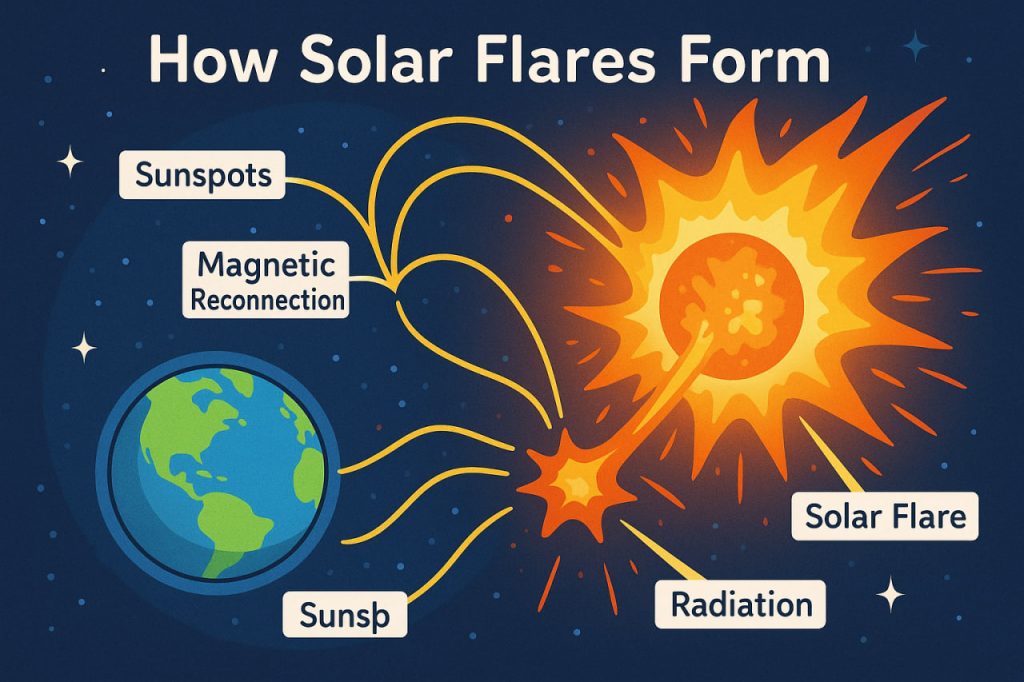
The Sun may look calm from Earth, but it is in constant motion — a fiery, magnetic storm of plasma and light. Among its most dramatic phenomena are solar flares: sudden bursts of energy that release the power of millions of nuclear bombs in seconds. These cosmic explosions can affect satellites, disrupt radio signals, and even paint the sky with colorful auroras. But what exactly causes them?
What Is a Solar Flare?
A solar flare is a sudden, intense release of electromagnetic energy from the Sun’s atmosphere. It occurs when magnetic energy, stored in twisted magnetic field lines above sunspots, is suddenly released.
During a flare, the Sun ejects powerful radiation across the electromagnetic spectrum — from radio waves to X-rays and gamma rays. These energetic emissions can travel at the speed of light, reaching Earth in just eight minutes.
Astrophysicist Dr. Elena Vargas describes solar flares as:
“The Sun’s way of snapping back after twisting itself too tightly — a magnetic outburst that shakes the entire solar system.”
How Solar Flares Form
- Sunspots and Magnetic Fields
Solar flares start in areas called sunspots — dark, cooler regions on the Sun’s surface with intense magnetic activity. The Sun’s plasma, made of charged particles, moves constantly, causing magnetic field lines to twist and tangle. - Magnetic Reconnection
When these field lines become too distorted, they suddenly reconnect, releasing vast amounts of stored energy. This process, known as magnetic reconnection, is the spark that triggers a solar flare. - Explosion and Radiation Release
The released energy accelerates particles and heats plasma to tens of millions of degrees Celsius. The result: an explosive burst of light and radiation that can be observed even from Earth.
Types of Solar Flares
Scientists classify solar flares based on their X-ray brightness into several categories:
- A and B-class — small flares, barely affecting Earth.
- C-class — moderate, occasionally causing minor radio disruptions.
- M-class — strong flares that can disturb communications and navigation systems.
- X-class — the most powerful, capable of causing geomagnetic storms and satellite damage.
Effects on Earth
While solar flares themselves don’t harm humans directly (thanks to Earth’s magnetic field and atmosphere), they can impact our technology:
- Satellites may experience interference or damage.
- Power grids can suffer voltage surges.
- Radio and GPS signals can be disrupted.
- Auroras — spectacular displays of colored light — often occur after powerful solar activity.
According to NASA physicist Dr. Marcus Allen:
“Solar flares remind us that even from 150 million kilometers away, the Sun is still the most influential force in our cosmic neighborhood.”
Interesting Facts
- A single X-class flare can release energy equal to 10 billion atomic bombs.
- The largest recorded flare occurred in September 1859 — the “Carrington Event” — and caused global telegraph failures.
- Solar activity follows an 11-year cycle, alternating between quiet and active phases.
- Flares often accompany coronal mass ejections (CMEs) — vast eruptions of solar plasma that can affect space weather.
Glossary
- Sunspot — a cooler, dark region on the Sun’s surface with intense magnetic fields.
- Magnetic reconnection — the process by which magnetic field lines break and reconnect, releasing energy.
- Geomagnetic storm — a disturbance in Earth’s magnetic field caused by solar activity.
- Coronal mass ejection (CME) — a massive burst of solar plasma and magnetic field from the Sun’s corona.