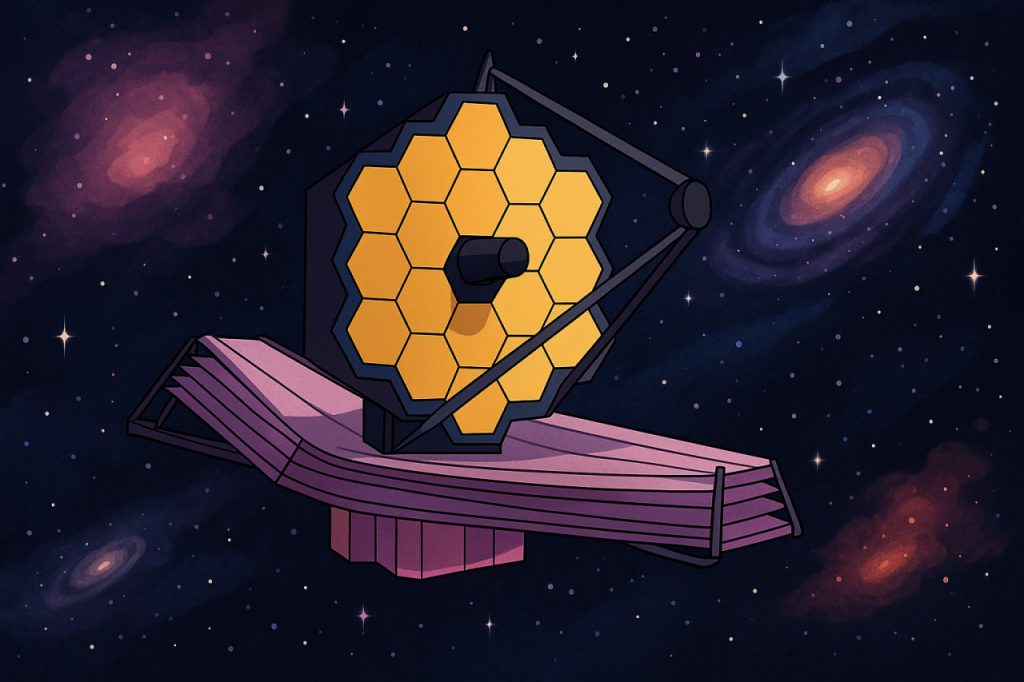
The James Webb Space Telescope (JWST) is one of the most ambitious scientific instruments ever built. Launched on December 25, 2021, it has revolutionized astronomy by allowing humanity to peer deeper into space — and further back in time — than ever before. Often called the “successor to Hubble,” Webb is not just a telescope; it’s a time machine revealing the universe’s earliest galaxies and the secrets of cosmic evolution.
A New Era of Space Observation
The JWST was developed through a collaboration between NASA, the European Space Agency (ESA), and the Canadian Space Agency (CSA). Unlike the Hubble Space Telescope, which observes primarily in visible and ultraviolet light, Webb operates in the infrared spectrum. This allows it to see through cosmic dust and detect light from objects that formed more than 13 billion years ago.
According to NASA astrophysicist Dr. Jane Rigby:
“Webb doesn’t just show us what’s out there — it reveals how everything began. It’s rewriting cosmic history in real time.”
Engineering Marvel
The telescope’s design is a masterpiece of precision and innovation:
- A 6.5-meter gold-coated mirror — more than twice the size of Hubble’s — collects faint infrared light.
- A five-layer sunshield the size of a tennis court protects the instruments from the Sun’s heat, keeping them at -233°C.
- It orbits around the Lagrange Point 2 (L2), 1.5 million kilometers from Earth, in perfect balance between the Sun’s and Earth’s gravity.
The deployment process, involving over 300 single points of failure, was so complex that NASA called it “the most intricate space deployment in history.”
Breakthrough Discoveries
Since beginning operations in 2022, the James Webb Telescope has delivered breathtaking results:
- Capturing the oldest galaxies ever observed, dating back to just a few hundred million years after the Big Bang.
- Revealing the chemical composition of exoplanet atmospheres, including water vapor and carbon dioxide.
- Producing high-resolution images of nebulae, star nurseries, and dying stars, revealing the life cycles of celestial bodies.
Astronomer Dr. Eric López summarizes Webb’s impact:
“Every new image challenges what we thought we knew. Webb is not just confirming theories — it’s creating new ones.”
The Future of Cosmic Exploration
The JWST will continue to operate for at least 20 years, with enough fuel to maintain its orbit for decades. Scientists plan to use it to study dark matter, dark energy, and the origins of life by examining organic molecules in distant planetary systems.
It’s not only a triumph of science but also of human collaboration and imagination — proving that when nations unite for knowledge, humanity’s reach extends to the edge of the cosmos.
Interesting Facts
- The telescope’s mirror is made of 18 hexagonal beryllium segments coated with real gold.
- It cost about $10 billion and took over 25 years to design and build.
- Webb can detect heat signatures as faint as a candle on the Moon.
- Its infrared sensors can observe stars forming inside dense cosmic dust clouds, invisible to optical telescopes.
Glossary
- Infrared spectrum — electromagnetic radiation with wavelengths longer than visible light, used to detect heat.
- Exoplanet — a planet located outside our solar system.
- Lagrange Point (L2) — a stable orbital position where gravitational forces from the Sun and Earth balance.
- Sunshield — a multilayer barrier protecting the telescope’s instruments from heat and light.