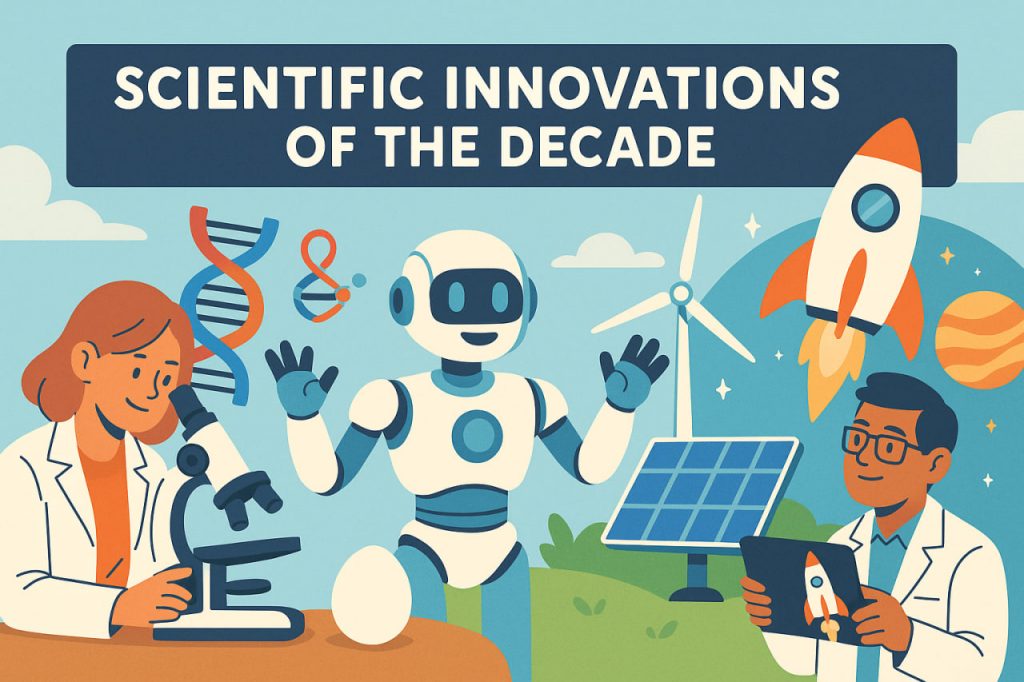
Science never stands still. Over the past decade, humanity has witnessed a wave of discoveries and technologies that are transforming medicine, energy, communication, and our understanding of the universe. These innovations are not just reshaping industries — they’re redefining what’s possible for human progress.
Medical Advances: From Genetics to Regeneration
One of the most remarkable areas of innovation has been medicine. The development of mRNA vaccines, pioneered during the COVID-19 pandemic, revolutionized how scientists design and produce vaccines — opening doors for future treatments against cancer and autoimmune diseases.
Another frontier is gene editing, particularly the CRISPR-Cas9 system. This technology allows precise modification of DNA, offering hope for curing hereditary diseases such as cystic fibrosis and sickle cell anemia.
According to geneticist Dr. Sarah Mitchell:
“We’re entering a new era of personalized medicine, where treatments are tailored to a person’s genetic code. The implications for global health are enormous.”
Artificial Intelligence and Quantum Computing
Artificial intelligence (AI) has become a cornerstone of modern science. AI systems now assist in drug discovery, climate modeling, and even space exploration. Machine learning algorithms analyze massive datasets faster than any human, leading to breakthroughs in everything from agriculture to astrophysics.
Meanwhile, quantum computing is beginning to challenge the limits of classical computing. Companies like IBM and Google have developed prototype quantum processors capable of performing calculations once deemed impossible — promising future leaps in encryption, material science, and data processing.
Sustainability and Green Technologies
In the face of climate change, sustainable innovation has accelerated. Breakthroughs in renewable energy, including ultra-efficient solar panels, hydrogen fuel technologies, and carbon capture systems, are reshaping global energy strategies.
Biotechnology has also played a crucial role — from lab-grown meat to biodegradable plastics made from algae. These advances could drastically reduce the ecological footprint of modern civilization.
Environmental scientist Dr. Luca Fernandez explains:
“Innovation in sustainability is not optional — it’s essential for survival. Every new technology that cuts emissions or saves resources helps secure the planet’s future.”
Space Exploration and Beyond
Space science has seen a renaissance. Private companies like SpaceX have lowered launch costs and reignited global interest in exploration. The James Webb Space Telescope has already provided breathtaking insights into the formation of galaxies, while lunar and Mars missions continue to push the boundaries of what humanity can achieve.
Interesting Facts
- The first fully lab-grown synthetic meat burger was produced in 2013; today, it’s commercially viable.
- In 2022, scientists created the world’s first fusion reaction that produced more energy than it consumed.
- AI has discovered new antibiotics by analyzing billions of molecular structures.
- Quantum computers can perform calculations millions of times faster than traditional supercomputers in specific tasks.
Glossary
- CRISPR-Cas9 — a gene-editing tool that can modify DNA sequences with high precision.
- Quantum computing — a type of computation that uses quantum bits, enabling vastly superior processing power.
- mRNA vaccine — a new type of vaccine that teaches cells to make a protein to trigger an immune response.
- Carbon capture — technology that traps carbon dioxide emissions to prevent them from entering the atmosphere.