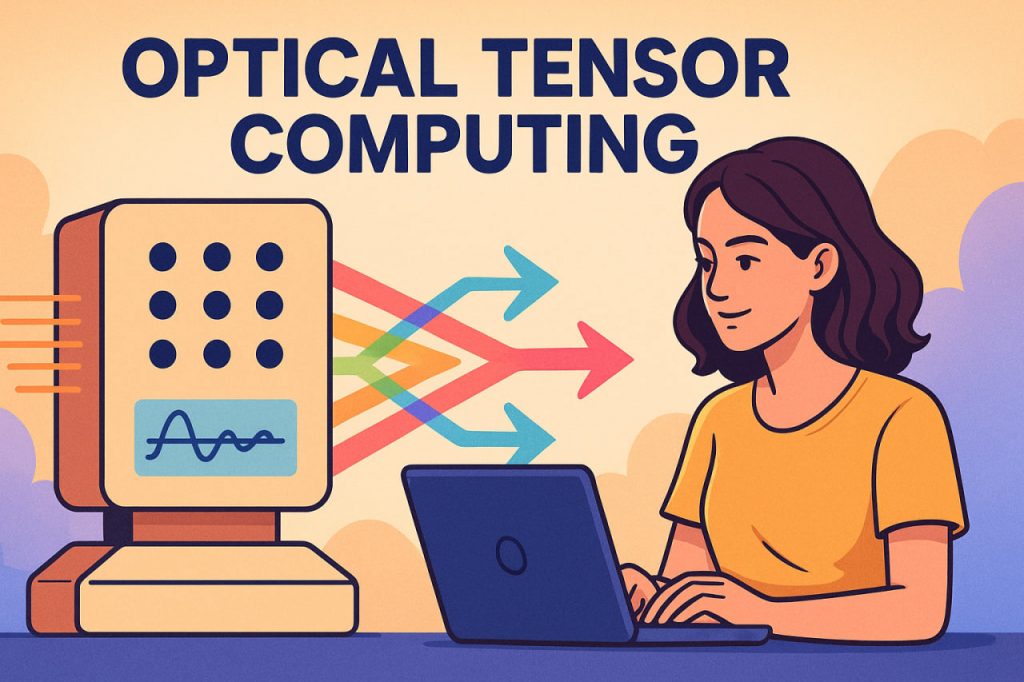
Optical tensor computing represents a breakthrough approach to performing complex mathematical operations using light instead of traditional electronic circuits. This technology relies on photonic components to process multidimensional data structures—known as tensors—at unprecedented speeds and with significantly lower energy consumption. Because photons travel faster and generate far less heat than electrons, optical systems can execute massive parallel computations more efficiently, making them especially valuable for fields such as artificial intelligence, scientific simulations, and large-scale data analytics. Many researchers believe that optical tensor processors will eventually complement or even surpass conventional semiconductor-based accelerators in certain applications. At the same time, experts caution that while optical systems offer impressive speed advantages, they must be carefully engineered to integrate reliably with existing computing infrastructure. As development continues, optical tensor computing stands out as one of the most promising directions in next-generation computational technology.
How Optical Tensor Computers Work
Optical tensor computers operate by encoding numerical values into the properties of light, such as intensity, phase, or polarization, and then manipulating these values using specialized photonic devices. Components like diffractive layers, nonlinear optical materials, and waveguides perform the equivalent of tensor multiplications and convolutions as light passes through them. Because these operations occur simultaneously across the entire optical field, the system naturally supports extremely high levels of parallelism. Researchers highlight that such devices can perform trillions of operations per second while consuming only a fraction of the power required by electronic processors. However, the design must ensure precision in controlling optical pathways, as minor distortions may lead to computational inaccuracies. This technology demonstrates how principles of physics can be harnessed to achieve computational performance far beyond traditional limits.
Expert Opinions on Photonic Acceleration
According to optical computing researcher Dr. Mei-Lin Zhou, photonic tensor processors have the potential to revolutionize AI workloads by dramatically reducing inference latency and energy costs. She emphasizes that optical systems excel at multiplying large matrices, a core operation in deep learning. Meanwhile, computational physicist Dr. Robert Hale notes that despite the impressive theoretical capabilities, real-world deployment requires advancements in hybrid architectures that combine optical and electronic subsystems effectively. He stresses that engineers must ensure long-term stability, calibration protocols, and compatibility with standard software frameworks. Together, these expert perspectives reveal both the promise and the current challenges associated with bringing optical tensor computing into mainstream use.
Applications and Industry Potential
Optical tensor computing is poised to impact a wide range of industries, from autonomous vehicles to climate modeling. In machine learning, optical processors can accelerate neural network inference for tasks like image recognition, natural language processing, and predictive analytics. In scientific research, they can handle large numerical models such as fluid dynamics simulations, astronomical data processing, and materials science calculations. Telecommunications could benefit as well, using optical processors to manage real-time signal processing for high-bandwidth networks. Companies exploring these technologies foresee major reductions in operational costs thanks to lower power usage and smaller cooling requirements. As governments and research institutions increase funding for photonic technologies, the development landscape continues to expand rapidly.
Interesting Facts
Optical computing concepts first emerged in the 1960s, but only recent advances in nanophotonics made practical optical tensor processors possible. Some experimental devices can perform matrix multiplications using a single pass of light through a patterned optical layer, completing operations almost instantaneously. Photonic chips are often fabricated using the same methods as semiconductor chips, allowing potential integration into future computing hardware. Researchers are also exploring hybrid quantum-photonic systems that could combine optical tensor processing with quantum algorithms.
Glossary
- Tensor — a multidimensional array of numerical values used widely in machine learning and physics.
- Photonic Processor — a computing device that uses light instead of electricity to perform operations.
- Nonlinear Optics — a field studying how light interacts with materials in ways that change its frequency or amplitude.
- Diffraction Layer — a patterned optical surface that manipulates light to perform mathematical transformations.