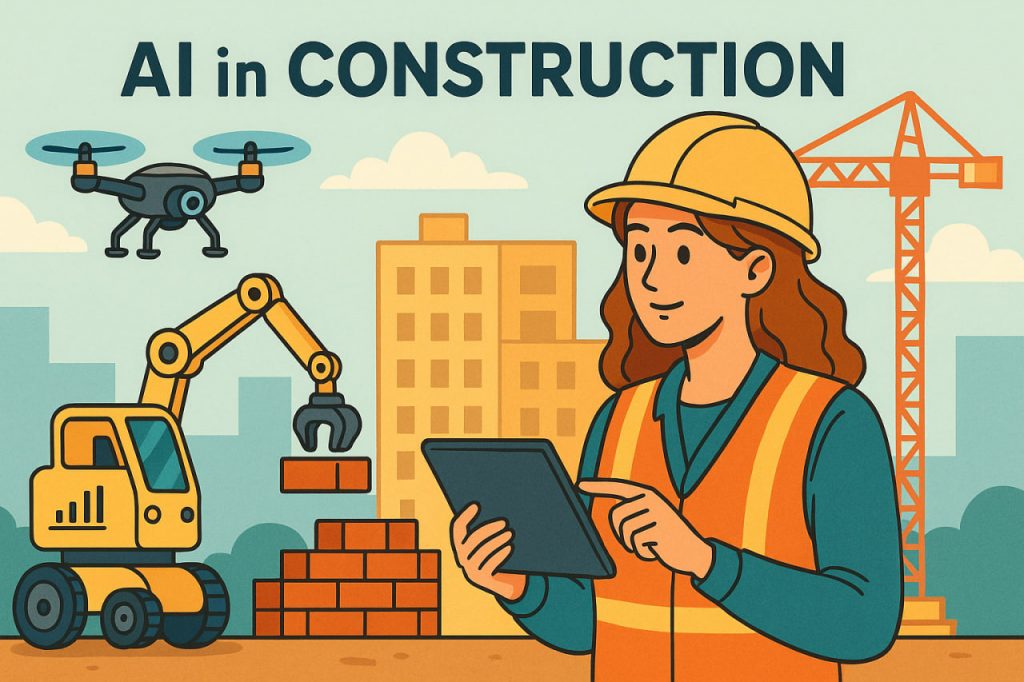
Artificial intelligence is rapidly transforming the construction industry, offering new possibilities for improving efficiency, safety, and project management. Modern construction projects generate massive amounts of data, from material estimates to structural measurements, and AI provides the tools needed to analyze this information quickly and accurately. The implementation of AI also helps reduce human error by automating repetitive tasks and providing predictive insights that guide decision-making. As a result, construction companies are increasingly adopting AI-driven systems to streamline operations and optimize resources. At the same time, experts emphasize that AI is not a replacement for skilled professionals but rather a tool that enhances their abilities. The careful integration of AI ensures that construction remains innovative, reliable, and aligned with global technological standards.
How AI Improves Construction Processes
AI enhances construction processes by automating time-consuming tasks such as scheduling, cost estimation, and equipment management. Machine learning algorithms can analyze historical project data and predict delays, allowing teams to take preventive measures before issues escalate. Building Information Modeling (BIM) systems powered by AI can detect design inconsistencies early, reducing costly rework and improving collaboration between architects, engineers, and contractors. In addition, AI-based drones and robotics improve worker safety by performing hazardous inspections in difficult-to-reach areas. Experts note that companies using AI-supported planning tools often achieve more accurate timelines and budget forecasts, leading to higher client satisfaction. As a result, AI contributes to more efficient, safer, and higher-quality construction outcomes.
Expert Opinions on AI Adoption in Construction
Many industry experts agree that the construction sector is experiencing a major technological shift driven by AI innovations. Structural engineering specialist Dr. James Thornton states that AI allows teams to identify structural risks earlier than ever before, significantly reducing safety concerns on large projects. In contrast, project management consultant Olivia Martinez highlights that companies should adopt AI gradually, ensuring that staff receive proper training to avoid misunderstandings about how the technology works. Both experts underline the importance of combining AI with human expertise to achieve the best possible results. They argue that when professionals understand and manage AI tools correctly, project performance improves while maintaining high safety and quality standards. Their perspectives demonstrate that responsible AI integration is essential for sustainable progress in construction.
Future Trends of AI in Construction
The future of AI in construction includes the rise of autonomous machinery capable of performing tasks such as excavation, bricklaying, and material transportation with minimal human intervention. Predictive analytics are expected to play an even greater role, helping companies forecast maintenance needs and resource requirements long before problems arise. AI-enabled sensors will become more common on construction sites, continuously tracking structural stability and environmental conditions. As global interest in smart cities grows, AI will support the development of infrastructure that is both efficient and environmentally sustainable. Many specialists believe that augmented reality (AR) combined with AI will provide real-time visualizations that help teams detect inaccuracies instantly. These trends indicate that AI will continue to be a driving force behind the modernization of the construction industry.
Interesting Facts
AI-driven robotics were first tested for construction tasks in Japan in the 1980s, but only recent advances in machine learning made mass adoption possible. Some modern construction robots can lay more than 3,000 bricks per day, significantly more than a human worker. AI-powered drones can scan entire building sites in minutes, creating detailed 3D maps that previously required hours of manual labor. Many universities now offer specialized programs in construction technology to prepare future professionals for AI-supported work environments.
Glossary
- Machine Learning — a branch of AI that enables systems to learn from data rather than being programmed with explicit rules.
- BIM (Building Information Modeling) — a digital representation of a building’s physical and functional characteristics.
- Predictive Analytics — advanced analysis that forecasts future events based on historical data.
- Autonomous Machinery — equipment capable of operating with minimal or no human control.