Every time you start your car or ride a motorcycle, a complex series of explosions happens beneath the hood — safely and efficiently. This is the work of the internal combustion engine (ICE), one of the most important inventions in human history. Despite growing electric alternatives, internal combustion engines still power most vehicles around the world today.
The Basic Principle
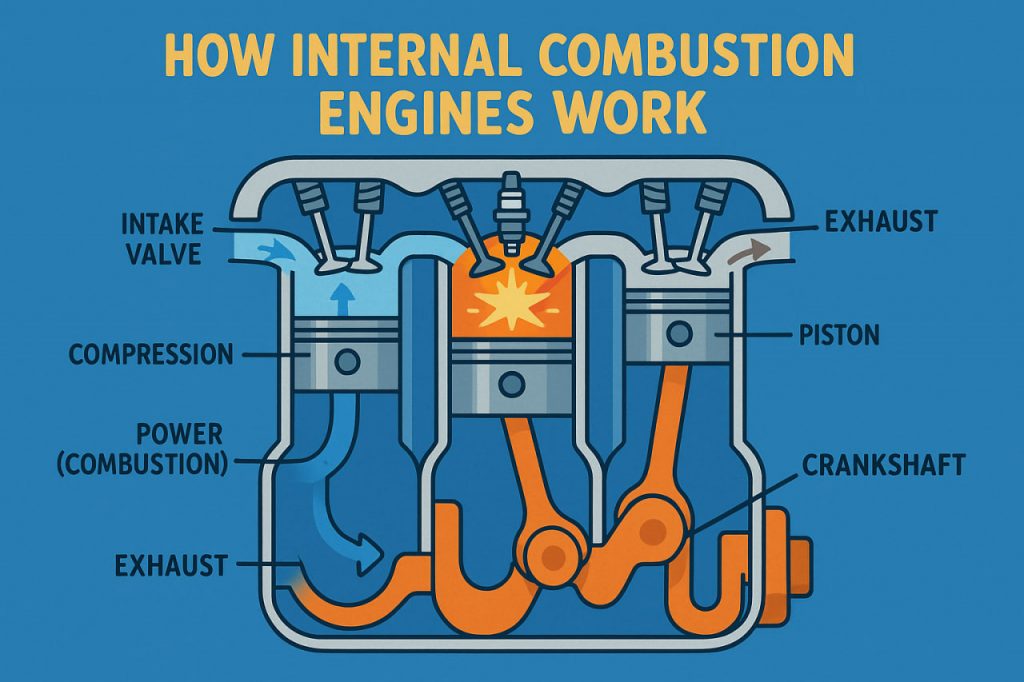
An internal combustion engine converts chemical energy (from fuel) into mechanical energy (motion). This happens through controlled explosions — or combustions — inside cylinders. The expanding gases from burning fuel push pistons, which in turn rotate a crankshaft that powers the wheels.
Mechanical engineer Dr. Hugo Fernández explains:
“The internal combustion engine is a masterpiece of timing and precision — every spark, valve, and piston must move in harmony to turn explosions into motion.”
The Four-Stroke Cycle
Most car engines operate on the four-stroke cycle, developed by Nikolaus Otto in the 19th century. It includes four stages:
- Intake — The piston moves down, drawing in a mixture of air and fuel through an open valve.
- Compression — The piston moves up, compressing the mixture to make it more combustible.
- Power (Combustion) — A spark plug ignites the mixture, causing an explosion that pushes the piston downward — this is the stroke that generates power.
- Exhaust — The piston moves up again, pushing burned gases out of the cylinder through the exhaust valve.
This sequence repeats thousands of times per minute, providing smooth, continuous motion.
Main Parts of an Internal Combustion Engine
- Cylinder — the chamber where combustion occurs.
- Piston — moves up and down inside the cylinder.
- Crankshaft — converts the piston’s movement into rotation.
- Valves — control air and fuel intake and exhaust flow.
- Spark plug — ignites the fuel-air mixture in gasoline engines.
- Camshaft — coordinates valve movement.
- Fuel injector or carburetor — mixes and delivers the correct amount of fuel.
Types of Internal Combustion Engines
- Gasoline engines — use spark ignition; common in cars and motorcycles.
- Diesel engines — use compression ignition; more efficient and powerful, used in trucks and ships.
- Rotary (Wankel) engines — use a triangular rotor instead of pistons; compact but less fuel-efficient.
- Two-stroke engines — simpler and lighter, used in small machines like chainsaws or scooters.
Efficiency and Emissions
Although ICEs are powerful and reliable, they produce carbon dioxide (CO₂) and nitrogen oxides (NOx), contributing to air pollution and climate change. Engineers are developing hybrid systems and cleaner fuels to reduce their environmental impact while maintaining performance.
Automotive expert Dr. Irina Volkova notes:
“Modern engines are far cleaner than their predecessors — electronic control, catalytic converters, and precise fuel injection have transformed their efficiency.”
Interesting Facts
- A typical car engine completes over 2,000 combustion cycles per minute at highway speed.
- Diesel fuel has 15% more energy per liter than gasoline.
- Formula 1 engines can reach over 15,000 revolutions per minute (RPM).
- The first practical internal combustion engine was built by Étienne Lenoir in 1859.
Glossary
- Combustion — a chemical reaction of fuel and oxygen producing heat and energy.
- Torque — rotational force generated by the engine.
- RPM (Revolutions per minute) — the number of crankshaft rotations per minute.
- Hybrid engine — combines an internal combustion engine with an electric motor.