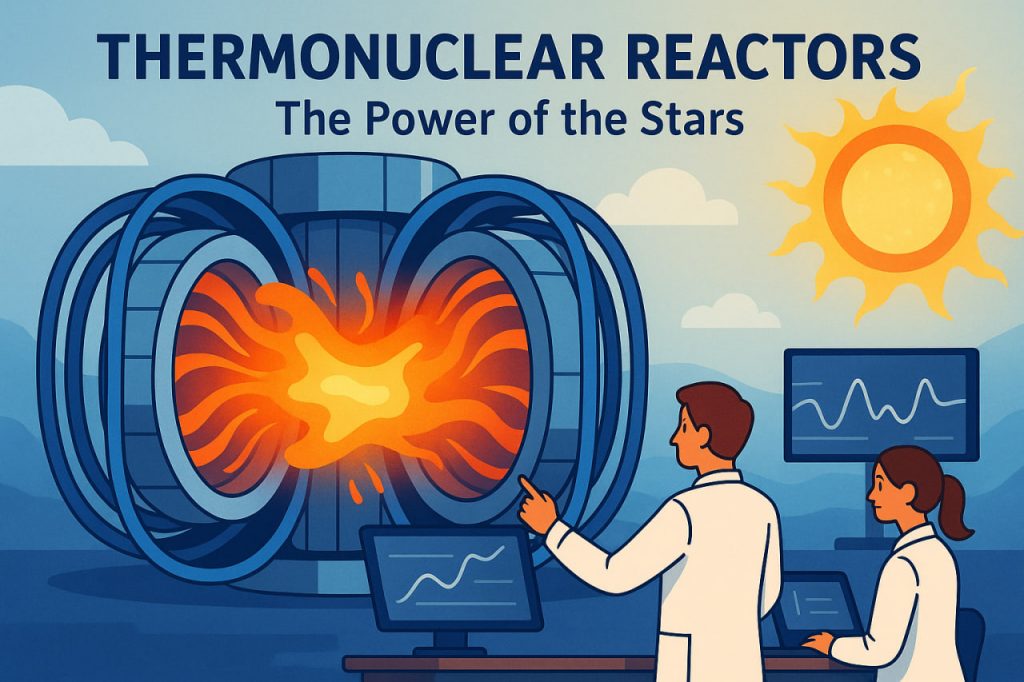
For decades, scientists have dreamed of recreating the Sun’s immense power here on Earth. Thermonuclear fusion, the process that fuels stars, promises nearly limitless clean energy — if we can learn to control it. Modern thermonuclear reactors are at the frontier of physics and engineering, offering hope for a future free from fossil fuels and pollution.
What Is Thermonuclear Fusion?
Thermonuclear fusion is the process in which atomic nuclei combine to form a heavier nucleus, releasing enormous amounts of energy. In the Sun, hydrogen atoms fuse into helium under extreme temperature and pressure, producing light and heat.
On Earth, scientists attempt to replicate this by heating hydrogen isotopes — deuterium and tritium — to over 100 million degrees Celsius, creating a plasma where fusion can occur.
Plasma physicist Dr. Laura Mendoza explains:
“Fusion is the ultimate clean energy source. A few grams of hydrogen fuel could power a city for days — without carbon emissions or radioactive waste.”
How a Thermonuclear Reactor Works
A fusion reactor must heat and confine plasma long enough for fusion reactions to take place. The two main approaches are:
- Magnetic Confinement (Tokamak and Stellarator)
Powerful magnetic fields trap plasma in a ring-shaped chamber, preventing it from touching the walls. The ITER project in France is currently the world’s largest tokamak reactor under construction. - Inertial Confinement
Tiny fuel pellets are compressed and heated with lasers or particle beams, causing rapid fusion before the plasma dissipates. Facilities like the National Ignition Facility (NIF) in the U.S. are advancing this method.
When fusion occurs, the resulting energy can be converted into electricity using heat exchangers and turbines — similar to conventional power plants, but without greenhouse gases or long-lived nuclear waste.
Advantages of Fusion Energy
- Clean energy — no carbon emissions or air pollution.
- Virtually limitless fuel — deuterium can be extracted from seawater.
- Safe operation — fusion reactions stop automatically if conditions are lost, avoiding meltdown risks.
- Minimal radioactive waste — materials used in reactors decay quickly compared to fission waste.
Challenges to Overcome
Despite decades of research, achieving stable, sustained fusion remains one of science’s greatest challenges:
- Extreme temperature control — plasma must be hotter than the Sun’s core.
- Magnetic stability — preventing plasma from escaping magnetic fields.
- Material durability — reactor walls must withstand intense heat and radiation.
- Energy balance — the energy produced must exceed the energy required to start and sustain the reaction.
Fusion engineer Dr. Kenji Watanabe notes:
“We’re no longer asking if fusion is possible — only when it will become practical and affordable.”
Global Fusion Projects
- ITER (France) — an international collaboration of 35 countries, expected to produce ten times more energy than it consumes.
- JET (UK) — the largest operational tokamak, providing key data for ITER.
- NIF (USA) — achieved a major milestone in 2022 with net energy gain from fusion for the first time.
- SPARC (USA) and Wendelstein 7-X (Germany) — private and public projects pushing compact reactor designs.
Interesting Facts
- A single glass of seawater contains enough hydrogen to produce energy equivalent to a barrel of oil.
- The Sun fuses 600 million tons of hydrogen per second.
- Fusion power could supply the world’s energy needs for millions of years.
- The first experimental hydrogen bomb used uncontrolled fusion — proving its power, but also its danger when not contained.
Glossary
- Plasma — a high-energy state of matter where electrons separate from atomic nuclei.
- Tokamak — a donut-shaped magnetic fusion reactor design.
- Deuterium/Tritium — hydrogen isotopes used as fusion fuel.
- Ignition — the point at which a fusion reaction sustains itself without external input.