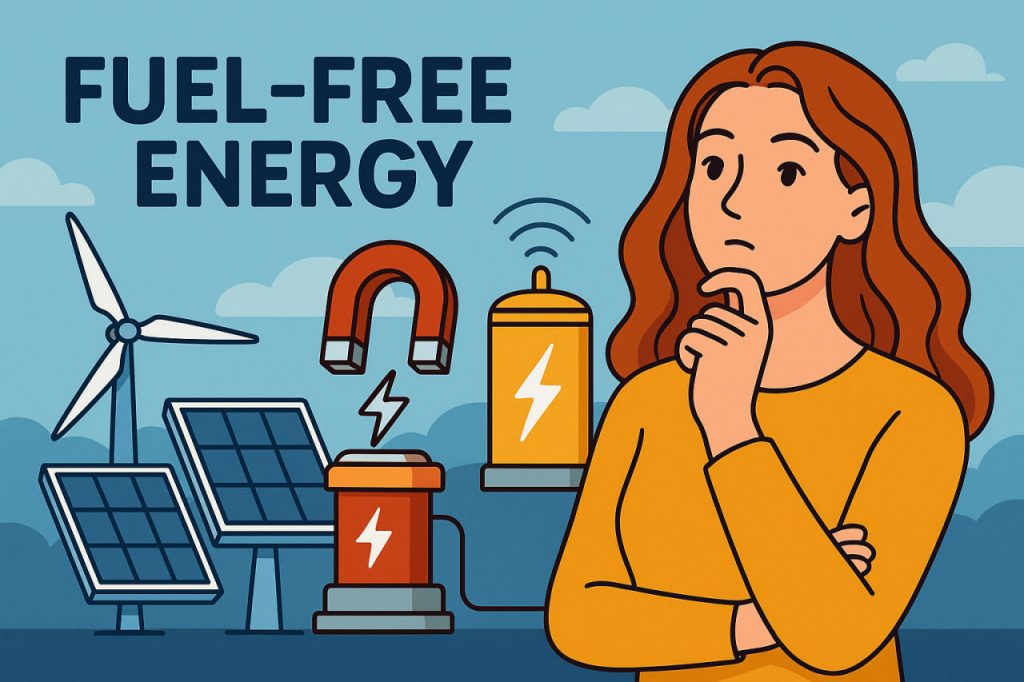
Fuel-free energy represents one of the most ambitious areas of modern scientific research, focusing on ways to generate power without traditional fossil fuels or consumable energy sources. This field includes technologies that harness natural physical phenomena, such as magnetic fields, ambient heat, atmospheric electricity, and zero-point energy. While many concepts remain theoretical or experimental, researchers worldwide continue exploring solutions that could drastically reduce humanity’s dependence on conventional energy systems. Some scientists argue that fuel-free approaches may complement renewable energy rather than replace it, helping stabilize grids and reduce environmental impact. However, experts also emphasize that rigorous testing, peer-reviewed studies, and transparent methodology are essential to distinguish real scientific progress from unverified claims. Understanding current developments allows us to identify which technologies show genuine potential and which remain purely speculative.
Magnetic and Electromagnetic Systems
One of the most actively explored areas in fuel-free energy research involves magnetic and electromagnetic configurations designed to generate rotational or linear motion without fuel consumption. These systems typically rely on permanent magnets, inductive coils, or resonant circuits to maintain continuous motion. Researchers highlight that while no verified perpetual-motion device exists, certain magnetic configurations may improve energy efficiency in motors and generators. Some modern prototypes attempt to reduce friction and increase torque using advanced materials and precision engineering. Electrical engineers note that laboratory results must be interpreted cautiously, as measurement errors can easily create the illusion of excess energy. Nonetheless, magnetic research continues to inspire innovations in motor design, electric vehicle components, and industrial automation.
Atmospheric and Ambient Energy Harvesting
Another promising direction involves capturing small amounts of energy naturally present in the environment. Technologies such as triboelectric nanogenerators, atmospheric electricity harvesters, and thermal-gradient converters are being tested for practical use. These devices operate by extracting energy from vibrations, temperature differences, humidity, or electrostatic charge in the air. Dr. Sofia Langen, an expert in nanoscale energy systems, notes that such technologies can already power low-energy sensors and microelectronics. Meanwhile, energy analyst Patrick Holmes emphasizes that scaling these systems to household or industrial levels remains a significant challenge. Despite limitations, ambient-energy harvesting plays an important role in developing self-sustaining electronic devices and next-generation IoT infrastructure.
Speculative and Emerging Concepts
Fuel-free energy also includes more speculative areas of research, such as zero-point energy extraction, space-time fluctuation resonance, and advanced thermodynamic cycles. These concepts often appear in theoretical physics and have not yet demonstrated practical energy output under controlled scientific conditions. However, they inspire new ways of thinking about physical laws and may contribute to long-term breakthroughs. Some research groups experiment with high-frequency vacuum fluctuations or exotic materials in hopes of uncovering previously unknown energy interactions. Experts warn that while exploration is valuable, extraordinary claims require extraordinary evidence, and all experiments must undergo repeatable validation. Even so, speculative research occasionally leads to innovations that transform modern engineering.
Interesting Facts
Some of the earliest attempts at fuel-free energy appeared in the late 19th century, inspired by discoveries in electromagnetism. Nikola Tesla experimented with atmospheric electricity collectors, some of which resemble modern energy-harvesting devices. Triboelectric nanogenerators can produce electricity simply from the friction of walking, wind vibrations, or raindrops. Even today, scientists continue searching for new physical principles that might one day enable breakthrough energy systems.
Glossary
- Zero-Point Energy — the lowest possible energy state of a quantum system, often referenced in theoretical energy discussions.
- Triboelectric Nanogenerator — a device that generates electricity from mechanical friction or motion.
- Thermal Gradient — a temperature difference between two points that can be converted into energy.
- Electromagnetic Resonance — amplification of oscillations within an electromagnetic system at specific frequencies.