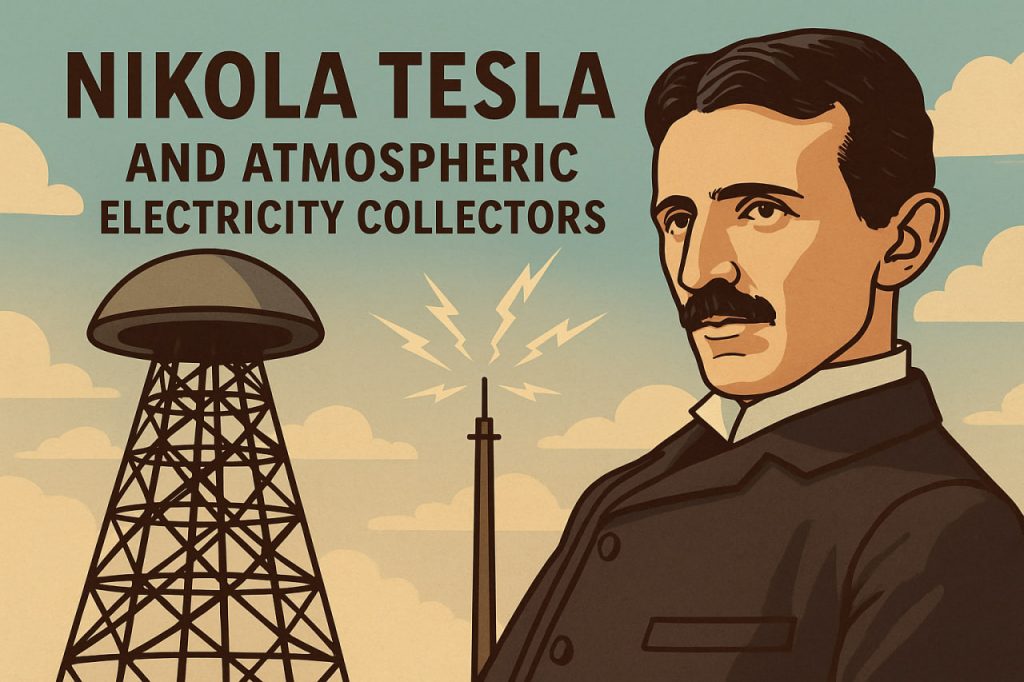
Nikola Tesla’s experiments with atmospheric electricity collectors remain one of the most intriguing chapters in the history of electrical engineering. Tesla believed that Earth’s atmosphere contained vast stores of electrical energy that could be captured and transmitted without traditional fuel sources. Throughout the late 19th and early 20th centuries, he conducted numerous experiments involving high-frequency currents, elevated conductive plates, and resonant transformers designed to tap into natural electrical potentials. Although many of Tesla’s patents and laboratory notes describe his concepts in detail, the full technical feasibility of his atmospheric collectors remains a subject of debate among historians and engineers. Even so, his pioneering research laid foundational ideas for modern wireless energy transfer and environmental energy harvesting. Tesla’s atmospheric electricity concepts continue to inspire scientists, inventors, and enthusiasts exploring alternative methods of clean power generation today.
How Tesla’s Atmospheric Collectors Worked
Tesla’s designs typically involved elevated metal plates or conductive surfaces connected to specialized circuitry capable of capturing electrical charges from the atmosphere. These charges originated from natural phenomena such as the ionosphere, lightning activity, and Earth’s electric field. Tesla theorized that by raising conductive collectors high enough, they could accumulate significant electrical potential, which could then be processed by transformers and capacitors. Some of his patents describe using an insulated elevated terminal paired with a ground connection, creating a system that pulls charge from the surrounding air. While the exact energy output remains uncertain, Tesla insisted that the atmosphere’s electrical gradient was a largely untapped resource. Modern engineers note that although atmospheric energy can be harvested in small amounts, replicating Tesla’s grand-scale vision would require significant technological breakthroughs and careful scientific validation.
Expert Opinions on Tesla’s Theories
Electrical engineering historian Dr. Laura Whitman states that Tesla’s atmospheric electricity experiments were visionary but limited by the technology of his time. She emphasizes that although Tesla’s theories were ambitious, many of his core ideas influenced modern wireless energy technologies. Meanwhile, renewable energy researcher Prof. Daniel Ortega explains that small-scale atmospheric energy harvesters exist today, but they operate on principles that produce low power suitable for sensors rather than large electrical systems. Both experts agree that Tesla’s atmospheric experiments were ahead of their time and continue to inspire research into unconventional energy sources. Their perspectives highlight the blend of scientific innovation and speculative exploration that defined Tesla’s work.
Modern Developments Inspired by Tesla
Today’s atmospheric energy research includes triboelectric air harvesters, electrostatic collectors, and devices that capture energy from humidity or air ionization. These technologies draw conceptual parallels to Tesla’s early ideas but rely on far more advanced materials and nanoscale engineering. Although none currently produce enough power to supply homes or industrial systems, they offer valuable opportunities for self-powered electronics and remote sensors. Research teams around the world continue exploring ways to increase efficiency, energy density, and scalability. Tesla’s vision serves as a philosophical foundation, demonstrating how curiosity-driven science can inspire innovations more than a century later. While large-scale atmospheric power remains a distant goal, ongoing research keeps the concept alive in modern scientific discourse.
Interesting Facts
Tesla built several atmospheric electricity devices at his Colorado Springs laboratory, including massive resonant transformers capable of producing spectacular lightning-like discharges. His Wardenclyffe Tower was originally intended as a global wireless power station, potentially powered in part by atmospheric electricity. Modern atmospheric energy harvesters can generate power from air humidity, raindrops, and even wind-blown dust particles. Some researchers believe Earth’s electric field could one day support new forms of micro-scale power systems.
Glossary
- Ionosphere — a charged region of Earth’s upper atmosphere that affects radio waves and electrical activity.
- Electrostatic Collector — a device that gathers electrical charge from the surrounding environment.
- Resonant Transformer — a transformer designed to operate at high frequencies, amplifying voltage through resonance.
- Electrical Gradient — the difference in electrical potential between two points in the atmosphere.