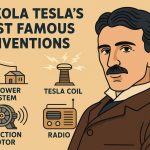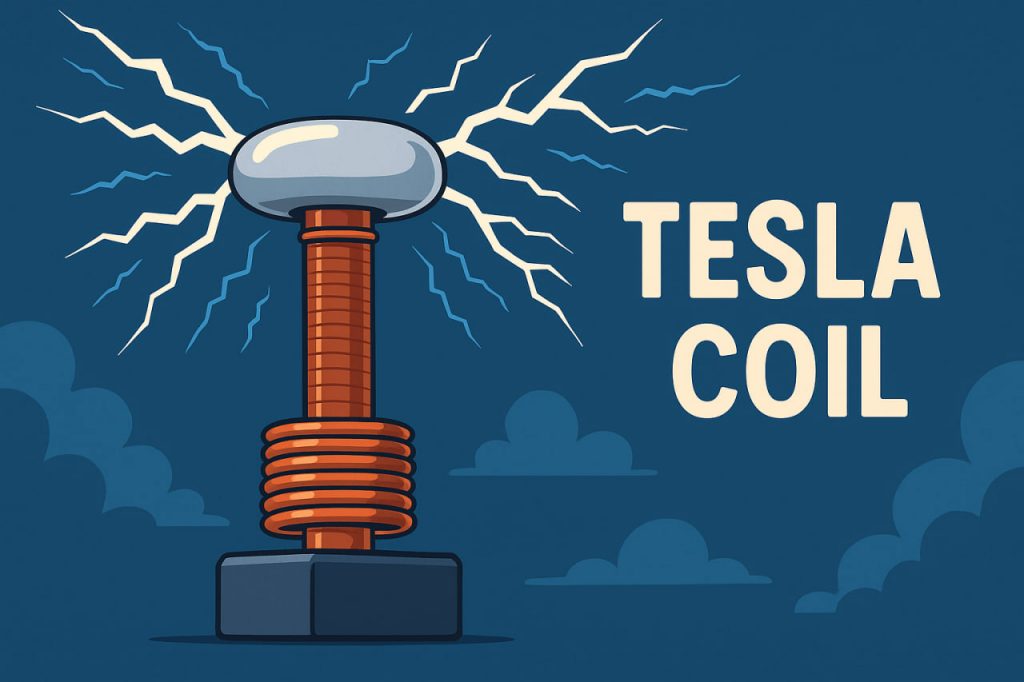
The Tesla Coil is one of the most iconic inventions in the history of electrical engineering, developed by Nikola Tesla in the 1890s as part of his pioneering research into high-frequency and wireless power transmission. This remarkable device produces extremely high voltages, creates spectacular electrical discharges, and demonstrates principles of resonance that were revolutionary for its time. Tesla originally designed the coil as a tool for transmitting electricity wirelessly across long distances, a concept he hoped would one day power homes and industries without traditional wires. Although this grand vision was never fully realized, the Tesla Coil became an essential experimental instrument that advanced the understanding of electromagnetism, radio-frequency engineering, and resonant circuits. Experts emphasize that despite being more than a century old, the Tesla Coil remains an extraordinary example of engineering creativity and scientific intuition.
How the Tesla Coil Works
A Tesla Coil operates on the principle of electromagnetic resonance, using two coupled circuits tuned to the same resonant frequency. The primary circuit, consisting of a capacitor and coil, generates high-frequency oscillations when charged and discharged rapidly. These oscillations induce energy into the secondary coil, which contains many more turns of wire, amplifying the voltage dramatically. As voltage builds up in the secondary coil, the surrounding air becomes ionized, allowing electric arcs and corona discharges to form. Engineers note that the coil can reach voltages exceeding one million volts depending on its design. Tesla used this phenomenon to test wireless energy transfer, lighting lamps at a distance and creating controlled electrical discharges that demonstrated the immense potential of resonant systems.
Expert Perspectives on Tesla Coil Technology
Electrical engineering professor Dr. Karen Ellis explains that the Tesla Coil served as a precursor to modern technologies such as radio transmitters, resonant transformers, and wireless communication systems. She highlights that many early radio inventions relied heavily on the resonant principles Tesla demonstrated. Meanwhile, research physicist Dr. Leo Han stresses that Tesla’s invention remains unmatched in its ability to visually demonstrate high-voltage behavior, making it invaluable for education and public demonstrations. Together, these expert insights show that the Tesla Coil is not merely a historical curiosity but a functional scientific instrument that continues to influence contemporary engineering.
Modern Uses of the Tesla Coil
Although the Tesla Coil is no longer used for large-scale energy transmission, it still plays an important role in various fields. Laboratories use advanced Tesla Coils for high-voltage testing, plasma research, and studies involving electrical breakdown of air. Smaller coils are popular in science museums, educational demonstrations, and artistic performances that combine music and synchronized electrical arcs. Tesla Coils also appear in modern innovations such as wireless charging systems, resonant inductive coupling, and specialized RF technologies. Engineers working on wireless power transfer note that many concepts in today’s devices echo Tesla’s early experiments. This ongoing relevance highlights the enduring impact of Tesla’s research on modern science and engineering.
Interesting Facts
Tesla famously created artificial lightning more than 15 meters long at his Colorado Springs laboratory using giant Tesla Coils. Early versions of the Tesla Coil were used in some of the first radio transmitters before more efficient designs replaced them. Modern “singing Tesla Coils” can modulate electrical discharges to play music using plasma-generated sound. Some of Tesla’s notes describe coils designed far larger than any built in his lifetime.
Glossary
- Resonant Circuit — an electrical circuit that oscillates at a specific natural frequency.
- Corona Discharge — a type of electrical discharge caused by ionization of air around a conductor at high voltage.
- Inductive Coupling — the transfer of electrical energy between coils using magnetic fields.
- High-Frequency Oscillation — rapid electrical cycles used to transmit energy through resonance.