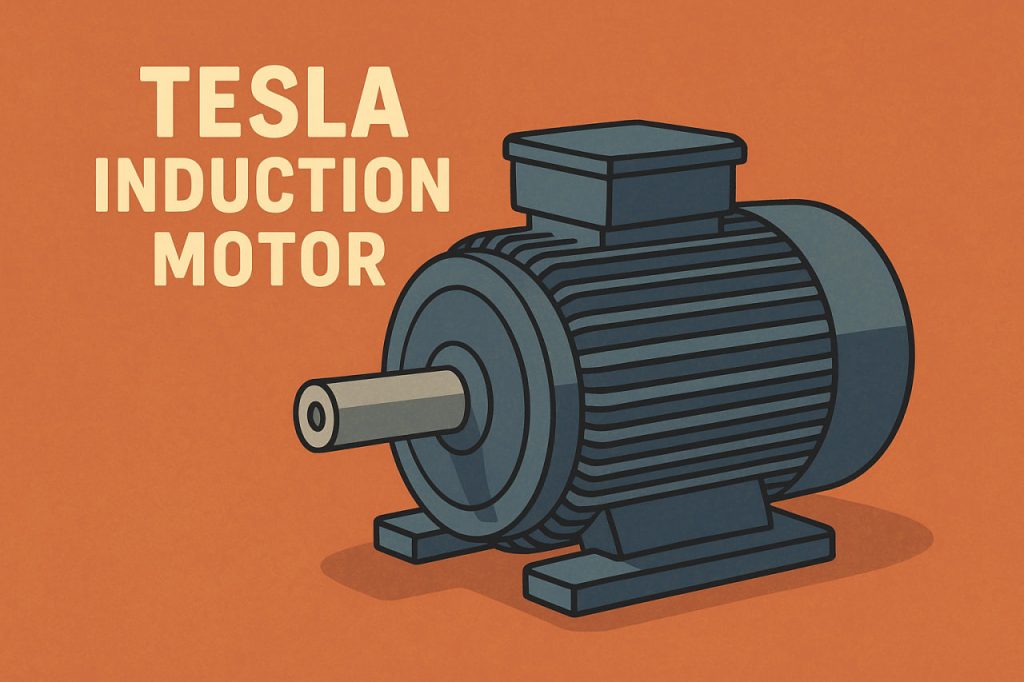
The induction motor invented by Nikola Tesla in 1887 is considered one of the most transformative technologies in the history of engineering. This motor changed the way industries operate by introducing a highly efficient, self-starting machine that runs on alternating current. Before Tesla’s work, electric motors were unreliable, required constant maintenance, and operated poorly under load. Tesla’s induction motor solved these problems by using a rotating magnetic field, a concept that became a cornerstone of modern electromechanical systems. Today, induction motors power everything from household appliances to large industrial machines, showcasing their durability, efficiency, and stability. Engineers often describe Tesla’s invention as the foundation upon which the modern electrical age was built, demonstrating his extraordinary vision and deep understanding of electromagnetic principles.
How Tesla’s Induction Motor Works
The principle behind the induction motor lies in the interaction between alternating current and magnetic fields. The stator, which remains stationary, generates a rotating magnetic field when powered by AC electricity. This magnetic field induces an electric current in the rotor, creating its own magnetic field that attempts to align with the stator’s rotation. As a result, the rotor spins without requiring physical electrical contact such as brushes or commutators. This design reduces mechanical wear and significantly improves reliability. Electrical engineering expert Dr. Samuel Hart notes that Tesla’s innovation eliminated many of the inefficiencies common in earlier motor designs. Meanwhile, industrial specialist Dr. Maria Cortez explains that the self-regulating nature of the induction motor makes it ideal for heavy-duty applications. Their combined insights confirm the exceptional elegance and practicality of Tesla’s design.
Industrial Impact and Modern Applications
Tesla’s induction motor quickly became a key technology during the Second Industrial Revolution, enabling factories to operate more efficiently and with fewer mechanical failures. Its simple yet powerful design allowed industries to adopt automated machinery on a large scale. Today, induction motors are found in pumps, elevators, air conditioners, electric vehicles, and manufacturing equipment. Engineers value them for their ability to operate continuously with minimal maintenance, even under demanding conditions. Modern variations include single-phase and three-phase models, each tailored to different applications. The widespread adoption of induction motors highlights the enduring influence of Tesla’s work and the timeless relevance of his contributions to electrical engineering.
Interesting Facts
Tesla patented the induction motor and rotating magnetic field in 1888, shortly before partnering with George Westinghouse to commercialize AC technology. Three-phase induction motors are considered some of the most efficient electric machines ever designed. Many electric vehicle manufacturers use induction motors inspired by Tesla’s original designs. Some of the earliest hydroelectric power plants used induction motors to transmit energy over long distances.
Glossary
- Stator — the stationary part of an electric motor that generates a rotating magnetic field.
- Rotor — the rotating component of a motor driven by induced magnetic forces.
- Rotating Magnetic Field — a magnetic field that moves in a circular motion, enabling induction motors to function.
- Three-Phase Power — a common AC electrical system used for industrial and high-power applications.