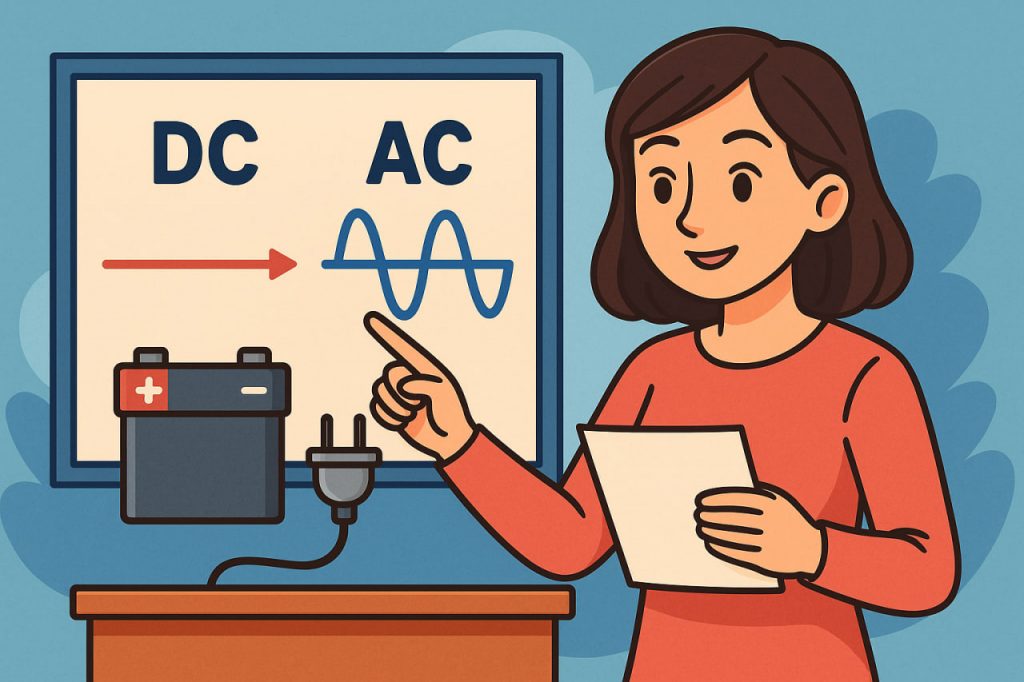
Electricity powers modern life, and understanding the difference between direct current (DC) and alternating current (AC) is essential for grasping how global energy systems operate. Both forms of electrical current play crucial roles in everything from household appliances to industrial machinery and modern electronics. DC flows continuously in one direction, making it vital for batteries, digital devices, and renewable energy storage systems. AC, on the other hand, changes direction periodically and is used for large-scale power distribution due to its efficiency over long distances. Experts emphasize that the coexistence of AC and DC systems reflects the diversity of technological needs in the modern world. By exploring their properties, applications, and history, we can better appreciate how these two electrical systems support daily life and technological progress.
What Is Direct Current (DC)?
Direct current is a type of electrical flow where electrons move steadily in a single direction. This characteristic makes DC highly stable and ideal for sensitive electronic components that require constant voltage. Batteries, solar panels, USB-powered devices, and electric vehicles all rely on DC to function efficiently. Electrical engineering specialist Dr. Laura Jennings explains that DC is essential for systems where voltage precision and stability are critical. She notes that DC technology continues to expand alongside renewable energy developments, particularly in storage solutions and electric transportation. Many modern power supplies convert AC from the grid into DC for safe use inside electronic devices, demonstrating the importance of DC in everyday applications.
What Is Alternating Current (AC)?
Alternating current periodically reverses direction, typically in a sinusoidal waveform, allowing for efficient transmission of electricity across long distances. This property makes AC the dominant form of electrical power used in homes, cities, and industries worldwide. The voltage of AC can be easily increased or decreased using transformers, enabling energy companies to transport electricity with minimal loss. Energy analyst Dr. Marcus Healy highlights that AC’s ability to adapt to different voltage levels revolutionized global power systems. He explains that AC distribution remains the most practical and economical way to power large-scale infrastructure. This adaptability ensures that AC continues to serve as the backbone of modern electrical grids.
Historical Background and Technological Significance
The rivalry between AC and DC, often called the “War of Currents,” shaped the development of electrical engineering in the late 19th century. Nikola Tesla championed AC for its efficiency in large-scale distribution, while Thomas Edison supported DC for its simplicity and safety in localized systems. Ultimately, AC became the standard for power grids, but DC remained indispensable for electronics and energy storage. Today, both systems coexist harmoniously due to advances in power conversion technology. High-voltage DC lines are now used for long-distance energy transmission, complementing traditional AC grids. This historical evolution demonstrates how competition between ideas can lead to technological progress benefiting future generations.
Interesting Facts
Long-distance power transmission lines can carry AC electricity for hundreds of kilometers with minimal loss thanks to high-voltage transformers. USB chargers and computer power supplies internally convert AC to DC before powering devices. Electric vehicles operate entirely on DC stored in their batteries, but they rely on AC motors in many designs. Some renewable energy systems use hybrid AC/DC architectures to maximize efficiency and flexibility.
Glossary
- Sinusoidal Waveform — a smooth, repetitive oscillation characteristic of AC power.
- Transformer — a device that changes voltage levels in AC circuits.
- Power Conversion — the process of converting AC to DC or DC to AC for different applications.
- Voltage Stability — the ability of a power source to maintain consistent voltage over time.