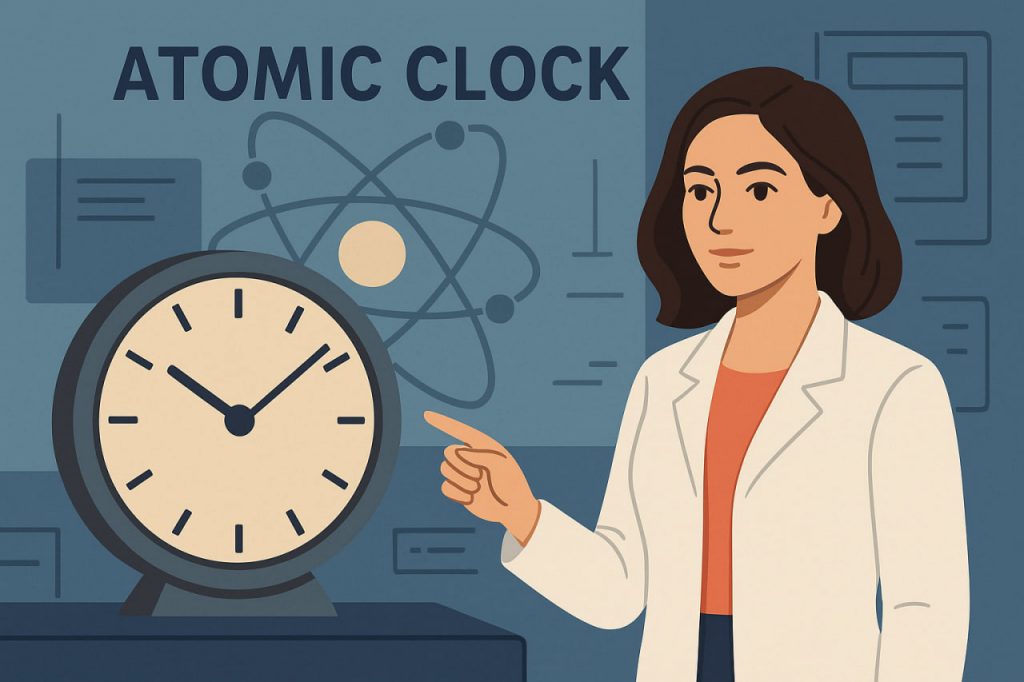
Atomic clocks are the most accurate timekeeping devices ever invented, capable of measuring time with extraordinary precision by tracking the natural vibrations of atoms. Unlike mechanical or quartz clocks, which rely on physical movement or crystal oscillation, atomic clocks use electromagnetic transitions within atoms, most commonly cesium or rubidium. These atomic oscillations are incredibly stable, allowing scientists to define the second based on the frequency of these transitions. Because of their unmatched accuracy, atomic clocks serve as the foundation of global navigation systems, telecommunications networks, scientific research, and international time standards. Their development represents a major milestone in physics and engineering, enabling technological advances that depend on nanosecond-level precision. Understanding how atomic clocks work reveals the extraordinary science behind modern timekeeping and the role they play in shaping today’s technological world.
How Atomic Clocks Work
Atomic clocks operate by measuring the frequency of electromagnetic radiation absorbed or emitted when electrons in an atom change energy levels. For cesium-133, the most widely used standard, this frequency is exactly 9,192,631,770 oscillations per second, a value that defines the modern SI second. Inside an atomic clock, atoms are exposed to microwave radiation tuned to this frequency. When the atoms absorb the energy, they transition to a higher state, allowing the system to detect whether the frequency is correct. The clock then adjusts itself to stay locked onto the exact natural resonance of the atom. Physicist Dr. Helena Brooks notes that the stability of atomic transitions allows these clocks to lose less than a second in millions of years. She emphasizes that without atomic clocks, technologies like GPS would be impossible because they rely on extremely precise timing signals.
Types of Atomic Clocks and Their Technologies
Several types of atomic clocks exist, each offering different advantages in accuracy and complexity. Cesium atomic clocks are the global standard for defining time and are widely used in laboratories and national timing centers. Rubidium clocks, while slightly less accurate, are smaller and more affordable, making them useful in navigation systems and telecommunications. More advanced optical lattice clocks trap atoms such as strontium or ytterbium in laser fields and measure their optical transitions, which oscillate thousands of times faster than microwave frequencies. According to time-standards researcher Dr. Marco Leland, optical clocks may eventually redefine the second because they are significantly more precise than current cesium clocks. He explains that future timekeeping may rely entirely on optical frequencies, offering unprecedented stability.
Applications in Science, Technology, and Navigation
Atomic clocks play an essential role in modern technology and global infrastructure. GPS satellites, for example, carry atomic clocks that broadcast precise timing signals to receivers on Earth. Even tiny timing errors could cause massive positional inaccuracies, making atomic precision crucial for navigation. Telecommunications networks synchronize data transmission with atomic time to ensure that signals are delivered in the correct sequence. In scientific research, atomic clocks help test fundamental theories of physics, including general relativity and the stability of physical constants. They also assist astronomers in measuring pulsar timing and tracking Earth’s rotation. These clocks underpin international timekeeping, ensuring that scientific, commercial, and civil systems operate on a unified global timescale.
Interesting Facts
Modern atomic clocks can remain accurate to within one second over more than 50 million years.
GPS satellites must account for Einstein’s relativity, which slightly alters the rate at which their atomic clocks tick.
Optical lattice clocks are so sensitive they can detect differences in gravitational potential just a few centimeters apart.
The official SI second has been defined by cesium atomic transitions since 1967.
Glossary
- Cesium-133 — the atom used to define the standard second in the International System of Units.
- Optical Lattice Clock — a highly advanced atomic clock using atoms trapped in a laser “lattice.”
- Microwave Frequency — electromagnetic waves used in cesium clocks to stimulate atomic transitions.
- Time Standard — an agreed-upon measurement used to maintain accuracy and consistency in global timekeeping.