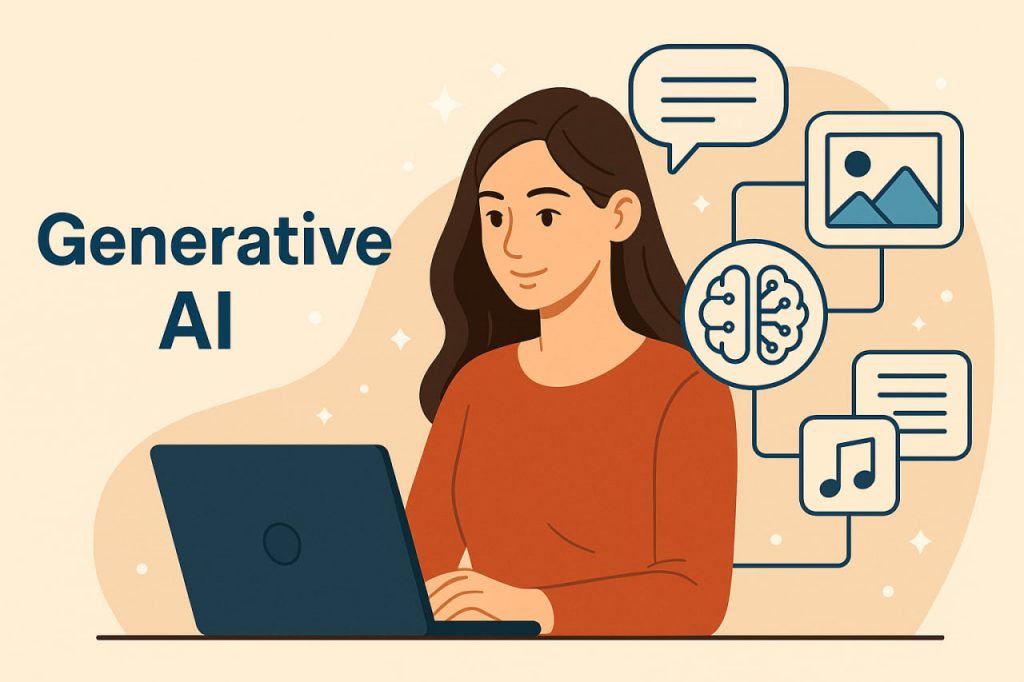
Generative artificial intelligence refers to a class of AI systems capable of producing new content such as text, images, audio, or even code based on patterns learned from large datasets. Unlike traditional software, which follows explicit rules, generative AI models learn statistical relationships and use them to generate outputs that can mimic human creativity. These systems rely on deep learning methods, particularly neural networks, to understand structure, style, and context in the data they process. Generative AI has become widely used in fields like art, entertainment, science, design, and business automation. Its rapid development has sparked both excitement and debate about its capabilities, limitations, and long-term societal impact. Understanding how generative AI works reveals not only its technological foundations but also the challenges of responsible deployment.
How Generative AI Works
Generative AI models are trained on massive datasets that allow them to learn patterns, relationships, and structures. During training, the model adjusts millions or billions of parameters to build an internal representation of the data it has seen. When prompted, it uses these learned representations to generate new outputs that resemble the training material while still being original. According to machine-learning researcher Dr. Adrian Lewis, transformer architectures have revolutionized generative AI by enabling models to understand long-range dependencies in language and images. He emphasizes that these architectures allow AI systems to produce coherent, context-aware content. Another specialist, Dr. Mira González, notes that the quality of generative output depends heavily on training data diversity and model size, explaining why modern models require enormous computational resources.
Applications Across Different Fields
Generative AI is used in a wide variety of industries to enhance productivity, creativity, and analytical capabilities. In the creative arts, AI assists with music composition, illustration, video generation, and storytelling. Businesses deploy generative systems to automate document drafting, customer support, and marketing content. In scientific fields, generative AI helps design new materials, optimize molecular structures, and simulate physical systems. Engineers use generative models to create 3D designs, accelerate prototyping, and improve manufacturing processes. The flexibility of generative AI allows it to adapt to user needs, often producing specialized results tailored to specific tasks. As industries continue to experiment with generative solutions, the technology is increasingly becoming a core tool in innovation workflows.
Challenges, Risks, and Ethical Considerations
Despite its advantages, generative AI also raises significant challenges and ethical concerns. Models sometimes generate inaccurate or biased information because they reflect imperfections in the datasets used to train them. This issue highlights the importance of data curation and responsible evaluation. Copyright questions also emerge when models generate content influenced by existing works, prompting ongoing debates in legal and creative communities. AI ethicist Dr. Samuel York warns that widespread adoption may amplify misinformation, especially if generated content is mistaken for verified facts. He stresses the need for transparency, governance, and human oversight. Moreover, high computational demands contribute to energy consumption, prompting calls for more efficient model architectures. Addressing these challenges is essential for ensuring long-term trust and safe deployment of generative AI systems.
Interesting Facts
Some of the earliest generative models date back to the 1950s, long before modern neural networks.
Large generative AI models can contain more than 100 billion parameters.
AI-generated artwork has been auctioned for hundreds of thousands of dollars.
Generative models can simulate proteins and molecules, accelerating medical and materials research.
Glossary
- Neural Network — a computational model inspired by the human brain, used to recognize patterns.
- Transformer Architecture — a deep-learning framework that enables models to process long sequences efficiently.
- Training Data — the information used to teach an AI model how to recognize patterns.
- Parameters — adjustable values inside an AI model that determine how it interprets and generates information.