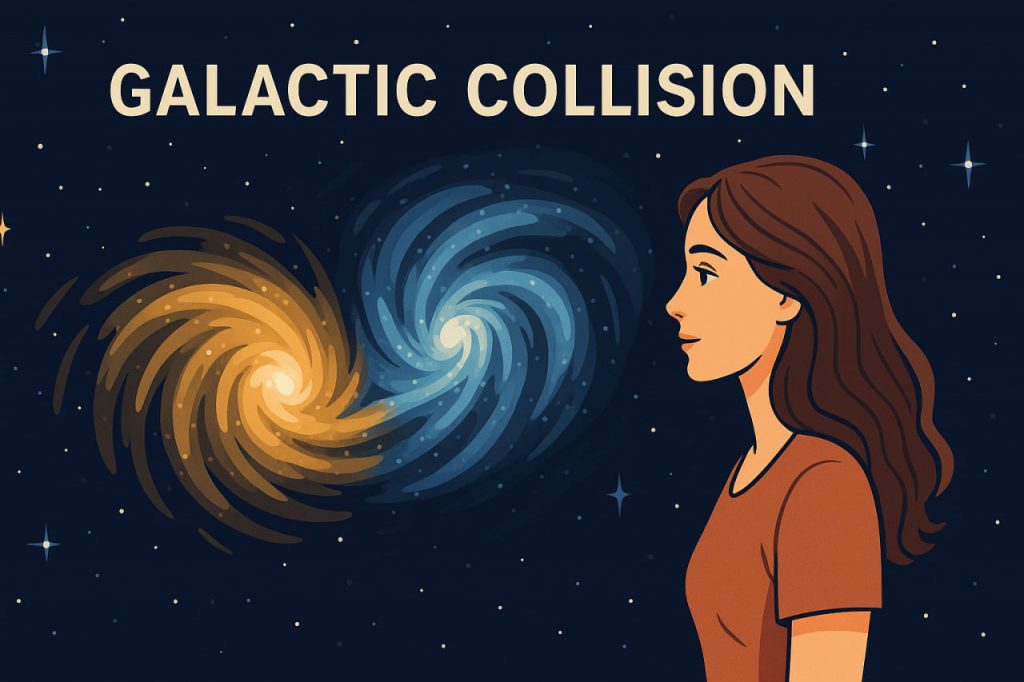
When two galaxies collide, the event becomes one of the most spectacular and transformative processes in the universe. Known as galactic mergers, these interactions shape the long-term evolution of galaxies, triggering bursts of star formation, distorting structure, and redistributing vast amounts of gas and dark matter. Despite their dramatic appearance, individual star collisions are extremely rare because stars are separated by enormous distances. Instead, the gravitational pull of each galaxy reshapes the other, stretching spiral arms, compressing gas clouds, and sometimes creating entirely new galactic forms. These mergers unfold over hundreds of millions of years, gradually blending the two galaxies into a single, larger system. Studying galactic collisions helps astronomers understand the forces that sculpt the cosmos and predict the future of our own Milky Way.
How Galactic Collisions Begin
Galactic collisions start when two galaxies drift close enough for their gravitational fields to interact. Even before the galaxies physically touch, gravity distorts their shapes, pulling out long tidal tails of stars and gas. As the galaxies move closer, their central regions experience stronger interactions that can ignite massive bursts of star formation. According to astrophysicist Dr. Hannah Cole, the first encounter is often the most chaotic, producing intense gravitational disturbances that reshape entire star systems. She explains that many of the dramatic structures we see in images—such as arcs, bridges, and luminous knots—are signs of active interaction. Over time, the galaxies lose orbital energy through gravitational friction and spiral closer until they fully merge.
What Happens During the Merger
During the merger phase, gas clouds inside each galaxy are compressed, creating rapid star formation known as starburst activity. This burst of stellar birth can produce thousands of new stars in a relatively short cosmological period. Meanwhile, supermassive black holes at the centers of both galaxies move inward, eventually forming a binary black hole system that may later merge. Stellar orbits become randomized, transforming graceful spiral galaxies into more spherical or elliptical shapes. Astrophysicist Dr. Leon Fischer notes that mergers are a major mechanism for galaxy growth, contributing significantly to the evolution of massive galaxies in the universe. He adds that these processes reveal how gravitational dynamics influence the structure and distribution of matter on cosmic scales.
The Future of the Milky Way and Andromeda
The Milky Way is currently on a collision course with the Andromeda galaxy, with the merger expected to begin in about four billion years. Computer simulations show that the two galaxies will interact multiple times before settling into a single, larger elliptical galaxy sometimes referred to as “Milkdromeda.” Although the collision may produce stunning visual displays in the night sky, it is not expected to pose a danger to the solar system. Instead, the stars will simply shift into new orbital patterns as the combined galaxy stabilizes. Researchers emphasize that this event is a natural phase in galactic evolution and has already occurred countless times throughout cosmic history. Observing other galactic collisions today helps scientists model what our future sky may eventually look like.
Interesting Facts
Some galactic collisions produce long streams of stars called tidal tails that stretch for hundreds of thousands of light-years.
Merging galaxies often trigger the formation of quasars when their central black holes rapidly consume incoming material.
Elliptical galaxies are believed to be the end products of multiple past mergers.
NASA’s Hubble and James Webb telescopes have captured detailed images of interacting galaxies at various stages of collision.
Glossary
- Tidal Tail — a long stream of stars and gas pulled out of a galaxy by gravitational forces during a collision.
- Starburst Galaxy — a galaxy undergoing a rapid and intense period of star formation.
- Gravitational Friction — the process by which interacting galaxies lose orbital energy and spiral together.
- Elliptical Galaxy — a smooth, spherical or oval-shaped galaxy often formed after mergers.