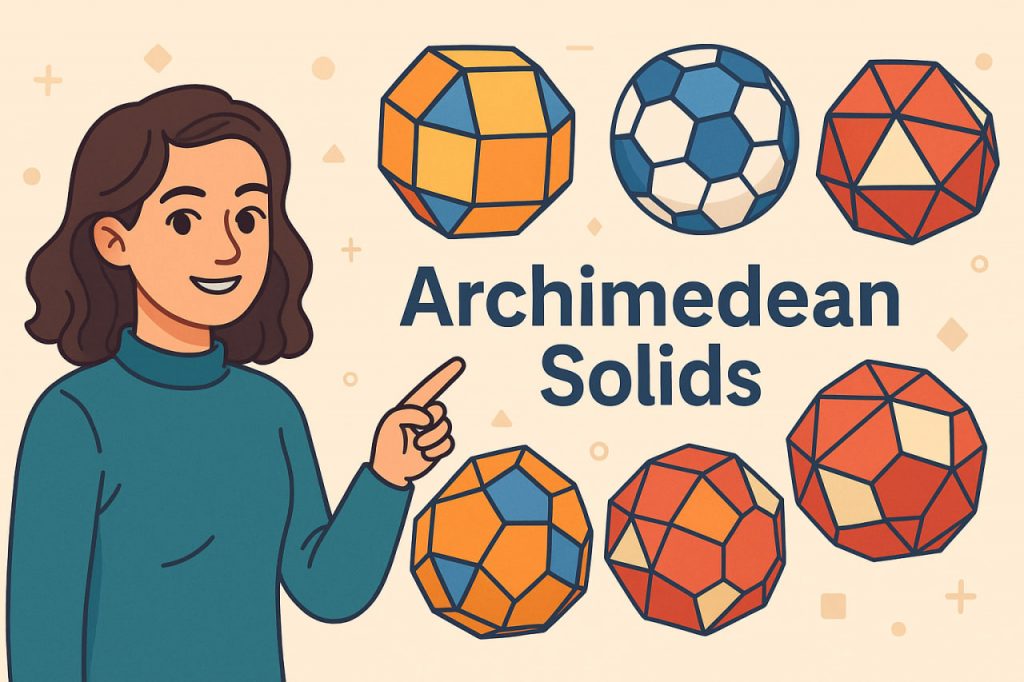
Archimedean solids are a unique family of polyhedra distinguished by their elegant balance of symmetry, uniformity, and combinatorial regularity. Unlike Platonic solids, which consist of identical faces and identical vertices, Archimedean solids feature two or more types of regular polygons arranged in repeating vertex patterns. This combination of order and variation creates shapes that are both mathematically rich and visually fascinating. These solids have inspired centuries of study in geometry, architecture, crystallography, and art, serving as examples of how mathematical principles manifest in natural and human-made structures. Researchers continue to explore how their symmetries relate to group theory, spatial tiling, and even molecular formation. Studying Archimedean solids reveals the depth and beauty of geometric structures that arise from simple rules yet produce intricate and diverse forms.
What Defines an Archimedean Solid?
Archimedean solids are defined by two key characteristics: their faces are regular polygons, and their vertices are identical in arrangement. There are exactly thirteen such solids, each combining polygons such as triangles, squares, pentagons, and hexagons in specific configurations. Although attributed to Archimedes, the original Greek manuscripts describing these solids have been lost; they were rediscovered and formalized during the Renaissance by mathematicians such as Johannes Kepler. According to geometrician Dr. Lily Hammond, the uniformity of vertices ensures that each solid maintains a high degree of symmetry, even when composed of multiple polygon types. She emphasizes that this vertex uniformity makes Archimedean solids valuable in mathematical modeling. Their structure illustrates how symmetry principles extend beyond perfect uniformity to more complex but still ordered forms.
Types and Properties of Archimedean Solids
The thirteen Archimedean solids include well-known shapes such as the truncated cube, the truncated icosahedron (famously recognized as the shape of soccer balls), the cuboctahedron, and the truncated dodecahedron. Each of these shapes demonstrates unique geometric relationships that connect polygon angles, edge lengths, and vertex arrangements. Some solids, such as the snub cube and snub dodecahedron, also exhibit chiral forms that exist in left-handed and right-handed variations. Mathematician Dr. Robert Kline highlights that several of these solids serve as transitional forms between Platonic and Catalan solids, illustrating deeper structural relationships within polyhedral families. He adds that studying these solids helps mathematicians develop intuition about symmetry groups and spatial transformations. Their consistent geometric patterns make them essential objects in higher-level geometry.
Applications in Science, Engineering, and Nature
Archimedean solids appear in a wide range of scientific and engineering applications due to their stability, symmetry, and efficiency of surface distribution. Chemists observe structures resembling Archimedean solids in molecular cages and virus capsids, where repeating geometric patterns support biological function. Engineers use these solids to design strong yet lightweight frameworks for architecture, aerospace components, and geodesic structures. In crystallography, Archimedean forms help describe atomic arrangements in certain quasicrystals and alloys. Computer scientists also use their geometry in mesh generation, 3D modeling, and spherical point distribution algorithms. The widespread relevance of Archimedean solids demonstrates how classical geometry continues to influence modern scientific innovation.
Interesting Facts
Some Archimedean solids can tessellate spherical surfaces, making them ideal for designing efficient geodesic domes.
The truncated icosahedron inspired the structure of the carbon molecule C₆₀, known as the buckyball.
Many natural structures, including radiolarian skeletons, exhibit polyhedral symmetries similar to Archimedean forms.
Only thirteen Archimedean solids exist, a number proven mathematically by symmetry classification.
Glossary
- Vertex Transitivity — a property where all vertices of a shape are identical in arrangement.
- Regular Polygon — a polygon with equal sides and angles.
- Chirality — the property of an object existing in two mirror-image forms.
- Polyhedron — a three-dimensional shape composed of flat polygonal faces.