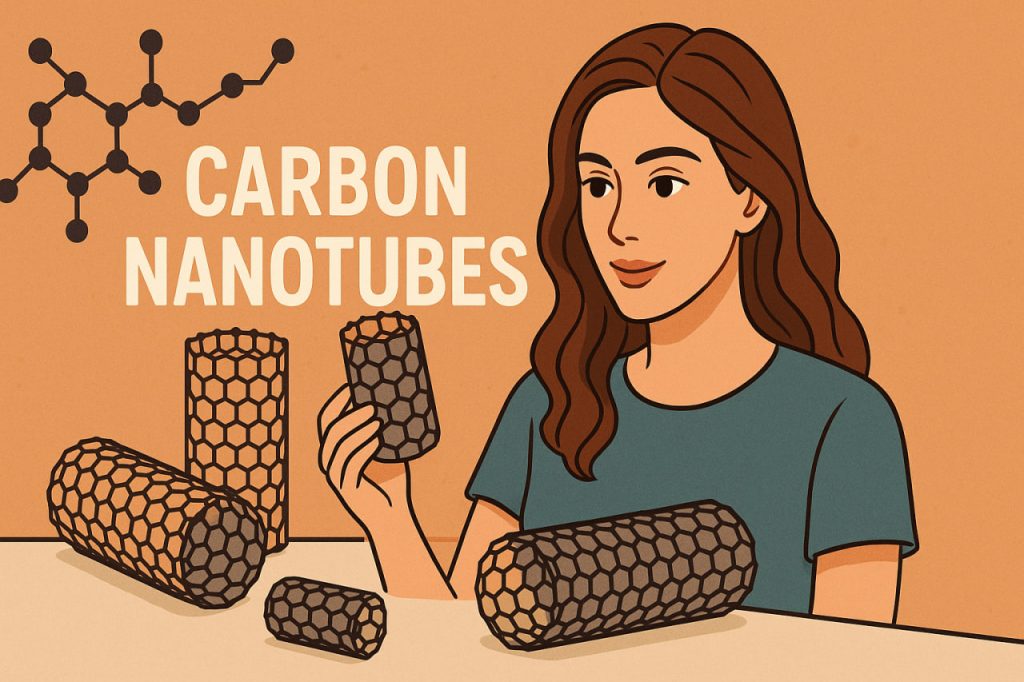
Carbon nanotubes (CNTs) are cylindrical nanostructures composed entirely of carbon atoms arranged in a hexagonal lattice, forming tubes with extraordinary mechanical, electrical, and thermal properties. Discovered in the early 1990s, they quickly became one of the most studied materials in nanotechnology due to their remarkable strength, low weight, and unique conductivity. CNTs can be single-walled or multi-walled, with each type offering different characteristics suitable for specialized applications. Scientists consider carbon nanotubes a major breakthrough because their properties exceed those of many conventional materials used in engineering and electronics. Research continues to uncover new uses for CNTs in fields such as energy storage, medicine, aerospace, and advanced manufacturing. Understanding their structure and behavior helps researchers design cutting-edge technologies that push the boundaries of modern science.
Structure and Fundamental Properties of Carbon Nanotubes
The structure of carbon nanotubes is based on rolled sheets of graphene, forming tubes only a few nanometers in diameter but potentially millimeters in length. This unique form gives CNTs exceptional tensile strength, estimated to be more than 100 times stronger than steel at a fraction of the weight. Their electrical properties vary depending on how the graphene sheet is rolled, allowing CNTs to behave as metals or semiconductors. According to materials scientist Dr. Kevin Marshall, the combination of strength, flexibility, and conductivity makes CNTs one of the most versatile nanomaterials ever discovered. Thermal properties are equally impressive, with CNTs capable of conducting heat more efficiently than copper. These capabilities arise from the strong carbon–carbon bonds and the quantum behavior of electrons inside the nanotube structure.
Modern Applications Across Science and Industry
Carbon nanotubes are used in a growing number of technological fields, each taking advantage of their unique properties. In electronics, CNTs serve as conductive films, transistors, and components of next-generation flexible circuits. Aerospace engineers use CNT-reinforced composites to create lightweight materials with high resilience and reduced fuel consumption. In energy technology, CNTs appear in advanced batteries, supercapacitors, and hydrogen storage systems, improving performance and efficiency. Biomedical researchers explore CNTs for targeted drug delivery, biosensors, and imaging systems due to their ability to interact with specific cells at molecular scales. Nanotechnology expert Dr. Elena Matsuda highlights that CNT applications are expanding rapidly as manufacturing techniques become more precise, allowing industries to integrate nanotubes into commercial products.
Challenges, Safety Considerations, and Future Prospects
Despite their enormous potential, carbon nanotubes present challenges related to large-scale production, uniformity, and safety. Manufacturing CNTs with consistent length, purity, and chirality remains difficult, limiting certain high-precision electronics applications. Environmental and health concerns also require careful research, as some types of CNTs may behave similarly to asbestos fibers when inhaled. Scientists emphasize the need for strict handling guidelines and long-term safety studies to ensure responsible development. Nevertheless, future prospects for CNTs are promising, with ongoing breakthroughs in synthesis methods, purification technologies, and hybrid material design. Many researchers believe carbon nanotubes will play a central role in next-generation materials science, enabling innovations that are currently impossible with traditional materials.
Interesting Facts
Some carbon nanotubes have the highest tensile strength ever recorded for any known material.
CNTs can conduct electricity better than copper while being far lighter and more flexible.
Single-walled nanotubes can exhibit metallic or semiconducting behavior depending on their atomic structure.
NASA has studied CNT composites for use in ultra-strong space elevator concepts.
Glossary
- Graphene — a single layer of carbon atoms arranged in a hexagonal pattern, forming the basis of CNTs.
- Chirality — the geometric orientation of the carbon lattice that determines whether a nanotube is metallic or semiconducting.
- Composites — materials made by combining different components to enhance strength or performance.
- Supercapacitor — an energy storage device that charges and discharges much faster than traditional batteries.