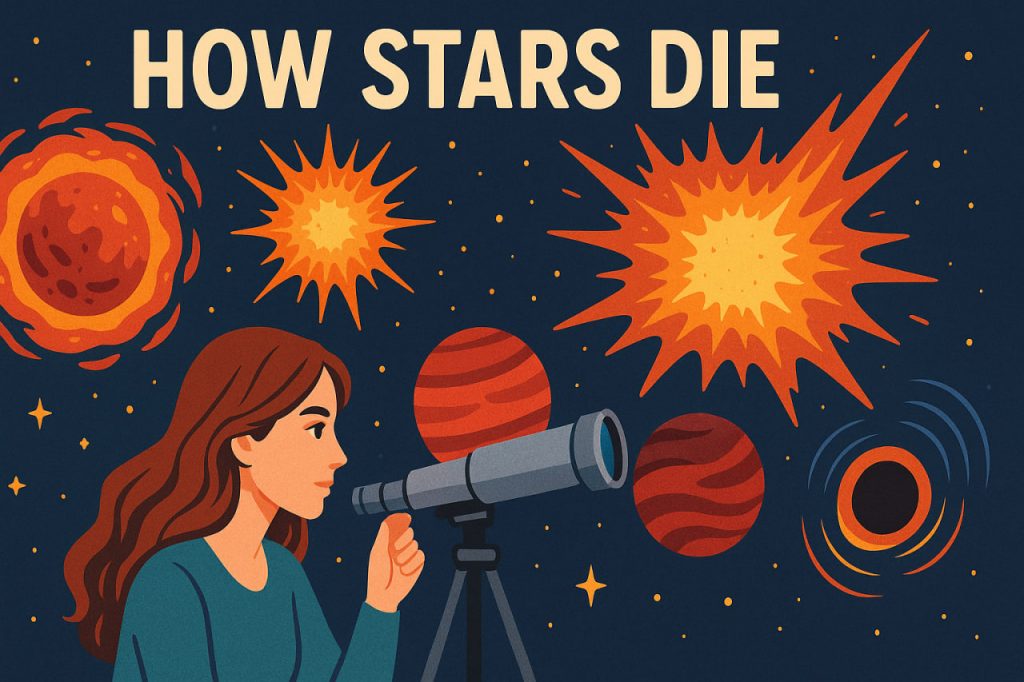
The death of a star is one of the most dramatic and influential processes in the universe, shaping galaxies and creating many of the elements essential for life. Every star, regardless of its size, eventually exhausts the nuclear fuel that keeps it shining, causing fundamental changes that lead to its collapse, explosion, or gradual fading. The fate of a star depends largely on its mass, with small, medium, and massive stars following very different evolutionary endings. Scientists study stellar death to understand how heavy elements form, how supernovae enrich the cosmos, and how compact objects such as white dwarfs, neutron stars, and black holes originate. Observations of dying stars also reveal how galaxies evolve over billions of years, offering insights into cosmic cycles of birth, destruction, and renewal. This knowledge helps astronomers trace the universe’s history and predict its long-term future.
How Sun-Like Stars Reach Their End
Stars similar in size to our Sun end their lives in a relatively gentle but transformative process. After billions of years of burning hydrogen in their cores, they eventually run out of fuel and begin fusing helium, causing them to swell into red giants. During this stage, they lose outer layers in expanding shells of gas, forming colorful planetary nebulae that drift into space. Once the outer layers dissipate, the remaining core becomes a white dwarf—an extremely dense, Earth-sized object that slowly cools over billions of years. Astrophysicist Dr. Marissa Nolan notes that white dwarfs represent the final stage for most stars in the universe, acting as long-lasting cosmic embers. Her colleague, stellar evolution researcher Dr. Ethan Clarke, emphasizes that these stars enrich interstellar space with heavy elements that later form new stars and planets.
How Massive Stars Die in Explosive Supernovae
Massive stars live fast and die violently due to their high rate of fuel consumption. When such a star exhausts the elements it can fuse, its core collapses under immense gravity in a fraction of a second. This rapid collapse triggers a powerful shockwave that blasts the outer layers into space, creating a supernova—one of the brightest events in the universe. The remaining core may transform into a neutron star, an ultra-dense object composed almost entirely of neutrons, or if the original star was massive enough, it may collapse further into a black hole. Supernovae are crucial for dispersing heavy elements like iron, gold, and uranium into space, making them essential for planetary formation and life. Modern telescopes allow scientists to observe supernovae in distant galaxies, providing real-time data on stellar death.
Exotic Endings: Neutron Stars and Black Holes
Neutron stars and black holes represent some of the most extreme states of matter known to science. Neutron stars pack more mass than the Sun into a sphere only about 20 kilometers wide, creating gravity so strong light can curve around them. Some neutron stars spin rapidly and emit beams of radiation, becoming pulsars that astronomers detect as rhythmic radio signals. Black holes form when gravitational collapse becomes so strong that nothing—not even light—can escape their pull. These objects influence their surroundings by warping spacetime, consuming gas and dust, and merging with other black holes in events detectable through gravitational waves. Studying these exotic remnants helps scientists understand the limits of physics under extreme conditions, offering clues about the nature of matter, energy, and spacetime.
Interesting Facts
Some supernovae briefly outshine entire galaxies, emitting more light in a few weeks than the Sun will emit in its entire lifetime.
The atoms in your body—including carbon, oxygen, and calcium—were created inside stars that died long before the solar system formed.
White dwarfs are so dense that a teaspoon of their material would weigh several tons on Earth.
Black holes can merge and release energy detectable as ripples in spacetime called gravitational waves.
Glossary
- Planetary Nebula — an expanding shell of ionized gas ejected by a dying Sun-like star.
- Supernova — a powerful explosion marking the death of a massive star.
- Neutron Star — a compact stellar remnant composed almost entirely of neutrons.
- Gravitational Waves — ripples in spacetime caused by massive accelerating objects such as merging black holes.