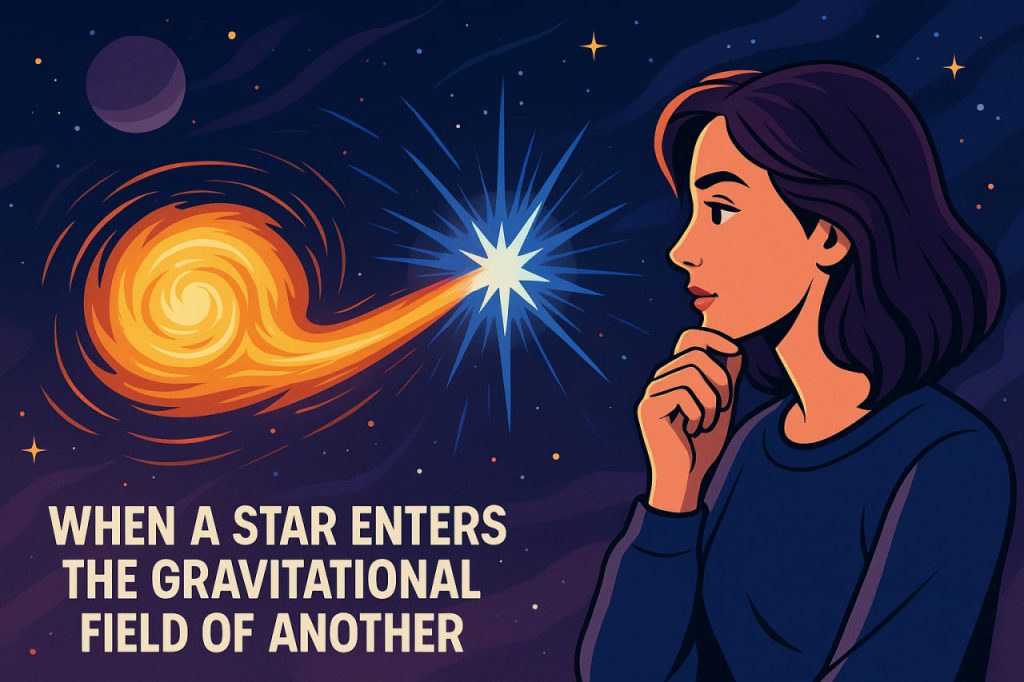
When a star enters the gravitational field of another, a dramatic astrophysical interaction begins that can reshape both stellar systems. Gravity becomes the dominant force, pulling the stars into complex orbital patterns or violent exchanges of energy and matter. These encounters occur across the universe, particularly in densely packed regions such as star clusters and galactic centers. Depending on the mass, distance, and velocity of the stars, the outcome may range from gentle orbital capture to complete tidal destruction. Scientists study these interactions to better understand stellar evolution, black hole formation, and the dynamic behavior of galaxies. Stellar encounters reveal how unstable and unpredictable the universe can be when massive bodies influence one another.
Gravitational Capture and Orbital Interaction
One of the most common outcomes of a stellar encounter is gravitational capture, where one star becomes bound to another through mutual gravitational attraction. If the relative speed between them is low enough, the stars can form a binary or multi-star system. Astrophysicist Dr. Elena Hargreaves explains that these captures often occur in star clusters where stellar density is high, increasing the likelihood of encounters. She notes that the captured star may enter an elongated orbit, gradually stabilizing over time as energy is exchanged within the system. In some cases, gravitational perturbations from nearby stars can cause the pair to spiral closer or eject one star entirely. These interactions help astronomers understand how complex multi-star systems form and evolve.
Tidal Forces and Stellar Deformation
When two stars pass extremely close to each other, powerful tidal forces begin to stretch and distort their outer layers. This deformation occurs because gravity on the near side of the star is stronger than on the far side, creating tidal bulges similar to those seen on Earth but vastly more intense. If the stars come too close, tidal stripping can occur, pulling gas away from their surfaces and forming streams of stellar material. Astrophysical researcher Dr. Noah Sandoval emphasizes that tidal interactions can alter a star’s rotation, magnetic field, and even internal structure. Over long timescales, repeated tidal stresses may cause stars to exchange mass or disrupt any surrounding planetary systems. These tidal effects reveal the hidden complexity of gravitational encounters.
Mass Transfer and Stellar Cannibalism
In binary systems formed through gravitational encounters, mass transfer can occur when one star expands or approaches its partner. If one star becomes a red giant or has a weaker gravitational hold, its outer layers can be pulled toward the companion star. This process is often referred to as stellar cannibalism. The receiving star may grow more massive, brighter, and hotter, while the donor star becomes stripped and unstable. Mass transfer episodes can create cataclysmic variables, novae, or even trigger supernova explosions under the right conditions. These events release tremendous energy and enrich the surrounding space with heavy elements. Such interactions demonstrate how stellar encounters shape the chemical evolution of galaxies.
Extreme Encounters and Stellar Destruction
The most dramatic outcomes occur when a star enters the gravitational field of a compact object such as a neutron star or black hole. In these scenarios, tidal forces can rip the star apart in a phenomenon known as a tidal disruption event (TDE). The shredded material forms an accretion disk around the compact object, generating intense radiation and sometimes relativistic jets. Even interactions between two massive stars can lead to collisions, merging them into a single, larger star or triggering powerful explosions. These extreme encounters are rare on human timescales but play a significant role in astrophysical evolution. They also provide scientists with valuable data on gravity, energy transfer, and the behavior of matter under extreme conditions.
Interesting Facts
Some stars in the Milky Way are “runaways” that were ejected at high speed after a violent stellar encounter.
Tidal disruption events can outshine entire galaxies for short periods.
Binary stars formed through gravitational capture may later merge, creating gravitational waves detectable from Earth.
Stellar collisions are more common in dense globular clusters than in typical regions of the galaxy.
Glossary
- Tidal Disruption Event — the destruction of a star caused by the extreme gravity of a massive object such as a black hole.
- Mass Transfer — the process of material moving from one star to another in a binary system.
- Gravitational Capture — when two stars become bound due to mutual gravitational attraction.
- Accretion Disk — a rotating disk of gas formed around a massive object after material is pulled inward.