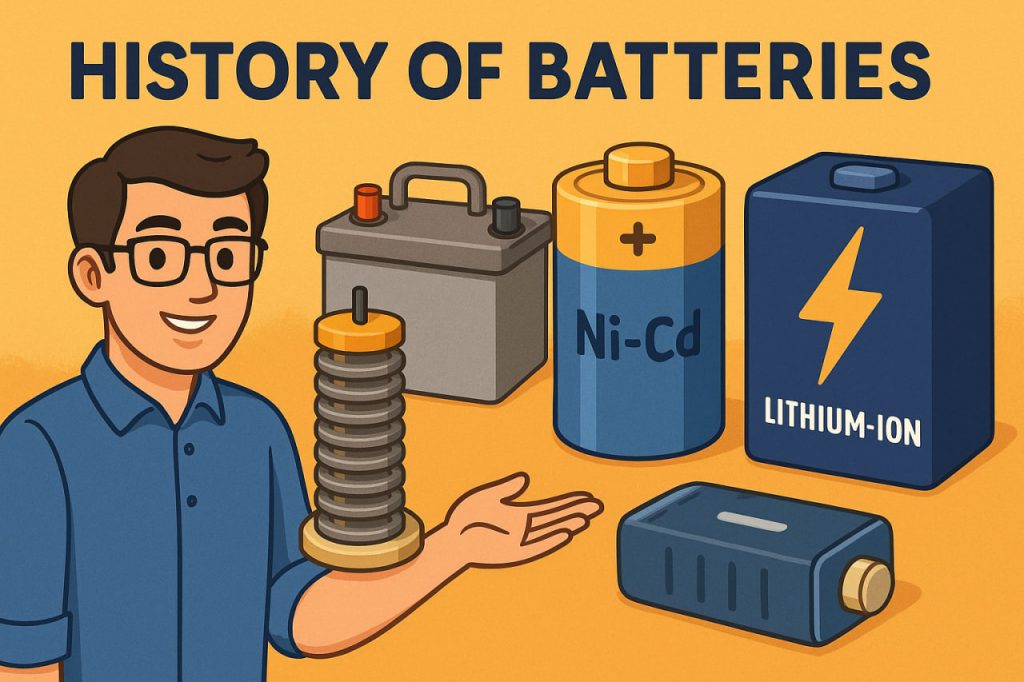
Batteries have transformed the world by providing portable, reliable electrical energy for everything from telecommunication devices to renewable power systems. The evolution of battery technology spans more than two centuries, beginning with simple chemical cells and expanding into sophisticated, high-density systems that power electric vehicles, satellites, and entire electrical grids. Understanding the history of batteries reveals how scientific discovery, industrial innovation, and global energy demands have shaped modern storage solutions. As the world transitions toward sustainable energy, cutting-edge battery technologies are becoming more important than ever, enabling cleaner transportation, stabilizing renewable electricity, and supporting the development of advanced electronics. The story of batteries is a story of continuous improvement — and it continues to accelerate.
Early Discoveries: From Volta’s Pile to Industrial Use
The history of batteries began in 1800 when Italian scientist Alessandro Volta created the Voltaic Pile, the world’s first true battery. His design used alternating layers of zinc, copper, and brine-soaked cloth to produce a steady electrical current. This simple structure inspired decades of experimentation, leading to the development of early wet-cell batteries and later lead–acid batteries, which were invented by Gaston Planté in 1859. Lead–acid batteries became the first rechargeable systems and are still used today in cars and backup power supplies. According to energy historian Dr. Mariah Collins:
“Volta’s invention did more than create electricity on demand —
it launched an entirely new era of scientific and technological progress.”
These early breakthroughs laid the foundation for portable electricity and modern battery science.
The Rise of Modern Consumer Batteries
The 20th century saw major advancements in battery technology as consumer electronics became more widespread. Nickel–cadmium (NiCd) batteries gained popularity due to their long life and rechargeability. Later, nickel–metal hydride (NiMH) batteries offered higher capacity with fewer environmental risks. The real revolution came in the 1990s with the introduction of lithium-ion batteries, which provided lightweight, high-energy storage well-suited for laptops, mobile phones, and eventually electric vehicles. Lithium-ion chemistry rapidly became the global standard due to its balance of performance, durability, and energy density.
Modern Innovations: Lithium-Ion and Beyond
Today, battery research is moving at an unprecedented pace. Lithium-ion technologies continue to improve with innovations such as solid electrolytes, silicon anodes, and high-voltage cathode materials. These improvements increase capacity, shorten charging times, and enhance safety. Newer systems like solid-state batteries promise even greater energy density and reduced fire risks by replacing liquid electrolytes with stable solid materials. Other next-generation technologies under development include:
- Sodium-ion batteries — lower cost and more abundant materials.
- Lithium–sulfur batteries — potentially five times higher energy density.
- Flow batteries — ideal for large-scale renewable energy storage.
- Graphene-enhanced batteries — improved conductivity and lifespan.
These emerging technologies aim to provide sustainable, scalable, and safer alternatives to current battery systems.
Batteries and Renewable Energy Integration
As the world increases its use of renewable energy sources such as solar and wind, the demand for advanced energy storage grows. Batteries help stabilize the grid, store excess energy during peak production, and ensure a reliable supply when sunlight or wind is insufficient. Grid-scale batteries, including giant lithium-ion farms and vanadium flow battery stations, are becoming essential components of clean energy infrastructure. These solutions enable countries to reduce emissions, minimize reliance on fossil fuels, and maintain stable electricity networks.
Sustainability Challenges and Recycling Efforts
Modern battery production relies on critical minerals such as lithium, cobalt, and nickel. Extracting these materials raises environmental and ethical concerns, prompting global efforts to improve mining practices, develop alternative chemistries, and expand recycling programs. Battery recycling technologies now recover valuable metals, reduce waste, and lower the ecological footprint of battery manufacturing. Researchers are also exploring biodegradable materials and closed-loop production cycles as part of a sustainable future for battery technology.
Interesting Facts
- The first true battery, the Voltaic Pile, was created more than 220 years ago.
- Lithium-ion batteries can store up to 150 Wh/kg, far more than earlier chemistries.
- Electric vehicle batteries can power homes during outages using bidirectional charging.
- Some next-generation batteries may last over 10,000 charge cycles.
- Sodium-ion batteries work even at low temperatures, making them ideal for cold climates.
Glossary
- Electrolyte — a substance that allows ions to move between battery electrodes.
- Energy Density — the amount of energy a battery can store relative to its weight.
- Solid-State Battery — a battery that uses solid materials instead of liquid electrolytes for improved safety.
- Flow Battery — a battery that stores energy in liquid tanks, ideal for large-scale storage.
- Anode — the negative electrode in a battery where oxidation occurs during discharge.